Tesla’s Driverless Gamble Pays Off: Robotaxi Fleet Blows Past 1 Million Unsupervised Miles
Tesla has officially shattered a major autonomy benchmark, confirming that its unsupervised Robotaxi fleet has surpassed 1 million fully autonomous mi...
Editorial Team
World Of EV
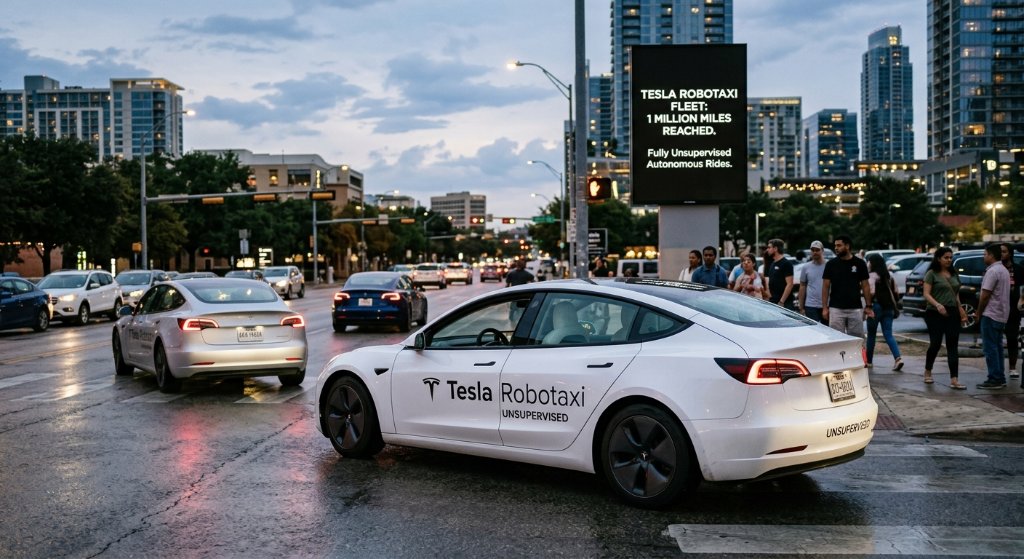
Tesla has officially shattered a major autonomy benchmark, confirming that its unsupervised Robotaxi fleet has surpassed 1 million fully autonomous miles. This milestone represents a seismic shift for the company, validating its long-debated camera-only Full Self-Driving (FSD) architecture after years of intense industry skepticism. For an audience accustomed to Elon Musk’s ambitious timelines—such as his famous 2019 claim that Tesla would have 1 million robotaxis on the road by 2020—the achievement serves as the first undeniable proof that Tesla’s driverless future is finally scaling.
While 1 million miles is a modest figure compared to industry pioneer Waymo’s estimated 200-million-mile driverless footprint, the sheer velocity of Tesla’s data accumulation signals that the gap is narrowing rapidly.
Unpacking the Six-Week Surge
The core of this achievement lies in how rapidly the fleet accumulated these miles. Between late July and early September, Tesla’s driverless vehicles logged an astonishing 620,000 miles—nearly tripling its previous cumulative total of 380,000 miles in just six weeks. This exponential growth curve was made possible by several strategic moves:
- Removal of Human Safety Monitors: Tesla eliminated in-vehicle safety drivers across its active test sites, transitioning the fleet to a genuinely "unsupervised" state.
- Geographic Expansion: The fleet now operates across six active cities spanning Texas and Florida, including high-density urban areas like Austin, Dallas, Houston, and Miami.
- A Dedicated Fleet: Over 200 driverless vehicles are currently in active service, recently joined by Tesla's newly debuted, purpose-built "Cybercab" which features no steering wheel or pedals.
This rapid scaling highlights the efficiency of Tesla’s rollout. By shifting safety monitors out of the driver's seat and utilizing a lean fleet of highly active cars, Tesla is optimizing its geographic footprint to maximize data collection where regulatory frameworks are most permissive.
Vision-Only AI vs. The Lidar Establishment
Tesla’s milestone is more than just a logistical win; it is a technical statement of intent. Unlike Waymo, which relies on a multi-thousand-dollar suite of Lidar, radar, and high-definition geofenced maps, Tesla uses an "end-to-end" neural network powered solely by cameras. Critics have long argued that a camera-only system lacks the redundancy required for true Level 4 autonomy.
However, the economics of Tesla’s vision-only system are unmatched. If Tesla can scale this software, its vehicle production costs will remain drastically lower than competitors. The newly launched Cybercab, built on a highly efficient 48-kWh battery and 4680 cell architecture, is targeted to cost between $20,000 and $30,000. For fleet operators, this represents a massive cost-per-mile advantage over traditional, sensor-heavy robotaxis that can cost upwards of $100,000 to build.
Yet, regulatory friction looms. The National Highway Traffic Safety Administration (NHTSA) recently opened an audit questioning the safety certification of the steering-wheel-free Cybercab. Tesla’s ability to turn this 1-million-mile proof of concept into a nationwide business relies entirely on its ability to pacify federal regulators.
Why This Matters:
- The Market Signal: By proving its vision-only system can safely rack up hundreds of thousands of unsupervised miles weekly, Tesla has silenced the loudest critics of its camera-only approach. It signals to the automotive market that expensive Lidar suites may not be the entry requirement for the autonomous age.
- Who Wins: Tesla’s bottom line and prospective fleet partners. By scaling unsupervised miles, Tesla shifts closer to a high-margin SaaS (Software-as-a-Service) business model, licensing its FSD stack to third-party operators. If the targeted $0.20 to $0.40 per-mile cost of Cybercab holds true, Tesla will democratize ride-hailing, undercutting traditional networks.
- Who Loses: Ride-hailing incumbents like Uber and Lyft, alongside legacy OEMs who have deferred their Level 4 autonomous programs. If Tesla achieves regulatory clearance at scale, competitors relying on human drivers or expensive geofenced hardware will face an existential pricing crisis.
- The Road Ahead: The real battle is scaling. Waymo remains the dominant heavyweight with a footprint of over 4,000 vehicles across 14 cities. For Tesla to truly dominate, it must transition its 200-vehicle pilot program into a nationwide fleet of tens of thousands, while navigating the regulatory minefield of a steering-wheel-free future.
Ultimately, Tesla’s 1-million-mile milestone is the turning point where its autonomous ambitions transitioned from speculative marketing to commercial reality. If the exponential growth of the last six weeks is a preview of what is to come, the race for autonomous dominance has just entered its most aggressive phase.