Tesla’s European Autonomous Dreams Delayed as EU Regulators Postpone Crucial FSD Vote
Tesla’s aggressive push to blanket European roads with its Full Self-Driving (Supervised) system has hit a massive bureaucratic wall. The European Uni...
Editorial Team
World Of EV
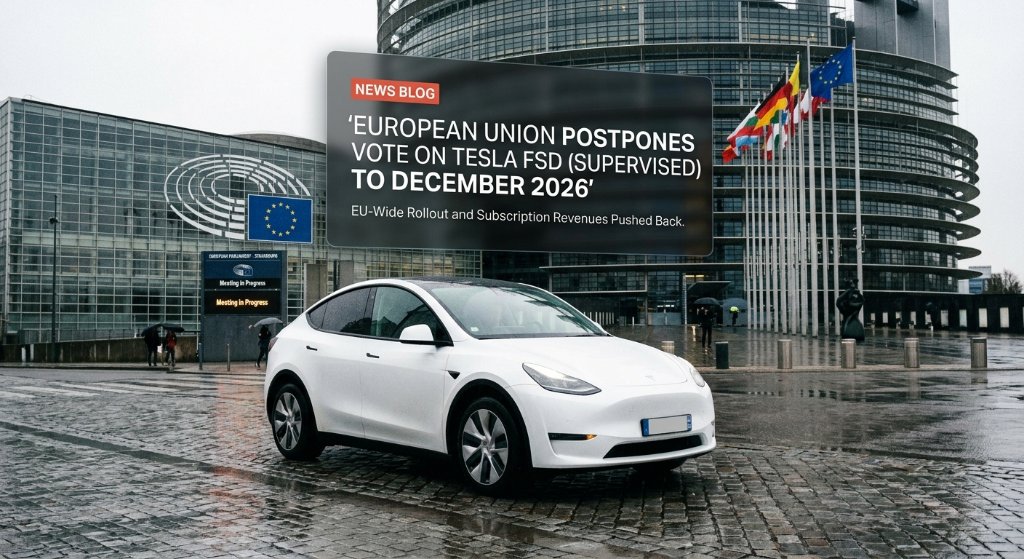
Tesla’s aggressive push to blanket European roads with its Full Self-Driving (Supervised) system has hit a massive bureaucratic wall. The European Union's Technical Committee on Motor Vehicles (TCMV) has officially postponed its highly anticipated vote on extending the Dutch-granted FSD approval across all 27 member states. Originally slated for October 6, 2026, the updated meeting agenda has neutered the session, reducing it to a mere 25-minute "continuation of discussions".
This setback is a harsh reminder of Tesla's long-standing regulatory struggles on the Continent. For years, European Tesla owners have lamented a severely restricted version of basic Autopilot, crippled by strict UNECE regulations. While the Dutch vehicle authority (RDW) offered a glimmer of hope in April 2026 by granting a provisional "Article 39" exemption, translating that national win into a sweeping, bloc-wide rollout has proved to be a far more complex political chess match than Tesla anticipated.
The 25-Minute Roadblock in Brussels
The draft agenda published by the European Commission’s DG GROW reveals that the 119th TCMV meeting in Brussels will bypass any decisive action on Tesla's software. Instead of a historic vote, item three on the docket allocates a tiny window right before lunch for continued talks. With the committee scheduled to convene next in December 2026, this regulatory roadblock effectively pushes the earliest possible EU-wide FSD rollout—and its highly anticipated subscription revenues—deep into late 2026 or 2027.
While Tesla continues to pitch its safety data—claiming FSD (Supervised) is over four times safer than manual driving on EU roads—the European regulatory machine demands absolute alignment before handing over the keys.
The Math Behind the Postponement
To secure an EU-wide green light, Tesla cannot simply rely on piecemeal victories. While the company has successfully activated FSD (Supervised) in seven countries, securing a unified market requires clearing a massive democratic hurdle.
- The Seven Pioneers: The Netherlands, Lithuania, Estonia, Denmark, Belgium, Slovenia, and Czechia have all individually recognized the provisional approval.
- The Population Problem: Despite representing seven sovereign states, these markets encompass only 53 million people—roughly 12% of the total EU population.
- The Qualified Majority Hurdle: To unlock the entire bloc, Tesla needs approval from at least 15 of the 27 member states, representing a minimum of 65% of the EU population (approximately 292 million people).
- The Heavyweight Holdouts: Crucial powerhouse markets like Germany, France, Italy, and Spain remain in the review phase. France, in particular, has expressed strong skepticism, and several nations have raised concerns regarding speed-limit compliance and winter weather performance.
This high-stakes review stands in stark contrast to Ford's successful integration of its BlueCruise hands-free system, which received a green light from the TCMV in early 2024 under German sponsorship. Ford's systematic, regulator-first approach highlights the exact friction Tesla is currently experiencing with its rapid-deployment philosophy.
Why This Matters:
This delay is a significant blow to Tesla’s near-term growth narrative and a major strategic win for its competitors.
- Financial Drag: The postponement stalls a massive, high-margin revenue stream. Wall Street was counting on European FSD subscriptions to bolster Tesla's software-driven bottom line by late 2026. This recurring revenue is now frozen for at least another two quarters.
- Legacy Automakers Gain Ground: European heavyweights like Mercedes-Benz, BMW, and the Volkswagen Group win crucial breathing room. Mercedes-Benz, which has already deployed its Level 3 Drive Pilot system in limited European markets, can use this window to scale its technology and solidify its reputation as the continent’s safety-first autonomy leader.
- A Clash of Philosophies: This is a classic "do-or-die" moment for Tesla's European expansion. The delay underscores a fundamental clash of cultures. Tesla's "move fast, iterate in public" ethos is directly colliding with Europe's rigid, precautionary regulatory framework. Elon Musk's single-word reaction on social media—"sigh"—perfectly captures the company's frustration with a system that refuses to prioritize tech disruptions over bureaucratically verified safety.
Conclusion
While Tesla’s FSD (Supervised) remains a technical marvel reshaping the North American driving landscape, Europe continues to prove that code is only as powerful as the paper it is signed on. The road to European autonomy is paved with heavy bureaucracy, and Tesla's drivers—and shareholders—will have to wait until late 2026 or 2027 to see if the continent is finally ready to let go of the wheel.