Tesla's FSD Autonomy Claims Under Fire: Chinese Consumers Seek $583,000 in Class-Action Lawsuit
Tesla, Inc. faces a significant legal challenge in its crucial Chinese market, as a class-action lawsuit filed by ten consumers demands over 3.95 mill...
Editorial Team
World Of EV
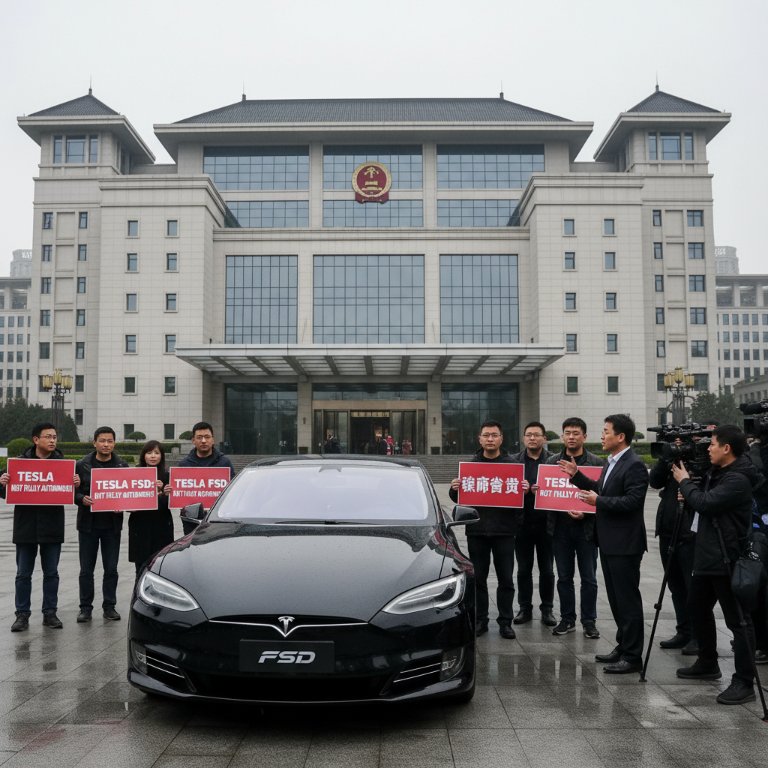
Tesla, Inc. faces a significant legal challenge in its crucial Chinese market, as a class-action lawsuit filed by ten consumers demands over 3.95 million yuan ($583,000) in damages. The plaintiffs allege that Tesla aggressively misrepresented its Full Self-Driving (FSD) feature, marketing it as capable of fully autonomous driving despite a clear lack of regulatory approval in China. This litigation places a magnifying glass on the often-ambiguous claims surrounding advanced driver-assistance systems and their real-world capabilities, especially within a highly scrutinized market like China.
The Core of the Accusation: Unfulfilled Autonomy and Concealed Limitations
The heart of the lawsuit revolves around two critical assertions. Firstly, the consumers contend that Tesla's FSD function did not deliver the 'fully autonomous driving capability' it advertised. This claim touches upon a sensitive nerve in the automotive industry, where the term 'self-driving' often creates a perception of Level 5 autonomy—a state where the vehicle handles all driving tasks under all conditions, without human intervention—a capability not yet achieved by any commercial passenger vehicle. Secondly, the plaintiffs allege that Tesla might have concealed hardware limitations that prevent FSD from truly achieving full autonomy. This accusation could refer to the iterative nature of Tesla's hardware (from HW2.5 to HW3.0 and now HW4.0), and whether earlier versions can genuinely support future 'full self-driving' features as promised.
Tesla, for its part, has acknowledged that while the FSD feature is operational, additional functions are still under development. This defense aligns with the company's long-standing strategy of continually pushing over-the-air (OTA) updates to enhance its software, but it also highlights the disconnect between marketing language and current regulatory and technological realities.
Why This Matters: A Crucible Moment for Tesla's Global FSD Ambitions
This lawsuit is far more than a simple financial dispute for Tesla; it represents a critical juncture for its Full Self-Driving ambitions, particularly in the strategically vital Chinese market. China is not only the world's largest automotive market but also a hotbed for EV innovation, with formidable local competitors like BYD, Nio, Xpeng, and Li Auto, all pushing their own advanced driver-assistance systems. Any perceived misstep by Tesla regarding FSD's capabilities could severely impact its brand trust and market share in this competitive landscape.
-
Credibility Under Scrutiny: The core allegation of misrepresentation directly challenges the credibility of Tesla's marketing around its most advanced and often most expensive software offering. A ruling against Tesla could force a significant re-evaluation of its FSD branding and communication strategy globally, not just in China.
-
Regulatory Ripple Effect: This legal action could spur greater regulatory scrutiny on autonomous driving claims across the entire industry in China and potentially influence other markets. Regulators worldwide are grappling with how to classify and approve systems like FSD, and a high-profile case like this could accelerate the demand for clearer guidelines and stricter enforcement.
-
Competitive Disadvantage: If Tesla is forced to dial back its FSD claims or faces significant penalties, it could inadvertently benefit local Chinese EV manufacturers who might adopt a more cautious and transparent approach to their ADAS offerings, potentially eroding Tesla's 'innovation leader' perception in this crucial tech segment.
-
Consumer Confidence: At its heart, this lawsuit addresses consumer confidence. Prospective buyers investing in FSD, often a premium add-on, expect specific capabilities. If the court finds in favor of the consumers, it sends a strong message that marketing promises must align precisely with delivered features and regulatory realities, forcing all automakers to be more circumspect.
This class-action lawsuit serves as a potent reminder that the road to truly autonomous vehicles is paved not only with technological innovation but also with regulatory compliance and transparent consumer communication. Tesla's navigation of this legal challenge in China will undoubtedly set precedents and influence the future trajectory of autonomous driving development and marketing across the globe.