Tesla's FSD Claims Spark Fierce Debate: Musk Asserts "Lives Saved" Amidst Regulatory Scrutiny
Tesla CEO Elon Musk has reignited the contentious debate surrounding the safety of the company's Full Self-Driving (FSD) software, asserting on social...
Editorial Team
World Of EV
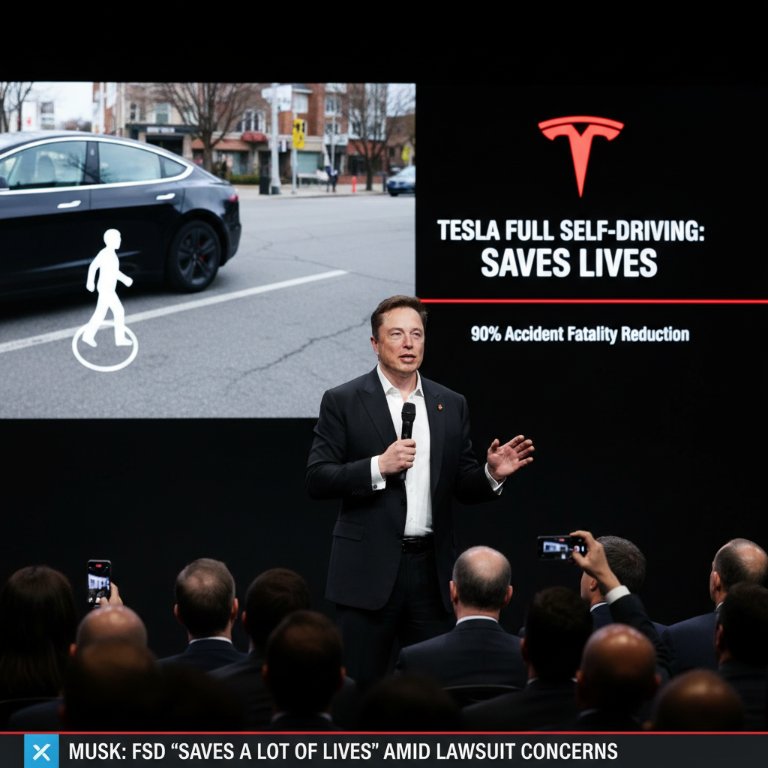
Tesla CEO Elon Musk has reignited the contentious debate surrounding the safety of the company's Full Self-Driving (FSD) software, asserting on social media platform X that 'Tesla self-driving saves a lot of lives – the statistics are unequivocal.' This bold claim, backed by a video purportedly showcasing an FSD-equipped Tesla skillfully avoiding a pedestrian collision, comes amidst ongoing regulatory investigations and persistent questions about the system's true capabilities and nomenclature.
Musk's statement further suggested that FSD prevents a staggering 90% of auto accident fatalities, though he acknowledged that Tesla would still face legal challenges for the remaining 10% of incidents. This assertion is not new territory for the outspoken CEO, who has long championed Tesla's advanced driver-assistance systems (ADAS) as a significant safety improvement.
Musk Touts FSD's Life-Saving Prowess
Musk's recent declaration highlights a central tenet of Tesla's argument for FSD: its potential to drastically reduce human error, which is a leading cause of traffic accidents. The video evidence presented, while compelling, represents a single instance and inevitably faces scrutiny given the complexity and variability of real-world driving.
Key aspects of Musk's claim include:
- Unequivocal Statistics: The assertion that FSD's life-saving impact is statistically undeniable. Tesla's own data claims FSD (Supervised) vehicles experience significantly fewer collisions than those driven manually, citing a 7x reduction in major and minor collisions, and 5x fewer off-highway collisions.
- 90% Fatality Prevention: A substantial claim that FSD actively prevents the vast majority of fatal accidents, implying a significant leap in automotive safety.
- Acknowledgment of Remaining Risk: Despite the high prevention rate, Musk concedes that Tesla would still be liable for a minority (10% of incidents), underscoring the legal and ethical tightrope walked by autonomous vehicle developers.
A History of Unfulfilled Promises and Regulatory Scrutiny
To understand the gravity of Musk's statements, it's crucial to provide context. Tesla's Full Self-Driving system, despite its name, remains a Level 2 advanced driver-assistance system (ADAS) according to the Society of Automotive Engineers (SAE) classification. This means it requires continuous, active human supervision, with the driver always ready to take control. For years, Tesla marketed the technology as 'Full Self-Driving Beta,' a label that allowed for frequent updates while arguably deflecting accountability for flaws. In late 2024, Tesla rebranded it to 'Full Self-Driving (Supervised),' a change that came alongside performance improvements via an over-the-air software update.
Regulatory bodies, particularly the National Highway Traffic Safety Administration (NHTSA) in the U.S., have been actively investigating Tesla's FSD system. The NHTSA escalated its probe into Tesla's FSD (Supervised) to an "engineering analysis" in March 2026, covering approximately 3.2 million Tesla vehicles. This escalation, a formal step that can precede a mandated recall, focuses on concerns that the system may fail to detect and alert drivers adequately when cameras are impaired, such as by sun glare, fog, or debris. These investigations follow previous preliminary evaluations and separate inquiries into FSD traffic violations, highlighting persistent concerns about the system's performance and safety.
While Tesla's internal data consistently reports a much lower crash rate for FSD-engaged vehicles compared to manual driving, these figures are often met with skepticism by independent analysts. Critics argue that Tesla's methodology for comparing crash rates has been historically misleading, for example, by comparing freeway-dominant Autopilot data to general police-reported crashes across all road types. While Tesla has made improvements in its data presentation, the inherent bias of self-reported data and the conditions under which FSD is typically engaged (often when drivers feel safer) continue to be points of contention.
Why This Matters:
Musk's latest assertions about FSD's life-saving capabilities carry significant weight for several stakeholders:
- For Prospective Buyers and Enthusiasts: These claims can instill a sense of confidence, suggesting FSD is a highly advanced and inherently safer option. However, it's crucial for buyers to remember that FSD is still a Level 2 system requiring constant driver attention and that regulatory scrutiny is ongoing. The ongoing cost of FSD, whether through a one-time purchase or a monthly subscription, remains a significant investment that requires careful consideration of its actual capabilities versus marketing claims.
- For Tesla: The renewed emphasis on FSD's safety benefits could be a strategic move to boost consumer confidence, drive adoption, and potentially pre-empt more stringent regulatory actions. By framing FSD as a life-saving technology, Tesla positions itself as a leader in automotive safety, despite the challenges. The acknowledgment of liability for 10% of incidents, however, signals Tesla's awareness of the legal risks associated with deploying such advanced technology, which could influence future legal battles.
- For the Autonomous Vehicle Industry: Tesla's aggressive approach to FSD deployment and its public claims continue to set a high, and often controversial, benchmark. This pushes other manufacturers to innovate but also highlights the broader industry's challenges in balancing rapid technological advancement with rigorous safety validation and transparent communication. The ongoing regulatory investigations into FSD also serve as a reminder to the entire industry about the importance of robust safety protocols and clear explanations of system limitations.
The Road Ahead: Navigating Autonomy's Ethical and Regulatory Crossroads
Elon Musk's unwavering belief in Tesla's Full Self-Driving as a life-saving technology remains a powerful narrative. However, the journey to truly autonomous and universally accepted self-driving cars is fraught with technical complexities, ethical dilemmas, and a challenging regulatory landscape. While the promise of vastly safer roads through advanced AI is compelling, the industry, regulators, and consumers must continue to demand independent verification, transparent data, and a cautious approach to deploying systems that, despite their impressive capabilities, still require human supervision. The debate over FSD's actual safety and its role in preventing — or contributing to — accidents is far from over, and its resolution will profoundly shape the future of transportation.