Tesla's FSD Divide: Millions of Older EVs Need Hardware 4 for True Autonomy
The dream of fully autonomous driving in a Tesla has long been a powerful draw, but for millions of early adopters, that dream now comes with a mandat...
Editorial Team
World Of EV
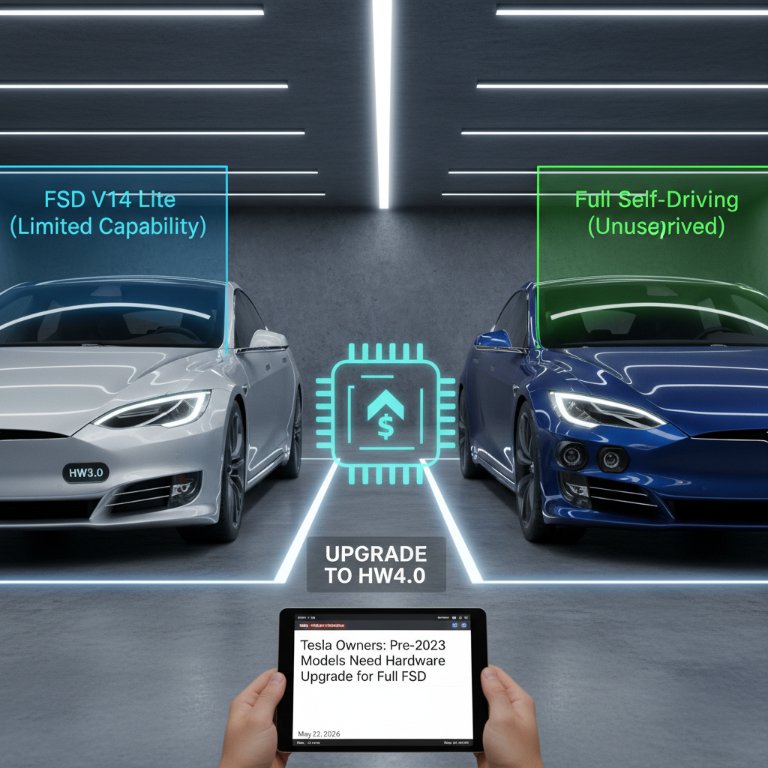
The dream of fully autonomous driving in a Tesla has long been a powerful draw, but for millions of early adopters, that dream now comes with a mandatory hardware upgrade. News released on May 22, 2026, confirms a significant bifurcation in Tesla's Full Self-Driving (FSD) roadmap: vehicles manufactured before 2023, largely equipped with the company's Hardware 3 (HW3.0) computer, will require an upgrade to the more advanced Hardware 4 (HW4.0) system to unlock what Tesla terms 'full driverless capabilities.' This announcement marks a critical juncture, highlighting the immense computational demands of true autonomy and placing a fresh burden on existing FSD customers.
Since the inception of its Autopilot and FSD programs, Tesla has consistently iterated on its underlying hardware, moving from earlier Nvidia-based systems to its custom-designed HW2.5 and then the much-lauded HW3.0 'Full Self-Driving Computer' in 2019. Each upgrade promised to be the key to the autonomous future, often marketed as future-proof. However, it’s now unequivocally clear that the computational prowess of HW3.0, once deemed sufficient, simply cannot fully support unsupervised FSD – the holy grail of autonomous driving where human intervention is no longer required. This necessitates a substantial and, for many, unexpected investment from their owners.
The Hardware Imperative: Why HW4.0 is Essential
The core of the issue lies in the sheer processing power and advanced sensor integration required for Level 4 or Level 5 autonomous driving. While HW3.0 represented a significant leap at its introduction, the complexity of real-world unsupervised navigation, object recognition, prediction, and redundant safety systems has outstripped its capabilities. HW4.0, with its more powerful chip, enhanced camera suite, and potentially different sensor architecture, is designed from the ground up to handle the exponential data processing and algorithmic demands of true autonomy. Without this foundational hardware, Tesla cannot confidently deploy its most advanced FSD software.
- Enhanced Processing Power: HW4.0 boasts significantly more raw computational power, critical for handling complex neural networks and real-time decision-making for true unsupervised driving.
- Upgraded Camera System: While specifics are still emerging, HW4.0 vehicles are understood to feature higher-resolution cameras and potentially a greater number of them, providing a richer, more detailed environmental perception.
- Future-Proofing (Again): The move to HW4.0 aims to provide a robust platform capable of supporting FSD advancements for years to come, reducing the likelihood of similar hardware limitations emerging in the near future.
FSD V14 Lite: A Temporary Compromise for HW3.0 Owners
Recognizing the immediate challenge for millions of HW3.0 owners, Tesla plans to roll out an 'FSD V14 Lite' version to these vehicles by the end of June 2026. This nomenclature itself – 'Lite' – is telling. It signifies a software package that, while offering advanced driver-assistance features, will be inherently limited by the older hardware. This version will not enable the full, unsupervised driverless capabilities that HW4.0 vehicles will eventually enjoy. For those who purchased the FSD package years ago with the expectation of full autonomy, this 'Lite' version may feel like a compromise, offering a taste of the future but not the full meal.
For those determined to achieve the promised full driverless experience, Tesla is also offering a paid upgrade option to HW4.0 hardware. While the exact cost has yet to be formally disclosed, such a significant hardware overhaul involving camera replacements and computer swaps is unlikely to be trivial. This presents a stark choice for many: continue with a limited FSD experience on HW3.0 or invest further to unlock the full potential of their Tesla's autonomous capabilities.
Why This Matters:
- For Existing Tesla Owners (Pre-2023 HW3.0): This is a critical moment. Many invested thousands in the FSD package, trusting Tesla's promise of future-proof hardware. The need for a paid upgrade for true driverless capabilities could foster resentment and erode brand loyalty. It forces a decision: pay more to get what was implicitly promised, or settle for a perpetually 'Lite' version. The perception of a 'bait and switch' could be significant, despite the technical necessity.
- For Prospective Tesla Buyers: This clarifies the need for HW4.0 in any new Tesla purchase if full FSD is a priority. It de-risks new purchases from immediate hardware obsolescence but also highlights the ongoing, dynamic nature of autonomous development and the potential for future hardware demands.
- For Tesla: This move is a double-edged sword. On one hand, it's a pragmatic and necessary step to advance its FSD ambitions, demonstrating a commitment to safety and capability over compromising on older hardware. Successfully transitioning customers to HW4.0 accelerates their path to true unsupervised autonomy and potential regulatory approval. On the other hand, it’s a significant public relations challenge. How Tesla handles the communication, pricing, and logistics of these upgrades will heavily influence customer perception and trust. It also presents a new revenue stream from hardware upgrades.
- For the Autonomous Driving Industry: Tesla's situation underscores the monumental technical hurdles in achieving true Level 4/5 autonomy. It signals that even industry leaders face hardware limitations and that a modular, upgradeable approach might be the future. This could push other OEMs to be more transparent about their hardware roadmaps and capabilities, preventing similar customer frustrations down the line.
In essence, Tesla is drawing a clear line in the sand. Full Self-Driving, as originally envisioned, requires the latest hardware. This isn't just an optional add-on; it's becoming a foundational requirement for the autonomous future Tesla has been promising. The coming months will test Tesla's engineering prowess, its customer relations, and the patience of its most ardent supporters as the company navigates this pivotal hardware transition.
The path to full autonomy is proving to be less a straight line and more a winding road with unforeseen detours. Tesla's decision to mandate a hardware upgrade for its most ambitious FSD goals is a clear indicator that the journey is far from over, and the costs – both financial and in terms of customer expectation – are still being tallied.