Tesla's FSD Enters the Dragon's Den: A V13 Gambit in the World's Toughest Market
Tesla officially announced the availability of its Full Self-Driving (Supervised) system in the Chinese market on May 21, 2026, marking a pivotal mome...
Editorial Team
World Of EV
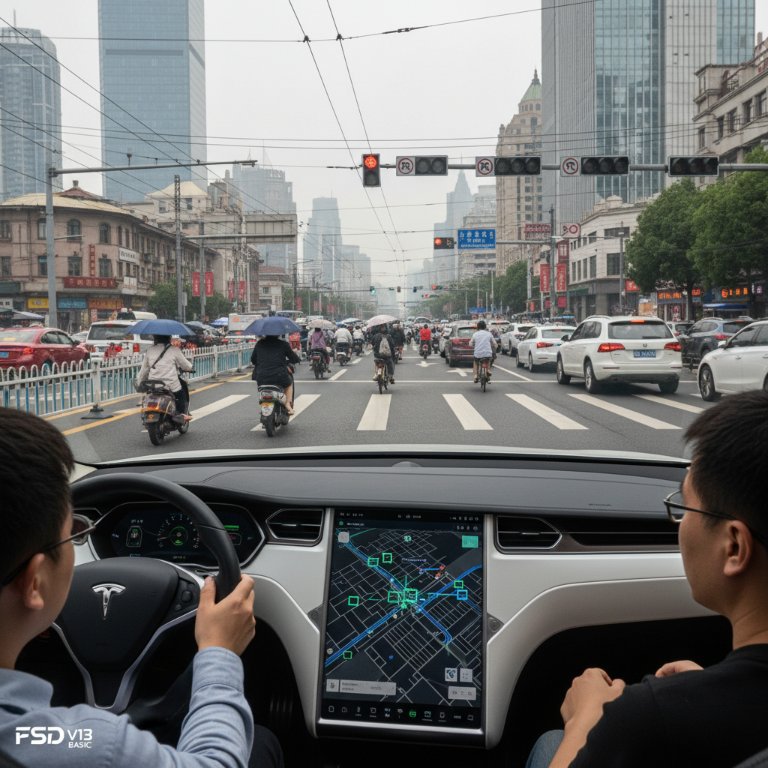
Tesla officially announced the availability of its Full Self-Driving (Supervised) system in the Chinese market on May 21, 2026, marking a pivotal moment for the EV giant's ambitious autonomous driving aspirations. This move, long anticipated, positions Tesla to finally tap into the immense revenue potential of FSD in the world's largest automotive market. However, the rollout is far from a straightforward victory lap, as discussions on May 27 reveal significant hurdles and strategic compromises.
This launch comes after years of Tesla refining its FSD system, which has been a cornerstone of its long-term vision and valuation, promising a future of fully autonomous mobility. While North American customers have seen continuous, incremental improvements through numerous software iterations, the Chinese market presents a uniquely complex environment that will test the very foundations of Tesla's self-driving technology and its ability to adapt.
The V13 Baseline and Uncharted Territory
The version of FSD (Supervised) now available to Chinese consumers is V13 basic. This is a critical distinction, as North American users have already iterated to V14.3.3, a significantly more advanced and refined version of the software. This generational gap immediately raises questions about the performance parity and the underlying reasons for Tesla's decision to deploy an earlier build in a market known for its demanding conditions and sophisticated local competition. Key details include:
- Version Discrepancy: China receives V13 basic, while North America operates on V14.3.3.
- Complex Road Conditions: Chinese urban environments are notoriously intricate, featuring diverse road furniture, unpredictable traffic flow, and a mix of vehicle types, posing a steep learning curve for any autonomous system.
- Data Compliance Barriers: Navigating China's stringent data localization and privacy regulations for mapping and vehicle data remains a formidable challenge for foreign companies, directly impacting FSD's ability to learn and improve at the same pace as its global counterparts.
Local Titans and the Battle for Autonomy
Tesla’s arrival with FSD is not occurring in a vacuum. The Chinese market is already a hotbed of innovation in intelligent driving systems, with robust local players making significant strides. Companies like Xpeng, Nio, and Huawei-backed solutions have invested heavily in developing advanced driver-assistance systems (ADAS) specifically tailored to local conditions and regulatory frameworks. These domestic competitors often leverage high-definition mapping data and local operational design domains, giving them a potential edge in performance and public trust within their home turf. The competition here is fierce, and consumers have increasingly high expectations for localized features and reliability.
Why This Matters:
Tesla's FSD launch in China is far more than a simple feature rollout; it's a high-stakes strategic play that will have profound implications for the company's future and the broader intelligent driving landscape. For Tesla, success in China is paramount. It’s the world’s largest EV market, and scaling FSD subscription revenue there could unlock a new, enormous profit stream vital for sustaining Tesla's growth trajectory and fulfilling CEO Elon Musk's long-held autonomous ambitions. A faltering FSD launch, however, could severely damage Tesla's reputation, erode consumer confidence, and embolden local rivals.
Who Wins? Initially, local Chinese intelligent driving system providers stand to gain by highlighting their mature, locally-optimized solutions against Tesla's V13 offering. Consumers, however, could ultimately win if the competition pushes all players, including Tesla, to rapidly innovate and deliver safer, more robust autonomous features. Tesla itself wins if it can quickly adapt FSD to China's unique demands, demonstrating the flexibility and superiority of its AI-driven approach.
Who Loses? Tesla faces the risk of losing significant market share and investor confidence if its FSD struggles with local adaptation or regulatory hurdles, proving unable to match the performance or user experience of domestic systems. Other foreign OEMs without competitive ADAS solutions will also find themselves further behind in the race for intelligent vehicles in China.
This moment signals Tesla's unwavering determination to globalize FSD, even if it means starting with an earlier version. It's a critical test of whether a 'one-size-fits-all' neural network approach can truly conquer the world's most diverse and challenging driving environments, or if deep localization remains the key to unlocking true autonomous success. For Tesla, this isn't just about selling a software upgrade; it's about validating its core technology and cementing its leadership in the global automotive future. The next few months will reveal whether the V13 gambit was a brilliant strategic entry or an underprepared plunge into the deep end.
Tesla’s official FSD (Supervised) launch in China is a bold declaration of intent, but the real work begins now. Overcoming the substantial challenges of complex road conditions, stringent data compliance, and fierce local competition will dictate whether this move is remembered as a stroke of genius or a cautionary tale in the annals of autonomous driving. The eyes of the global EV industry are firmly fixed on China, awaiting the unfolding chapters of this critical technological battle.