Tesla's FSD Fleet Surpasses 10 Billion Miles: Is True Autonomy Finally Within Reach, or Another Shifting Horizon?
Tesla's Full Self-Driving (Supervised) fleet has officially logged an astonishing 10 billion miles of real-world driving data. This monumental achieve...
Editorial Team
World Of EV
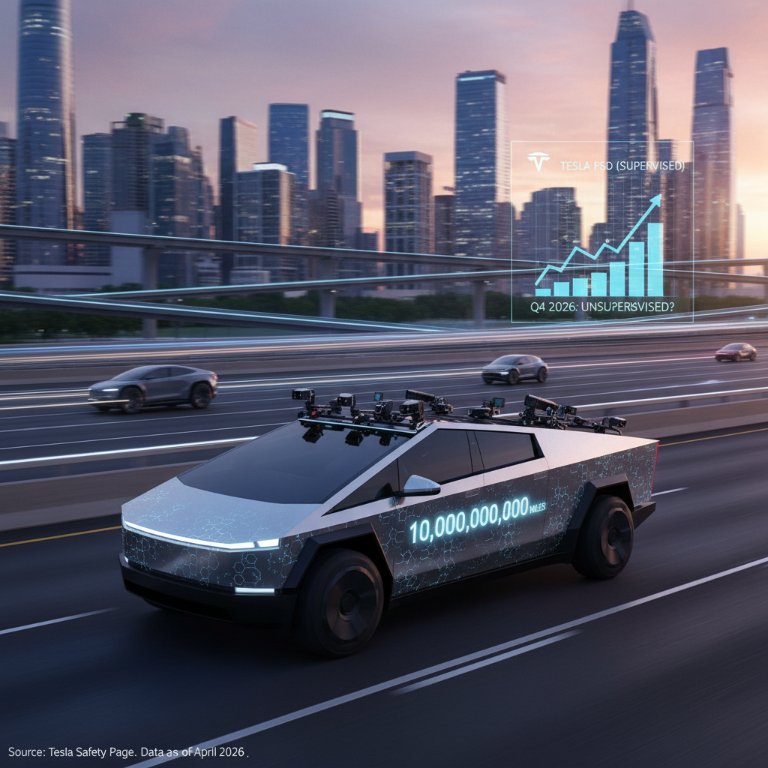
Tesla's Full Self-Driving (Supervised) fleet has officially logged an astonishing 10 billion miles of real-world driving data. This monumental achievement, detailed on the automaker's safety page, comes as CEO Elon Musk previously earmarked this very milestone as a critical data point for achieving 'safe unsupervised' driving. The company highlights a dramatic acceleration in its data collection efforts, with the FSD fleet accumulating approximately 29 million miles per day by late April 2026.
The 10 Billion Mile Barrier: A Data Tsunami
Reaching 10 billion miles isn't merely a numerical achievement; it represents an unparalleled volume of real-world driving scenarios processed by Tesla's AI. To put this into perspective, the fleet's daily mileage collection has surged to nearly 30 million miles – a rate that ensures an ever-growing, diverse dataset. This sheer quantity of data is foundational to training and refining the neural networks that power FSD, theoretically enhancing its ability to predict and react to complex driving environments. This milestone ostensibly fulfills a key requirement Musk himself established for the leap to fully unsupervised operation.
Unsupervised Autonomy: Q4 2026 and Persistent Concerns
Despite the impressive data accumulation, the timeline for unsupervised FSD for consumer vehicles has been re-projected for Q4 2026 at the earliest. This updated projection continues a trend of shifting deadlines for Tesla's ambitious autonomous driving goals. Critically, industry experts continue to voice significant concerns regarding Tesla's safety methodology, pointing to a stark contrast with standard data collection and analysis protocols stipulated by bodies like the National Highway Traffic Safety Administration (NHTSA). This methodological discrepancy remains a major point of contention and a potential roadblock to widespread regulatory approval.
Why This Matters:
The Data Mountain vs. The Regulatory Hurdle: While 10 billion miles offers an undeniable advantage in terms of raw data, the true litmus test is how this data translates into verifiable, statistically safer driving, and whether Tesla's proprietary safety assessments can withstand independent, regulatory scrutiny. The continued divergence from standard NHTSA methodologies is not a minor detail; it's a fundamental challenge to widespread acceptance and deployment of unsupervised FSD. Without alignment, the path to Level 4 autonomy remains fraught.
Credibility of Timelines and Consumer Trust: Tesla's FSD development has been characterized by optimistic, often missed, timelines. The Q4 2026 projection for unsupervised FSD, while potentially exciting, raises questions about the consistency of these predictions. Consumers who have paid thousands for the FSD package, sometimes years ago, are keenly aware of these delays. Each new projection, if not met, erodes trust and could impact future sales and the perceived value of the FSD offering.
Industry Standards and Competitive Pressure: Tesla's approach to autonomy, heavily reliant on cameras and vast data, stands in contrast to many competitors who integrate LiDAR and other sensor modalities. While Tesla leads in raw mileage, the ongoing safety concerns and regulatory skepticism could open doors for rivals. If Tesla cannot definitively demonstrate safety to external bodies, other manufacturers pursuing more conventional, slower, but perhaps more easily verifiable paths to autonomy might gain an advantage in public and regulatory confidence.
The 'Do-or-Die' Moment: For Tesla, FSD is more than just a feature; it's a cornerstone of their long-term vision and valuation. Successfully delivering on truly unsupervised FSD, with robust and verifiable safety credentials, would be a monumental achievement, potentially cementing their leadership in automotive AI. Failure to do so, or continued delays coupled with unresolved safety concerns, could significantly impact the brand's innovation narrative and market position in an increasingly competitive autonomous vehicle landscape.
Tesla's journey past 10 billion FSD miles marks a significant technical accomplishment, underscoring its unparalleled data advantage in the race for autonomous driving. However, the road to truly unsupervised FSD for the masses remains paved with both technological ambition and critical regulatory and public trust hurdles. All eyes will now be on Q4 2026 to see if this latest projection can finally bridge the gap between data-driven development and certified, universally accepted autonomous reality.