Tesla's FSD (Supervised) Fleet Shatters Mileage Records, Accelerating Autonomous Future
Tesla's Full Self-Driving (Supervised) fleet has collectively surpassed an astounding 11 billion miles driven worldwide, a monumental achievement unde...
Editorial Team
World Of EV
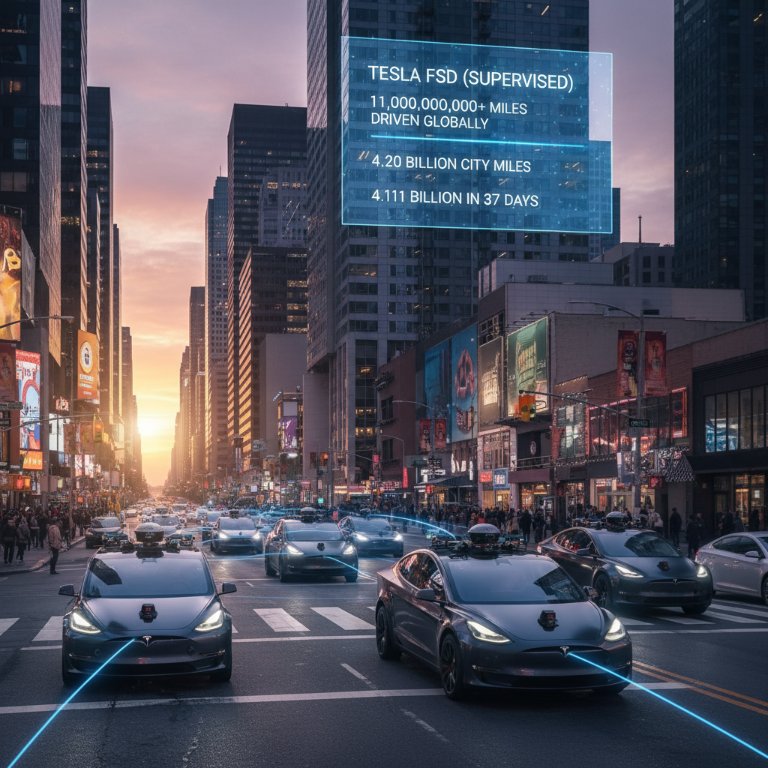
Tesla's Full Self-Driving (Supervised) fleet has collectively surpassed an astounding 11 billion miles driven worldwide, a monumental achievement underscoring the rapid expansion and data accumulation in the pursuit of autonomous driving. What's even more striking is the accelerating pace: the most recent billion miles were logged in a mere 37 days, a testament to the exponential growth in real-world testing and deployment. A significant 4.20 billion of these miles were accumulated on challenging city streets, the ultimate proving ground for any autonomous system.
This latest milestone isn't just a number; it represents a critical inflection point for Tesla's long-term vision of self-driving technology. It also highlights the company's unique, data-driven approach, which has been in development since Elon Musk first envisioned integrating autonomous driving in Tesla vehicles as early as 2013. Initially, Tesla explored paths similar to Google but ultimately committed to a pure vision-based system, distinguishing it from competitors that often rely on a combination of LiDAR, radar, and cameras.
The Data Avalanche: A New Benchmark for Autonomy
The sheer volume of 11 billion miles driven by the FSD (Supervised) fleet provides an unparalleled dataset for training and refining Tesla's AI models. For context, the previous billion miles, from 9 billion to 10 billion, took 31 days, demonstrating a sustained and increasing velocity in data collection. This acceleration is fueled by both an expanding fleet and growing availability, particularly as FSD (Supervised) gains regulatory approvals in additional European markets, with Denmark among the newest to gain access.
- Total Miles Driven: Over 11 billion worldwide.
- Recent Acceleration: The latest billion miles accumulated in just 37 days.
- Challenging City Driving: 4.20 billion miles recorded on complex urban streets.
- Data Volume: Tesla's FSD system processes over one million pixels of visual data every millisecond to react in real-time to complex driving environments.
Navigating the Urban Jungle: FSD's Toughest Test
Out of the total, the 4.20 billion miles driven on city streets are particularly noteworthy. Urban environments, with their unpredictable pedestrians, cyclists, intricate intersections, and unprotected left turns, present the most significant hurdles for autonomous systems. The ability of FSD (Supervised) to navigate these complex scenarios, as it has done for billions of miles, underscores the robustness of Tesla's vision-only approach and its neural network architecture. This focus on urban driving is crucial for FSD to earn credibility and move towards higher levels of automation.
Why This Matters:
This rapid accumulation of FSD (Supervised) miles signals a pivotal moment for Tesla and the broader autonomous driving industry. For savvy EV enthusiasts and prospective buyers, it means that the FSD system, while still requiring active human oversight, is benefiting from an unprecedented feedback loop, leading to continuous and significant improvements via over-the-air software updates.
- Tesla Wins: The company solidifies its lead in real-world data collection, a critical asset for AI training and validation. Elon Musk had previously cited 10 billion miles as a threshold for safe unsupervised operation, a figure now surpassed. This massive dataset is indispensable for achieving Tesla's long-term robotaxi ambitions and future unsupervised capabilities.
- Competitors Face Pressure: While other players like Waymo and Cruise focus on Level 4 robotaxi services in geo-fenced areas with LiDAR and radar, and traditional automakers offer Level 2+ ADAS like GM's Super Cruise and Ford's BlueCruise, Tesla's scale of data on consumer vehicles across diverse environments is unmatched. Competitors relying on smaller, more controlled fleets or different sensor suites will find it increasingly difficult to match the breadth and depth of Tesla's training data.
- The 'Supervised' Reality: It is crucial to remember that FSD remains a Level 2 system, officially rebranded as 'Full Self-Driving (Supervised)' since March 2024 to emphasize the driver's responsibility to remain attentive and ready to intervene. This distinction, though subject to past controversies and legal scrutiny regarding original purchase agreements, is a regulatory and safety imperative. The current hardware (HW4) is designed for the newest features, and older HW3 vehicles may face limitations for future unsupervised FSD.
- Market Signal: This milestone indicates growing maturity in Tesla's autonomous driving efforts, suggesting that the path to widespread, albeit supervised, advanced driver-assistance is scaling faster than many anticipated. It reinforces Tesla's narrative as an AI company at its core, constantly pushing the boundaries of what's possible in consumer vehicles.
Looking Ahead: The Road to True Autonomy
The accumulation of 11 billion FSD (Supervised) miles, particularly the acceleration on city streets, marks a significant step forward in Tesla's autonomous driving journey. While the transition to truly unsupervised autonomy (SAE Level 4 or 5) still faces regulatory hurdles and significant technical challenges, the sheer volume of real-world data generated by Tesla's fleet provides an invaluable foundation. The company's continuous iterative development, fueled by this data, will be key to addressing remaining edge cases and steadily improving system reliability. The next billion miles will undoubtedly arrive even faster, bringing us closer to understanding the full potential and societal impact of this transformative technology.