Tesla's FSD (Supervised) Gears Up for EU-Wide Rollout: A Crucial Validation in the Global Autonomy Race
The long-anticipated arrival of Tesla's Full Self-Driving (Supervised) system across the European Union is now within sight, marking a pivotal moment ...
Editorial Team
World Of EV
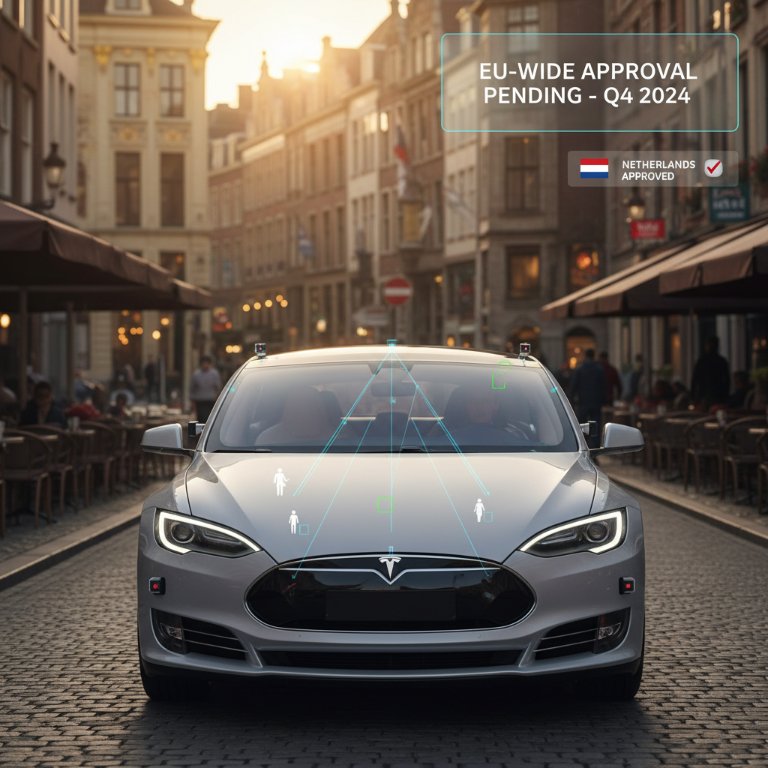
The long-anticipated arrival of Tesla's Full Self-Driving (Supervised) system across the European Union is now within sight, marking a pivotal moment for the EV giant's ambitious autonomous driving vision. Following rigorous testing and a landmark approval in the Netherlands in April, and subsequent adoption in Lithuania, Tesla CFO Vaibhav Taneja confidently anticipates EU-wide approval within the current quarter. This development isn't just a regulatory win; it's a testament to Tesla's perseverance in navigating Europe's complex legislative landscape and a significant step toward normalizing advanced driver-assistance systems on the continent's diverse roads.
Europe Opens Its Doors to FSD (Supervised)
Tesla's journey to bring its advanced driver-assistance system to Europe has been a marathon, not a sprint. The critical breakthrough came on April 10, 2026, when the Netherlands Vehicle Authority (RDW) granted provisional type-approval for FSD (Supervised). This approval, secured after an intensive 18-month evaluation that included 1.6 million kilometers of testing on European roads and thousands of closed-track scenarios, was a crucial first domino. Leveraging the EU's mutual recognition framework, Lithuania quickly followed suit on May 20, becoming the second EU nation to deploy the system. Tesla's CFO, Vaibhav Taneja, has since indicated that the company is "well-positioned" for broader EU-wide approval within the current quarter, a bold forecast that suggests confidence in the ongoing regulatory process.
It is vital to clarify that "Full Self-Driving (Supervised)" remains a Level 2 advanced driver-assistance system (ADAS). Despite the evocative branding, drivers are legally required to remain attentive, maintain continuous awareness of the road, and be prepared to intervene at all times. This "supervised" designation acknowledges that the system, while capable of assisting with steering, lane changes, and parking, is not yet a truly autonomous solution.
Navigating Europe's Autonomous Ambitions
The European market presents a unique blend of stringent safety regulations and diverse driving conditions, historically challenging for the rapid deployment of advanced ADAS. The EU's General Safety Regulation 2 (GSR2), which mandates various ADAS features in new vehicles, underscores Europe's commitment to road safety. Tesla's approach, which relies heavily on camera-based "vision" and AI, has diverged from some competitors, such as Mercedes-Benz, which initially deployed a Level 3 system, Drive Pilot, allowing "eyes-off" driving under specific, limited conditions in Germany, California, and Nevada. Interestingly, Mercedes later paused its Drive Pilot rollout in Europe and the US due to limited customer demand and high development costs, refocusing on Level 2 systems.
Tesla's anticipated EU-wide approval will simplify deployment significantly, moving beyond the country-by-country recognition model. The EU-wide process involves a vote by the Technical Committee on Motor Vehicles (TCMV), requiring approval from at least 15 of the 27 member states, representing 65% of the bloc's population. A vote is expected following a TCMV meeting in late June. While some Nordic regulators have voiced concerns regarding FSD's speed limit adherence and performance on icy roads, the overall momentum appears to be with Tesla. For European Tesla owners, this means:
- Enhanced driving assistance on highways and urban roads.
- Greater feature parity with FSD capabilities already available in North America and other markets.
- A subscription-based model (€99/month in Europe) for access, as Tesla has phased out one-time purchases, aligning its European strategy with its global revenue model.
Why This Matters:
Market Impact and Competitive Pressure: Tesla, already a dominant force in the EV market, solidifies its perceived technological lead in advanced ADAS within Europe. This could translate into increased sales and higher FSD subscription uptake, particularly as the company pivots to a recurring revenue model. For traditional European automakers and emerging EV competitors, Tesla's successful navigation of EU regulations on such a scale will intensify pressure to accelerate their own ADAS development and deployment. While Mercedes-Benz has demonstrated Level 3 capability, its recent pause highlights the immense challenges and costs associated with true autonomous driving, making Tesla's broader Level 2 deployment a compelling, if less ambitious, consumer offering.
Regulatory Precedent and Consumer Experience: The EU's approval sets a significant precedent for how future advanced ADAS and even higher levels of automation will be evaluated and integrated across the bloc. It underscores the importance of extensive real-world testing and transparent data submission. For the European consumer, this means an increasingly sophisticated driving experience, but also a continued emphasis on driver responsibility. The "Supervised" moniker is a constant reminder that the driver remains the ultimate safety backup, a distinction that regulators and consumers alike must fully grasp.
The Long Game of Autonomy: This isn't a "do-or-die" moment for Tesla, which boasts over 1.28 million FSD subscribers globally and continues to grow its user base. Instead, it's a vital step in its long-term vision of fully autonomous vehicles and robotaxis. By establishing a robust, widely approved Level 2 foundation, Tesla paves the way for future software iterations and potentially higher levels of automation, demonstrating its ability to meet diverse global regulatory requirements. The move reinforces Tesla's identity as a software company as much as a hardware manufacturer, offering a clear differentiator in an increasingly crowded EV landscape.
Conclusion: Tesla's anticipated EU-wide approval for Full Self-Driving (Supervised) represents a monumental achievement, transforming what was once a geographically fragmented offering into a potentially unified European experience. It validates years of development, rigorous testing, and painstaking regulatory engagement, fundamentally altering the competitive dynamics of advanced driver-assistance systems in one of the world's most discerning automotive markets. As the software rolls out, "World Of EV" will closely monitor its real-world performance, user adoption, and the ripple effects across an industry rapidly accelerating toward an autonomous future.