Tesla's FSD (Supervised) Lands in Estonia: A Strategic European Foothold Amidst Evolving Regulations
Tesla has secured a significant regulatory win, with Estonia granting approval for the rollout of its advanced driver-assistance features, the Full Se...
Editorial Team
World Of EV
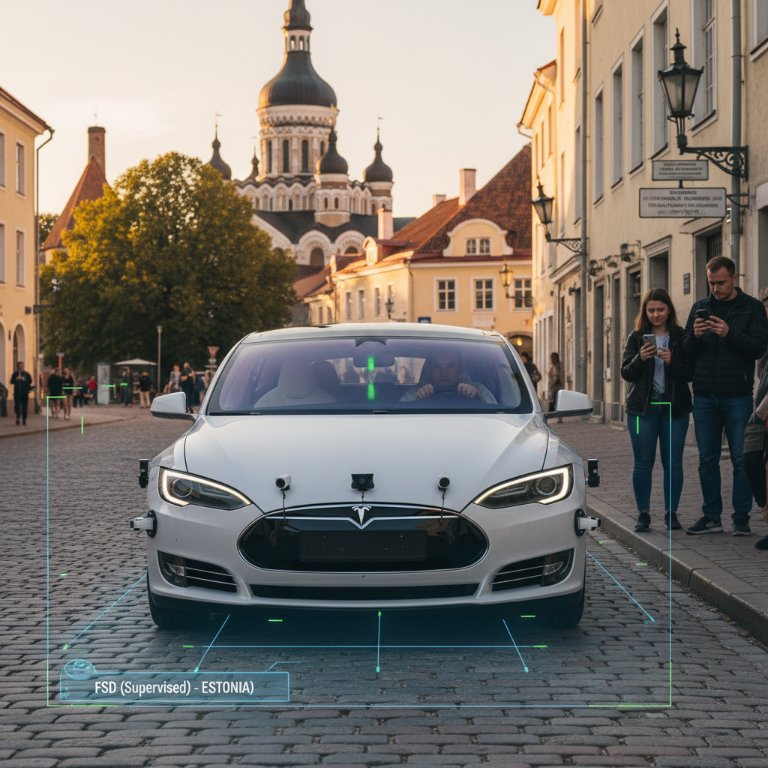
Tesla has secured a significant regulatory win, with Estonia granting approval for the rollout of its advanced driver-assistance features, the Full Self-Driving (Supervised) system. This makes Estonia the third European Union country to greenlight the technology, following Lithuania last week and the Netherlands in April. Tesla confirmed on X that the rollout in Estonia will commence soon, marking another step in its gradual European expansion.
This approval is not merely a formality; it signifies a growing acceptance of advanced ADAS (Advanced Driver-Assistance Systems) within the historically cautious European regulatory landscape. Unlike the relatively quicker adoption in North America, Europe has maintained a stringent, methodical approach to validating such technologies. This latest move by Estonia highlights a pragmatic recognition of Tesla's system, particularly given the country's extensive prior experience with self-driving and remote-controlled vehicles operating on its roads since 2017.
The Supervised Reality of FSD in Europe
It is crucial for enthusiasts and prospective buyers to understand the capabilities and limitations of 'Full Self-Driving (Supervised).' Despite its provocative name, Tesla unequivocally states that this system is not fully autonomous.
Key aspects of FSD (Supervised) in Europe include:
- Driver Responsibility Remains Paramount: The system is classified as a Level 2 driver assistance system under SAE standards. This means the human driver bears full responsibility for the vehicle's operation at all times and must remain fully attentive, ready to intervene instantly.
- Assistance, Not Autonomy: FSD (Supervised) aids with tasks like changing lanes, navigating around other vehicles, and maintaining speed, but it requires continuous human oversight.
- European Specifics: The FSD (Supervised) software version deployed in Europe is distinct from its U.S. counterpart, tailored to comply with European regulations and road conditions.
Estonia's decision to approve FSD (Supervised) leverages a type approval initially granted by the Netherlands Vehicle Authority (RDW) after over 18 months of rigorous testing on European roads. This process involved extensive evaluation, covering over 1.6 million kilometers and 4,500 test scenarios. This mutual recognition under EU Regulation 2018/858 allows individual EU member states to accept an approval from another, potentially accelerating broader adoption without requiring each country to conduct its own exhaustive review.
Why This Matters:
The gradual but steady expansion of Tesla's FSD (Supervised) into European markets carries significant implications for various stakeholders.
For Tesla: This is a crucial strategic victory. Each new country approval expands Tesla's addressable market for software services, which are becoming an increasingly vital revenue stream. It also provides invaluable real-world data, enabling further refinement of the system and strengthening Tesla's position in the global autonomous driving race. Furthermore, successful FSD (Supervised) deployments pave the way for future regulatory discussions regarding higher levels of autonomy, potentially including robotaxis.
For European Consumers: Early adopters in Estonia, Lithuania, and the Netherlands gain access to one of the most advanced ADAS systems available, enhancing their driving experience with sophisticated assistance features. This signals a broader trend where advanced driver-assistance features could become available in more places, offering greater consistency across borders for Tesla owners.
For the European Regulatory Landscape: These approvals, particularly Estonia's, demonstrate a pragmatic evolution in how European authorities are approaching sophisticated ADAS. Estonia's long-standing experience with autonomous and remote-controlled vehicles since 2017 played a significant role in viewing this as a 'logical step,' suggesting that countries with a forward-thinking stance on smart mobility may be quicker to adopt. This piecemeal approval process, leveraging the Dutch RDW's comprehensive testing, could set a precedent for other EU nations, potentially accelerating wider recognition of FSD (Supervised) even as the European Commission reviews an EU-wide application.
For Competitors: While Tesla focuses on its vision-based FSD, traditional automakers and other tech companies are also developing their own ADAS. The continued expansion of FSD (Supervised) puts pressure on competitors to accelerate their own efforts and navigate similar complex regulatory pathways. Companies like Mercedes-Benz and Ford, with Level 3 systems approved in some markets, illustrate the diverse approaches and varying regulatory speeds across the continent.
Conclusion
Estonia's approval of Tesla's Full Self-Driving (Supervised) system marks more than just another market entry; it's a testament to the persistent evolution of advanced driver-assistance technology and the regulatory frameworks governing it. As Tesla continues its methodical rollout across Europe, the industry will closely watch how these individual country approvals coalesce into a broader European strategy, shaping the future of assisted and, eventually, autonomous driving on the continent.