Tesla's FSD (Supervised) Lights Up Lithuania: A Crucial Regulatory Breakthrough for European Autonomy
Tesla has taken a significant stride in its ambition for global autonomy, officially expanding its Full Self-Driving (Supervised) suite to customer ve...
Editorial Team
World Of EV
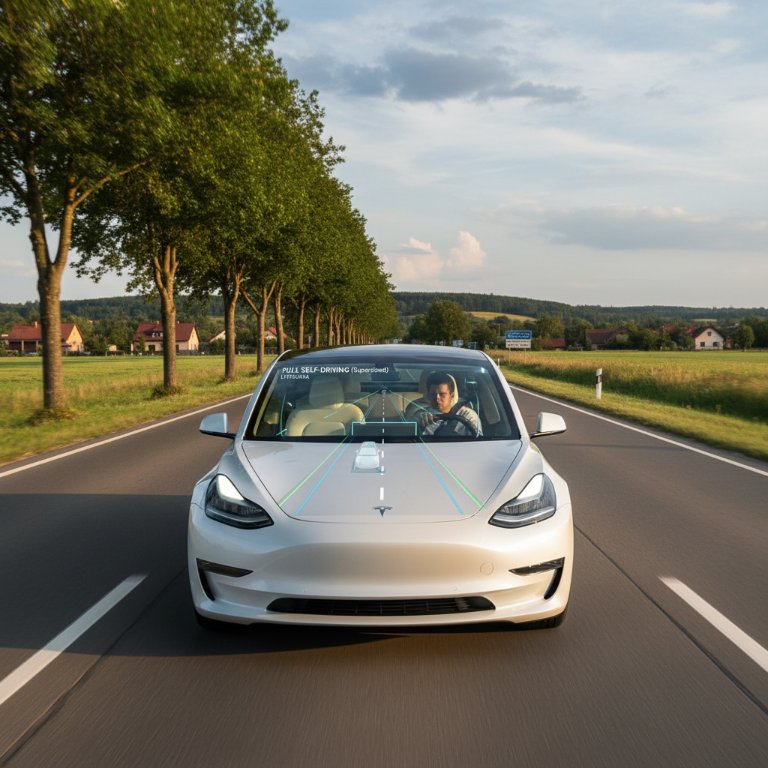
Tesla has taken a significant stride in its ambition for global autonomy, officially expanding its Full Self-Driving (Supervised) suite to customer vehicles in Lithuania. This makes Lithuania the second European Union country, following the Netherlands, to greenlight the advanced driver-assistance system. The swift expansion signals a crucial regulatory breakthrough for Tesla in a historically challenging European market, setting a precedent for wider adoption across the continent.
For years, European Tesla enthusiasts have watched with anticipation as their North American counterparts accessed advanced FSD features, while regulatory hurdles kept a more limited version of the software in Europe. The Dutch Vehicle Authority (RDW) granted the pioneering approval on April 10, 2026, after an extensive 18-month review that included 1.6 million kilometers of on-road testing across Europe. This rigorous evaluation under UN Regulation 171, which governs Driver Control Assistance Systems, paved the way for Lithuania's adoption.
Europe's FSD Frontier Expands with RDW's Blessing
The rollout in Lithuania was facilitated by the Lithuanian Transport Safety Administration's recognition of the Dutch RDW certification. This mechanism, allowed under EU rules, enables member states to recognize another country's type approval, bypassing the need for a separate, lengthy testing period. This is a game-changer, demonstrating a pathway for Tesla to accelerate FSD (Supervised) availability beyond individual country-by-country testing.
Key aspects of the European FSD (Supervised) rollout include:
- Human Oversight Required: The system assists with driving tasks but is not fully autonomous; continuous driver attention and readiness to intervene are mandatory.
- Tailored European Build: The European version of FSD (Supervised) differs from its North American counterpart, incorporating features like 'Contextual Max Speed' to adjust pace based on surroundings and an 'Out of View Traffic Lights Warning' adapted for European infrastructure.
- Mandatory Safety Quiz: To enable the software, Dutch owners, and likely those in Lithuania, must pass a mandatory safety quiz after watching a dedicated tutorial video, emphasizing regional safety regulations.
- Subscription Model: Tesla offers FSD via monthly subscriptions (around €99 in Europe) or a one-time purchase option, though the latter was recently discontinued in North America and may be phased out in Europe.
Why This Matters:
This expansion transcends a simple feature update; it marks a critical inflection point for Tesla's autonomous driving ambitions in Europe and sends a clear signal to the broader automotive industry.
- For Tesla: This is a crucial validation of its FSD technology and its ability to navigate complex regulatory landscapes. The RDW's comprehensive approval, followed by Lithuania's mutual recognition, establishes a scalable model for wider EU deployment. This momentum reinforces Tesla's technological leadership narrative and opens a new revenue stream through FSD subscriptions in a significant market.
- For European Consumers: The availability of FSD (Supervised) offers a significantly enhanced driving experience, particularly for long-distance travel and navigating complex urban environments. It brings European Tesla owners closer to the advanced capabilities long enjoyed by their North American counterparts, potentially influencing purchase decisions and increasing the appeal of Tesla vehicles. The emphasis on driver responsibility and safety onboarding also aims to build trust in the technology.
- For Competitors and the Industry: Tesla's progress puts immense pressure on traditional OEMs and other EV manufacturers vying for market share in Europe. Companies like Mercedes-Benz and BMW are also developing advanced driver-assistance systems, but Tesla's ability to achieve regulatory approval and scale deployment across multiple EU states could give it a significant competitive advantage. This move highlights the fragmented regulatory environment in Europe, where a unified framework is still evolving, contrasting with more targeted approaches in some member states like Germany. The mutual recognition mechanism, if widely adopted, could streamline approvals for other advanced ADAS systems in the future.
- Regulatory Precedent: The RDW's thorough 18-month evaluation, encompassing 1.6 million kilometers of testing, and Lithuania's subsequent recognition under Regulation (EU) 2018/858, sets a strong precedent. This demonstrates a viable path for the introduction of advanced L2 automation under existing UN and EU frameworks, even as the continent works towards a more harmonized approach to higher levels of autonomous driving.
Tesla's successful expansion of FSD (Supervised) into Lithuania, leveraging the Dutch RDW's comprehensive certification, represents more than just a geographic rollout. It's a strategic regulatory victory that validates Tesla's technology within Europe's stringent safety standards and charts a clearer course for future growth across the EU. This move not only benefits Tesla but also accelerates the conversation around advanced driver-assistance systems in Europe, pushing the industry forward while emphasizing the critical role of human oversight. Expect more EU countries to follow suit as the 'domino effect' of RDW's approval continues to play out.