Tesla's FSD v14 'Lite' Lifeline: Why the Wide Release of 2026.20.6.10 is a Triumph and a Warning for Hardware 3 Owners
Hardware 3 owners have spent the last year holding their breath. As Tesla pivoted its primary engineering focus to its newer, vastly more powerful AI4...
Editorial Team
World Of EV
Hardware 3 owners have spent the last year holding their breath. As Tesla pivoted its primary engineering focus to its newer, vastly more powerful AI4 (HW4) platform, millions of drivers who bought into the dream of Full Self-Driving (FSD) years ago feared they were being left in the dust. The anxiety was entirely justified: Elon Musk's previous admissions that HW3 might struggle with "Unsupervised" autonomy left legacy owners feeling like they were holding an expensive, obsolete ticket.
But Tesla has just thrown its legacy fleet a massive lifeline. Ashok Elluswamy, Tesla's Head of FSD AI, has confirmed that the newly compiled FSD v14 Lite point release (firmware version 2026.20.6.10) is finally slated for a wide release to legacy Hardware 3 (HW3/AI3) vehicles. Rather than letting older hardware wither, Tesla is deploying a sophisticated software strategy to keep its original promise of advanced autonomy alive.
Knowledge Distillation: Squeezing HW4 Brains into HW3 Silicon
How does Tesla run cutting-edge AI models on hardware that debuted in 2019? The answer lies in an advanced machine learning technique called "knowledge distillation."
Because HW3 has only a fraction of the compute capability and memory bandwidth of AI4, it cannot run the massive neural networks of the full FSD v14 natively. Instead, Tesla’s engineers used the uncompromised AI4 v14 model as a "teacher" to train a more compact, highly efficient "student" model for HW3. This approach allows the older hardware to inherit the benefits of advanced Reinforcement Learning (RL) and complex offline path-planning models without choking the vehicle's older processor.
What's New in FSD v14 Lite (Firmware 2026.20.6.10)
Early testers from the initial limited rollout have noted that this build represents a significant step forward from older FSD v12.6.x versions. The update is packed with both driving behavioral fixes and highly requested UI updates:
- Smoother Starts: Acceleration from stops is significantly more linear and natural, eliminating the hesitant, jerky starts that previously plagued city-street driving.
- Superior Curve Control: The vehicle handles high-speed, winding curves with a newfound level of confidence, maintaining a smooth lateral path.
- Reduced Left-Lane Camping: In a major quality-of-life upgrade for highway drivers, the system actively avoids lingering in the passing lane, executing smarter lane changes to let faster traffic pass.
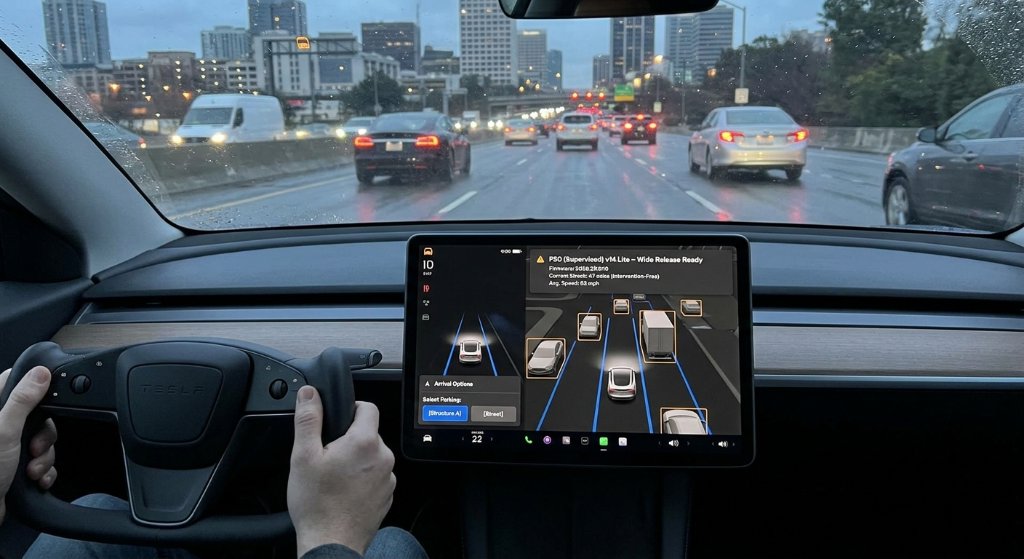
- Gamified Self-Driving Stats: The instrument cluster now features a live "intervention-free streak counter" and self-driving telemetry. This addition transparently shows how many miles the car has driven without human correction, boosting driver trust.
- Arrival Options: Drivers can now pre-select their exact parking preferences (such as curbside pull-over or parking lot positioning) right from the screen before arriving at their destination.
Why This Matters:
This is a masterclass in software engineering, but it also signals a critical turning point for Tesla's autonomous driving strategy.
The Winners: Legacy Owners and Tesla's Legal Team
By successfully rolling out FSD v14 Lite to HW3, Tesla scores a dual victory. First, it satisfies millions of Model 3, Model Y, Model S, and Model X owners who paid up to $15,000 for a feature they feared they would never receive in its modern form. This preserves vehicle resale values and keeps the brand's most vocal supporters happy. Second, it shields Tesla from massive potential class-action lawsuits and expensive hardware retrofit demands.
The Catch: The "Lite" Warning Sign
However, let's not ignore the elephant in the room. The very name—"v14 Lite"—is a tacit admission of HW3's physical limits. While distillation allows older cars to mimic the driving characteristics of newer AI4 models, HW3 is operating at its absolute hardware ceiling.
This release is a brilliant Level 2 "Supervised" solution, but it virtually confirms that true "Unsupervised" self-driving and integration into Elon Musk's promised Cybercab robotaxi network will remain exclusive to AI4 and future hardware generations. Tesla has squeezed every drop of blood from the HW3 stone, but this is likely the final platform peak for these older vehicles.
What This Signals to the Market
Tesla's ability to pull off this level of optimization shows why it remains the industry leader in software-defined vehicles. While legacy automakers struggle with basic OTA infotainment updates, Tesla is redesigning core AI neural networks to run on seven-year-old hardware. It is an impressive flex that will keep competitor engineering teams up at night.
Ultimately, firmware 2026.20.6.10 is the polished, highly capable swansong that HW3 owners deserved. It delivers a premium, smooth, and highly interactive Level 2 driving experience that rivals anything else on the road today. While it may not pave the way for a driverless robotaxi future on legacy hardware, it ensures that older Teslas remain at the cutting edge of driver-assist technology for years to come.