Tesla's FSD V14 Patent Unlocks Human-Like Driving Through Advanced AI, Revitalizing Older Hardware
Tesla's Full Self-Driving (FSD) system has long been a focal point of both fervent anticipation and intense scrutiny within the automotive world. Now,...
Editorial Team
World Of EV
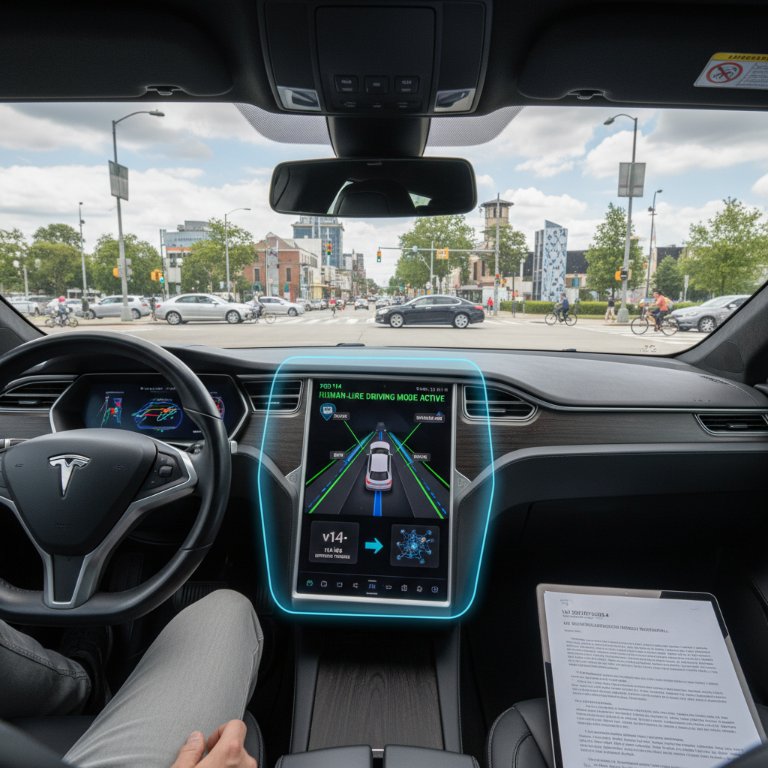
Tesla's Full Self-Driving (FSD) system has long been a focal point of both fervent anticipation and intense scrutiny within the automotive world. Now, a newly published patent, 'Artificial Intelligence Modeling Techniques for Joint Behavior Planning and Forecasting' (US 2026/0105614), pulls back the curtain on the technological underpinnings of the significantly more natural and confident driving behavior observed in the latest FSD V14. This isn't just an incremental update; it signals a profound leap in how Tesla’s AI perceives and interacts with the road, solidifying its vision-only approach.
After years of iterative improvements and public beta testing, often characterized by hesitant or overly cautious maneuvers, FSD V14 marked a noticeable shift. While other manufacturers, like Mercedes-Benz with their DRIVE PILOT, have focused on Level 3 autonomy in specific, limited conditions, Tesla has consistently pursued a broader, more ambitious Level 2+ system aiming for ubiquitous self-driving. This patent elucidates how Tesla is achieving a driving style that more closely mirrors human intuition, a critical step toward broader public acceptance and regulatory approval.
Unpacking the AI Behind FSD's Newfound Confidence
The core innovation described in the patent lies in its sophisticated approach to 'Joint Behavior Planning and Forecasting.' Traditionally, autonomous driving systems often separate the tasks of predicting other road users' actions and planning the vehicle's own trajectory. This new methodology, however, integrates these two critical functions, allowing for a more holistic and predictive understanding of the driving environment. This enables the Tesla vehicle to:
- Anticipate Interactions: Instead of merely reacting to present conditions, the system can better predict the likely actions of pedestrians, cyclists, and other vehicles, leading to smoother merges, turns, and lane changes.
- Optimize Trajectories: By forecasting behaviors, FSD V14 can plan more efficient and human-like paths, reducing abrupt braking or acceleration that can be jarring for occupants.
- Enhance Decision-Making: The AI can evaluate multiple potential scenarios simultaneously, selecting the safest and most efficient path forward based on a richer, predictive model of the environment.
This integrated approach moves beyond simple rule-based or reactive driving, allowing the system to truly understand and 'reason' about complex urban scenarios, much like an experienced human driver would.
'v14-lite': A Lifeline for Hardware 3 Owners
Perhaps equally significant for the vast installed base of Tesla owners is the patent’s revelation that these advanced capabilities will extend to older Hardware 3 (HW3) vehicles through an upcoming 'v14-lite' update. This is a game-changer, especially considering the speculation and concern among HW3 owners about the eventual obsolescence of their hardware as Tesla introduced the more powerful Hardware 4 (HW4) in newer vehicles. The 'v14-lite' update achieves this by:
- Reducing Computational Demands: The patent details efficiency improvements that allow the sophisticated AI models to run effectively on the less powerful HW3 chip, specifically by optimizing navigation in complex urban environments.
- Extending Value and Longevity: This move ensures that a significant portion of the Tesla fleet, which invested in FSD years ago, will continue to receive substantial feature enhancements without needing a costly hardware upgrade. This stands in stark contrast to some competitors who might require hardware overhauls for major feature sets.
- Broader Deployment: By bringing these improvements to HW3, Tesla dramatically increases the number of vehicles benefiting from V14's advanced capabilities, accelerating the real-world data collection and refinement process.
Why This Matters:
This patent and the impending 'v14-lite' update carry profound implications for Tesla, the broader automotive industry, and most importantly, current and prospective EV owners. Tesla unequivocally strengthens its position as a leader in AI-driven autonomous technology. By demonstrating the ability to deploy complex, human-like driving capabilities across a vast installed base – even on older hardware – they validate their vision-only strategy and the scalability of their AI models. This directly addresses the 'why does this matter to me?' question for hundreds of thousands of HW3 FSD owners, significantly boosting the value proposition of their existing investment.
For the competition, this development raises the bar considerably. While many are still grappling with basic ADAS functionalities or pursuing LiDAR-heavy, geo-fenced solutions, Tesla continues to push the envelope on generalized, vision-based autonomy. This could signal a potential acceleration in the race for true self-driving, forcing rivals to re-evaluate their own sensor suites and AI development strategies. Who wins? Tesla, by expanding its technological lead and customer goodwill. Who loses? Perhaps those who bet heavily on hardware-centric solutions that require costly upgrades, or those whose AI development lags in efficiently tackling complex, unstructured driving environments. This isn't a 'do-or-die' moment for the entire company, but it is certainly a pivotal validation point for their audacious FSD bet, signaling a potential inflection point towards widespread FSD adoption.
In conclusion, the 'Artificial Intelligence Modeling Techniques for Joint Behavior Planning and Forecasting' patent is far more than a technical document; it's a blueprint for Tesla’s continued pursuit of robust, human-like autonomous driving. By delivering these advanced capabilities to both new and older vehicles, Tesla is not only enhancing the FSD experience today but also laying crucial groundwork for the future of self-driving, promising a smoother, more confident ride for all its users.