Tesla's FSD V14.3.2: A Troubling Step Sideways for Autonomy on Model 3 Highland
For years, Tesla has positioned its Full Self-Driving (FSD) suite as the vanguard of autonomous vehicle technology, promising a future where cars navi...
Editorial Team
World Of EV
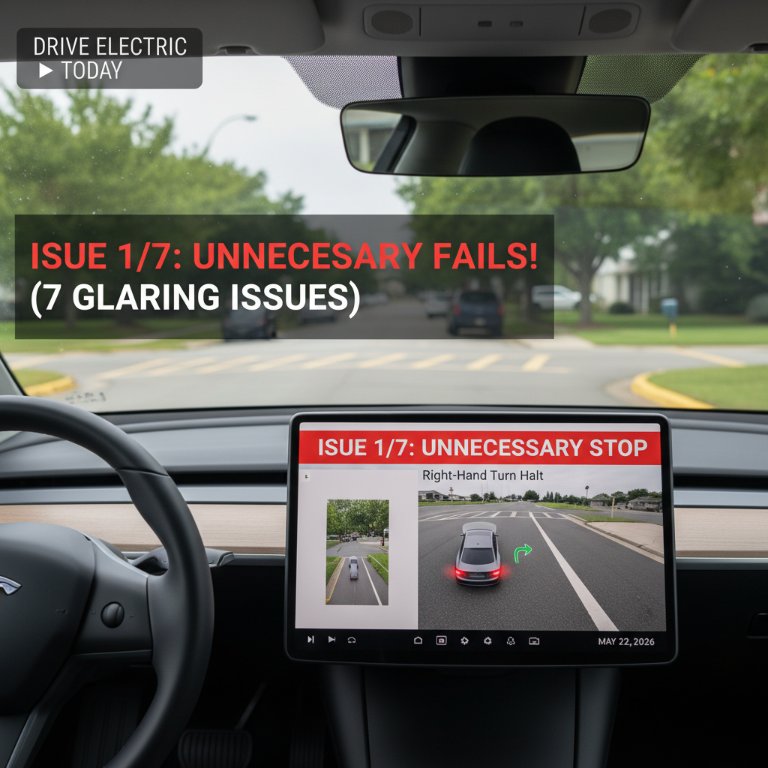
For years, Tesla has positioned its Full Self-Driving (FSD) suite as the vanguard of autonomous vehicle technology, promising a future where cars navigate effortlessly without human intervention. Yet, a recent deep dive into FSD V14.3.2, specifically tested on a 2024 Model 3 Highland, reveals a concerning pattern of persistent glitches that threaten to undermine consumer confidence and raise serious questions about the system's maturity and safety. While Tesla's ambitions for Level 4/5 autonomy remain bold, the real-world performance of its latest iteration suggests the road ahead is still fraught with significant obstacles.
The 'Drive Electric Today' YouTube channel, a respected voice in the EV community, published a comprehensive video on May 22, 2026, detailing 7 consistent issues observed with FSD V14.3.2. These aren't minor hiccups; they represent fundamental failures in predictive analysis and real-time decision-making, critical for any system aspiring to fully autonomous capabilities.
Persistent Performance Headaches
The observed issues paint a picture of an FSD system that, despite numerous updates and iterations, continues to struggle with basic driving scenarios, exhibiting behaviors that are at best inefficient and at worst, potentially hazardous. The consistent problems identified include:
- Unnecessary Full Stops on Right-Hand Turns: The system frequently brings the vehicle to a complete halt even when visibility and traffic conditions safely permit a rolling stop or slow turn, impacting traffic flow and driver frustration.
- Phantom Braking: A long-standing FSD bug, phantom braking, continues to plague V14.3.2, causing the vehicle to inexplicably apply brakes on clear roads without any apparent obstruction.
- Sketchy Lane Changes: FSD exhibits hesitation, last-minute decisions, or unsafe maneuvers when initiating and executing lane changes, leading to unpredictable driving behavior.
- Lack of Pothole Awareness: The system fails to identify and react to common road hazards like potholes, potentially leading to vehicle damage and occupant discomfort.
- Unsafe or Hesitant Lane Changes and Merging: Beyond just sketchy changes, FSD struggles with the nuanced decision-making required for safe merging onto highways or into busy lanes, often being overly cautious or making poor judgment calls.
These issues are particularly jarring considering the 2024 Model 3 Highland is equipped with Tesla's latest hardware suite, suggesting that the problem lies predominantly in the software's ability to interpret sensor data and execute reliable driving decisions, rather than a limitation of the physical sensors themselves. This latest iteration, rather than showcasing a definitive leap forward, appears to be grappling with fundamental challenges that have persisted across earlier versions.
Why This Matters:
This analysis of FSD V14.3.2 is far more than a review of a software update; it's a critical barometer for the future of Tesla's ambitious autonomous driving program and its implications for the broader EV and automotive industries. Persistent regressions or stagnation in FSD's development are a significant red flag for several reasons.
Firstly, it erodes the already fragile trust of consumers. After years of promised breakthroughs, the continued presence of fundamental flaws like phantom braking or unsafe lane changes can lead to FSD being perceived as a perpetual beta product rather than a reliable driving assistant. This directly impacts Tesla's ability to monetize FSD through subscriptions, a key revenue stream projected to contribute significantly to its valuation.
Secondly, the slow pace of tangible improvement in FSD compared to its bold marketing creates an opening for competitors. While no OEM has truly cracked Level 4 autonomy for widespread public use, companies like Mercedes-Benz are gaining regulatory approval for Level 3 systems (like Drive Pilot) in specific regions, offering a concrete, albeit limited, hands-off experience. Furthermore, dedicated robotaxi companies like Waymo and Cruise, operating in geofenced areas, continue to advance their fully autonomous services, setting a higher bar for reliability and safety that FSD struggles to meet in its current form. If Tesla cannot deliver on its FSD promises, it risks losing its perceived technological edge.
Finally, for Tesla, FSD is not just a feature; it's central to its long-term vision and often a justification for its premium valuation. Consistent stumbling blocks in its development could signal to the market that achieving truly generalized autonomy is far more challenging and distant than anticipated. This isn't a do-or-die moment for the company entirely, but it is a critical juncture for the credibility of its FSD program. Who loses? Early FSD adopters, whose significant investment isn't yielding the promised returns, and potentially Tesla's long-term stock performance if the FSD narrative falters. Who wins? Competitors who can offer more reliable (even if less ambitious) ADAS systems, and potentially dedicated robotaxi services that focus on highly validated, albeit restricted, autonomous operations.
The persistent issues plaguing Tesla's FSD V14.3.2 on the Model 3 Highland highlight the immense complexities of achieving true autonomous driving. While Tesla continues to push the boundaries, the current state of its FSD software suggests that reliability and consistent performance across diverse driving scenarios remain elusive. For the legions of EV enthusiasts and prospective buyers watching closely, the message is clear: the promise of full self-driving is still a distant horizon, and incremental, reliable progress is far more valuable than ambitious but flawed updates.