Tesla’s FSD v14.3.5 Gamifies Autonomy: Streak Tracking and Live Camera Previews Signal a Bold New Era for AI4 Owners
Tesla has officially commenced the rollout of its latest over-the-air (OTA) software update, version 2026.20.6.6, delivering the highly anticipated Fu...
Editorial Team
World Of EV
Tesla has officially commenced the rollout of its latest over-the-air (OTA) software update, version 2026.20.6.6, delivering the highly anticipated Full Self-Driving (FSD) v14.3.5 to Hardware 4 (AI4) vehicles. Far from a routine bug-fix patch, this release marks a strategic shift in how Tesla interacts with its user base and refines its self-driving model. For years, Tesla has faced intense scrutiny over the real-world reliability of its 'vision-only' approach, particularly as competitors like Alphabet’s Waymo rack up driverless miles in geofenced cities and legacy OEMs rely heavily on costly LiDAR arrays.
With FSD v14.3.5, Tesla isn't just updating code; it is restructuring the driver experience to crowdsource validation. By introducing highly requested utility features alongside a subtle psychological tool to gamify safe driving, the Austin-based EV giant is preparing its fleet for the next critical leap: regulatory approval and the impending Robotaxi era.
Live Camera Previews Unleashed on the Move
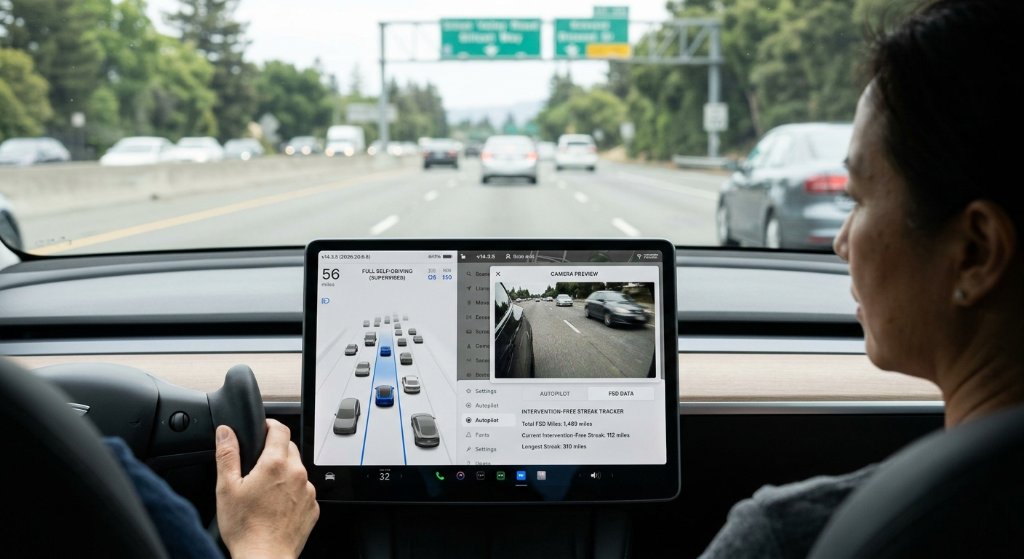
For years, Tesla owners have been restricted to viewing their external camera feeds exclusively when parked. Update 2026.20.6.6 completely smashes this limitation, giving AI4-equipped vehicles the ability to open a live Camera Preview at any moment, even while traveling at highway speeds. Drivers can access this via Controls > Service > Camera Preview, enabling a real-time diagnostic and situational awareness tool that was previously cordoned off.
This change addresses a long-standing grievance among power users and offers several immediate benefits:
- Real-Time Diagnostics: Drivers can now instantly check if glare, dirt, or condensation is obstructing a specific camera lens when FSD behaves unexpectedly.
- Enhanced Situational Awareness: The update allows users to tap into individual camera feeds or view a grid of all cameras, dramatically improving visibility in tricky highway merge or towing scenarios.
- HW4/AI4 Optimization: By utilizing the higher-resolution cameras found on Tesla’s latest AI4 hardware suite, the feed is razor-sharp, providing an ultra-clear window into what the vehicle’s neural network actually 'sees.'
Gamifying Autonomy via the 'Intervention-Free Streak' Tracker
Perhaps the most intriguing addition is a silent update embedded within the Self-Driving app: the 'Intervention-Free Streak' tracker. Rather than keeping FSD performance metrics locked in Tesla’s backend databases, this feature puts telemetry directly in front of the driver. It records and displays the total mileage driven autonomously, alongside the driver's consecutive driving streaks completed without a single manual intervention or override.
By transforming autonomous driving into a metric-driven achievement, Tesla is employing classic gamification tactics to influence driver behavior:
- Promoting Passive Supervision: FSD is notoriously active, and anxious drivers often disengage the system prematurely. The streak tracker incentivizes drivers to let the neural net 'work through' complex scenarios to keep their streak alive, yielding higher-quality training data.
- Quantifying Progress: Instead of relying on anecdotal social media clips, Tesla is giving its community a standardized way to measure FSD improvements version-over-version.
- Fleet-Wide Telemetry: This feature directly links to Tesla's broader push to gather high-fidelity data on why and when humans take over, directly feeding the reinforcement learning loops that power FSD v14.
Why This Matters:
This update is a masterclass in behavioral engineering and fleet preparation, signaling a crucial transition from FSD development to FSD validation.
The Wins: Tesla and its AI4 customer base are the clear winners here. By offering live camera feeds on the move, Tesla satisfies a massive safety and diagnostic demand. More importantly, the 'Intervention-Free Streak' tracker is a stroke of genius. It gamifies attentiveness and patience, encouraging owners to accumulate perfect runs. This does two things: it provides Tesla's AI training cluster with pristine, uninterrupted driving data, and it builds psychological trust. When an owner sees a '100-mile intervention-free' badge on their screen, the cognitive barrier to accepting a fully driverless future dissolves.
The Loses: Legacy Hardware 3 (HW3) owners are increasingly left in the cold. As Tesla pushes the boundaries of AI4 with v14.3.5, HW3 vehicles are struggling to keep up, often receiving 'Lite' or heavily delayed versions of these cutting-edge builds. This stark hardware bifurcation highlights an uncomfortable truth for early adopters: hardware obsolescence is a real threat in the software-defined vehicle era. Furthermore, competing legacy automakers (like GM with Super Cruise or Ford with BlueCruise) lose ground; they lack both the software agility to deploy these rapid behavioral-altering OTA updates and the direct-to-consumer relationship that gamifies driving data.
The Market Signal: Tesla is quietly building the framework to present an ironclad, crowdsourced safety case to regulators. When the time comes to approve driverless operations, Elon Musk won't just present simulated lab data; he will point to millions of verified, intervention-free streaks logged by real customers on public roads.
In Summary:
With version 2026.20.6.6 and FSD v14.3.5, Tesla proves that the battle for autonomy is fought as much on the screen as it is under the hood. By unlocking the camera preview and introducing the intervention-free tracker, Tesla has successfully turned its massive customer base into active, motivated quality-assurance testers. As the AI4 computer takes center stage, this update lays the final psychological and telemetry groundwork for a truly driverless future.