Tesla's FSD v15: Another 'Human-Beating' Promise, Or a Defining Moment for Autonomy?
Elon Musk has once again ignited the autonomous driving debate, boldly declaring that the forthcoming Full Self-Driving (FSD) software, Version 15, wi...
Editorial Team
World Of EV
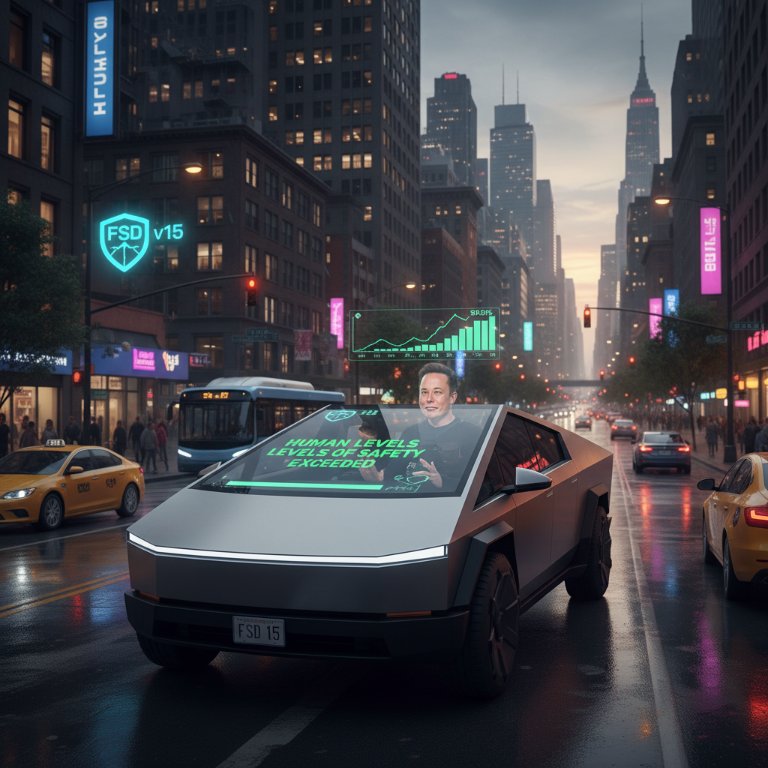
Elon Musk has once again ignited the autonomous driving debate, boldly declaring that the forthcoming Full Self-Driving (FSD) software, Version 15, will 'far exceed human levels of safety, even in completely unsupervised and complex situations.' This pronouncement, delivered in response to user feedback on the current FSD v14.3, carries the weight of immense expectation – and a fair degree of historical skepticism from the industry and consumers alike. After years of incremental updates and ambitious timelines, the EV world is left to ponder: is FSD v15 truly the breakthrough Tesla has long promised, or just another chapter in a familiar narrative of hyper-optimistic projections?
This latest claim follows a well-trodden path. Similar assurances were made for FSD Version 12 in 2023 and Version 14 in 2025, neither of which ultimately delivered on the promise of fully unsupervised autonomy. While Tesla has undeniably pushed the boundaries of advanced driver-assistance systems (ADAS), the leap to true Level 4 or Level 5 self-driving – where a vehicle can operate entirely without human intervention under specific or all conditions – remains an elusive goal for every player in the automotive sector.
The Lofty Ambition of FSD v15
Musk's statement for FSD v15 is uncompromising in its ambition, directly addressing the core challenge of autonomous vehicles: safety and reliability in the most unpredictable environments. The phrase 'far exceed human levels of safety' implies a significant reduction in accident rates compared to human drivers, a benchmark that, if achieved, would revolutionize transportation. Specifically, the commitment to performance in 'completely unsupervised and complex situations' aims at scenarios where human judgment is typically considered indispensable, such as navigating construction zones, adverse weather, or unpredictable pedestrian behavior. These are precisely the scenarios that have historically proven to be the most formidable hurdles for AI-driven systems.
A History of Unmet Milestones
The seasoned EV enthusiast understands that Tesla's FSD journey has been characterized by both groundbreaking innovation and persistent delays. When FSD v12 was announced in 2023, it too was heralded as a major step towards Level 5 autonomy, promising a comprehensive rewrite of the software stack. Version 14, in 2025, continued this narrative, with expectations set for a significant reduction in the need for human intervention. Yet, neither version fully achieved the 'unsupervised' capability that Musk now reiterates for v15. This pattern has led to a segment of the FSD subscriber base growing weary, questioning the timeline and the ultimate capability of the software to live up to its marketing. The persistent need for human oversight and the 'beta' label have tempered enthusiasm, despite continuous improvements.
Why This Matters:
This latest FSD v15 announcement is more than just another software update; it's a critical inflection point for Tesla and the wider autonomous driving industry. If FSD v15 genuinely delivers on Musk's 'far exceed human levels of safety' claim in unsupervised conditions, Tesla stands to gain an unparalleled advantage. It would cement its technological leadership, attract a massive new wave of subscribers, and potentially redefine urban mobility. The company's valuation would undoubtedly soar, validating years of R&D and billions invested. For competitors like Waymo, Cruise, and traditional automakers pouring resources into autonomy, a successful FSD v15 would demand a reassessment of their own strategies and timelines.
Conversely, another missed target for FSD v15 carries significant risks. Tesla's credibility, already under scrutiny due to past unfulfilled promises, would take a substantial hit. This could translate into reduced FSD subscriptions, increased regulatory pressure, and potential legal challenges regarding the 'Full Self-Driving' moniker. Competitors, while perhaps lagging in raw ADAS capabilities, could capitalize on the perception of Tesla's over-promising, highlighting their more cautious, safety-first approaches. This isn't a 'do-or-die' moment for Tesla as a whole, but it is unequivocally a defining moment for the future trajectory and public perception of its FSD program, signaling whether it can truly transition from advanced assistance to genuine autonomy.
The automotive world, and particularly the fervent EV community, awaits with a mix of anticipation and skepticism. The promise of FSD v15 is monumental, but the path to fully unsupervised autonomy is fraught with technical and ethical complexities. Tesla has once again set an incredibly high bar. The coming months will reveal whether FSD v15 finally clears it, or if it further solidifies the perception of autonomous driving as a perpetually just-out-of-reach dream.