Tesla's Groundbreaking Glass Roof Patent: A Cooler, More Efficient Future for EVs
Tesla, a pioneer in automotive innovation, has once again filed a patent that promises to redefine cabin comfort and energy efficiency in its electric...
Editorial Team
World Of EV
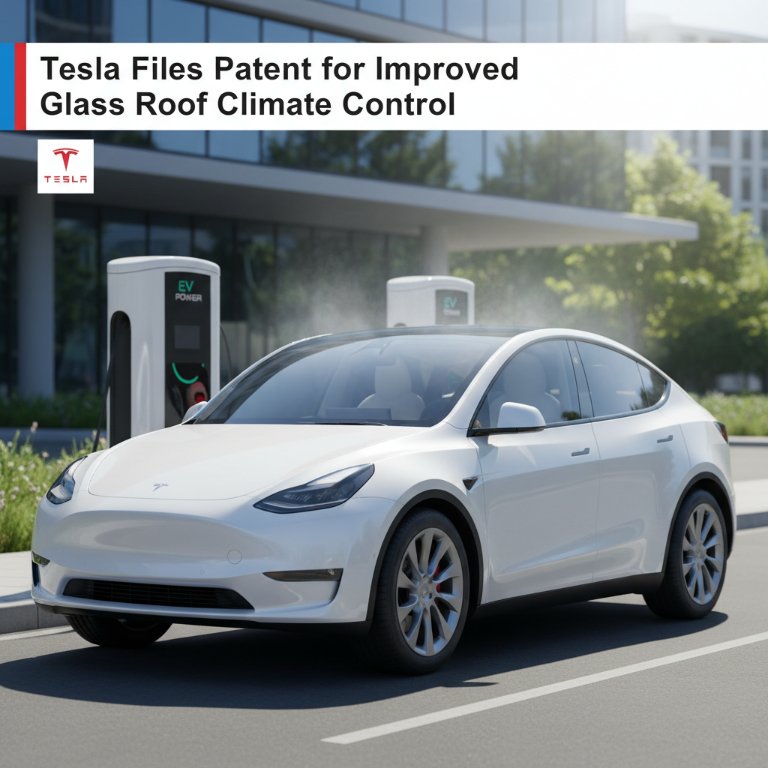
Tesla, a pioneer in automotive innovation, has once again filed a patent that promises to redefine cabin comfort and energy efficiency in its electric vehicles. The new intellectual property outlines an ingenious improvement to its signature glass roofs, focusing on actively extracting heat at its source rather than merely mitigating its effects. This move is poised to significantly reduce energy consumption and elevate the overall efficiency of Tesla's acclaimed EVs.
For years, panoramic glass roofs have been a hallmark of Tesla's design aesthetic, offering an unparalleled sense of openness and luxury. However, this design choice has historically presented a dual challenge: increased solar heat gain, particularly in warmer climates, and the subsequent burden on the vehicle's HVAC system. This often translated into higher energy consumption and, by extension, a subtle but measurable reduction in real-world range. While Tesla has employed various forms of UV and infrared coatings to good effect, this new patent signals a more proactive and sophisticated approach to thermal management.
What This New Patent Entails
This isn't about thicker tinting or more reflective coatings; it's a fundamental shift in how a vehicle's interior interacts with solar radiation. Tesla's new patent details a system designed to:
- Actively Extract Heat: Instead of simply deflecting or absorbing heat, the system aims to draw heat away from the cabin directly at the roof's surface. While specific mechanisms aren't fully public, this could involve micro-convection systems, thermoelectric coolers, or even advanced liquid cooling integrated within the glass layers.
- Targeted Thermal Management: The innovation is geared towards identifying and removing heat where it enters the cabin, before it can significantly raise the interior temperature. This precision dramatically reduces the workload on the conventional air conditioning system.
- Energy Consumption Reduction: By pre-emptively managing heat ingress, the vehicle's HVAC system won't need to work as hard or as long, leading directly to lower energy demands from the battery pack. This translates into improved efficiency and, critically, extended driving range for the end-user.
Beyond Simple Tinting: A Deeper Dive into Thermal Management
Tesla’s prior efforts with multi-layer glass and advanced coatings were commendable, providing a superior experience compared to traditional sunroofs. However, those methods are inherently passive. They attempt to slow down heat transfer. This new patent suggests an active, dynamic system, akin to the difference between insulating a house and installing an efficient air conditioning system that works to remove heat. This proactive approach differentiates it significantly from competitors who primarily rely on static solutions or simply avoid large glass panels due to thermal challenges. It highlights Tesla's commitment to pushing the boundaries of automotive engineering, even in seemingly minor comfort features, to achieve tangible performance benefits.
Why This Matters:
This patent isn't just a technical footnote; it carries significant implications for the EV market and for Tesla’s competitive standing.
- Consumers Win: Owners, particularly those in sun-drenched regions, will experience a noticeable improvement in cabin comfort. No more scorching seats or oppressive interior temperatures after parking in the sun. More importantly, the efficiency gains translate directly into more range, alleviating a key concern for all EV buyers. This enhances the appeal of Tesla vehicles, especially those with expansive glass roofs like the Model 3, Model Y, and Cybertruck.
- Tesla's Innovation Edge: This patent reinforces Tesla's reputation as a relentless innovator. While many legacy automakers are still catching up on fundamental EV platforms, Tesla continues to refine and optimize every aspect of the EV experience. This proactive thermal management system for glass roofs could become a new industry benchmark, forcing competitors to invest heavily in similar solutions if they wish to offer similar aesthetic appeal without compromising on efficiency.
- Setting New Standards: Expect this technology, or variations of it, to become a talking point in the industry. It signals that even seemingly mature features like panoramic roofs still have room for significant, efficiency-driven innovation. This is not a 'do-or-die' moment for Tesla, but rather a move that solidifies its leadership in integrated EV design and pushes the envelope for what constitutes a 'premium' EV experience.
In conclusion, Tesla's latest patent filing isn't merely an incremental upgrade; it represents a thoughtful and strategic approach to enhancing both user comfort and vehicle efficiency. By tackling heat gain at its source, Tesla is once again demonstrating its engineering prowess and setting a new benchmark for how electric vehicles can deliver a superior, more sustainable driving experience. This innovation ensures that the futuristic aesthetic of a glass roof comes with undeniable practical benefits, solidifying Tesla’s vision for a cooler, more efficient EV future.