Tesla's Latest Model Y Recall: Missing Labels Spark Renewed Quality Control Concerns
Tesla, the undisputed leader in electric vehicle innovation and market penetration, faces a significant new challenge with the recall of 14,575 Model ...
Editorial Team
World Of EV
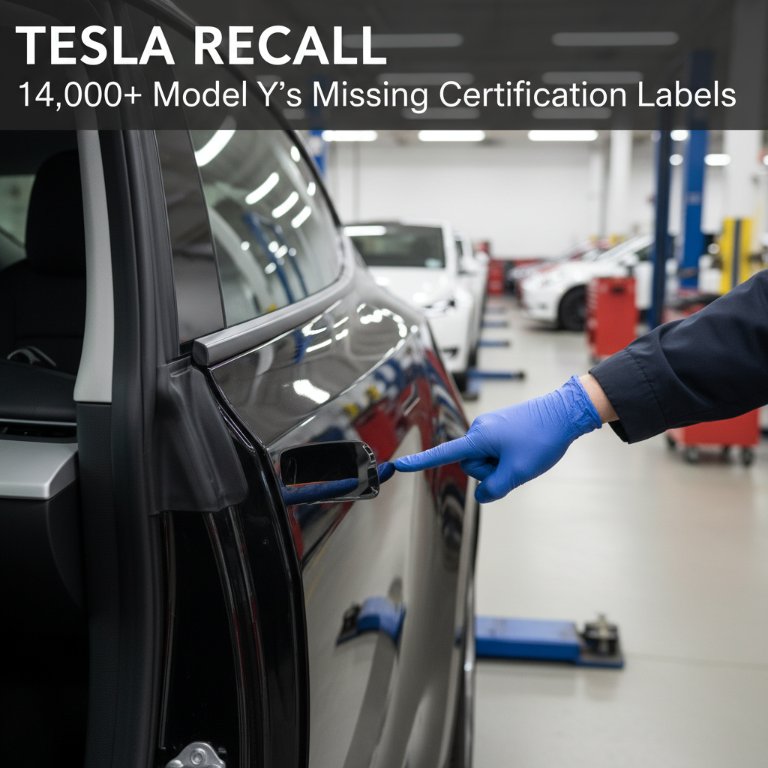
Tesla, the undisputed leader in electric vehicle innovation and market penetration, faces a significant new challenge with the recall of 14,575 Model Y vehicles. The National Highway Traffic Safety Administration (NHTSA) has issued a recall notice for Model Ys manufactured between November 2025 and April 2026, citing a crucial oversight: a potential missing weight certification label. While seemingly minor, this physical omission carries substantial safety implications, raising questions about Tesla's manufacturing consistency as it continues its aggressive production ramp.
This isn't merely a software glitch that an over-the-air update can resolve; it requires physical intervention at service centers. For a brand that has largely built its reputation on cutting-edge technology and seamless digital solutions, a fundamental manufacturing error like a missing mandatory safety label highlights a persistent Achilles' heel in its production processes. Prospective buyers and industry observers are once again scrutinizing Tesla's commitment to meticulous build quality alongside its pursuit of rapid expansion.
The Recall's Critical Details
The recall specifically targets 14,575 Model Y SUVs produced at Tesla's Fremont factory between November 17, 2025, and April 21, 2026. The core issue revolves around the absence of a weight certification label, typically affixed to the inside of the driver's side door. This label provides essential information including the vehicle's maximum loaded weight and critical tire specifications.
- Affected Vehicles: 14,575 Model Ys (manufactured Nov 17, 2025 – Apr 21, 2026).
- Root Cause: An automated vision-scanning tool, responsible for verifying the label's presence during production, performed inconsistently during this period.
- Estimated Impact: Tesla estimates approximately 45% of the affected vehicles may be missing this vital label.
- Remedy: Owners must bring their vehicles to a Tesla service center for a physical inspection and, if necessary, the affixing of a new label. This cannot be resolved via a software update.
- Owner Notification: Recall notices are scheduled to be mailed to owners starting July 17.
The Safety Imperative
Federal regulations mandate these weight certification labels because they are fundamental to safe vehicle operation. Without this clear information, owners risk inadvertently overloading their vehicles. An overloaded vehicle compromises critical safety systems, leading to:
- Reduced maneuverability.
- Increased braking distances.
- Higher risk of tire blowouts.
- Undue strain on the powertrain and suspension components.
The NHTSA explicitly warns that such conditions significantly elevate the risk of a crash. While Tesla reports no field incidents, crashes, or injuries related to this specific missing label issue to date, the potential for serious harm underscores the seriousness of this recall. It highlights the importance of regulatory oversight in upholding basic safety standards, even for seemingly small components like a sticker.
Why This Matters:
This latest Model Y recall, though ostensibly minor in its physical manifestation, carries substantial weight for Tesla's reputation, its customers, and the broader EV industry.
For Tesla's Brand and Quality Control: This incident serves as a stark reminder of Tesla's recurring struggles with manufacturing consistency. The company has faced criticism for panel gaps, paint issues, and other build quality concerns over the years, often attributed to aggressive production targets. While Tesla has become adept at resolving software-related recalls with swift over-the-air updates, a physical manufacturing flaw requiring hands-on service center visits is a different beast entirely. It indicates a failure in fundamental quality gates at its Fremont factory, where an automated system designed to prevent such errors malfunctioned for months. This isn't their first rodeo with missing labels either; a similar, albeit smaller, recall for the Model 3 occurred in 2019. The persistent nature of these issues could erode consumer trust, particularly as competition in the EV market intensifies and rivals like Hyundai, Kia, and traditional automakers like Ford enhance their build quality.
For Owners and Prospective Buyers: The immediate impact is the inconvenience of a mandatory service center visit for potentially tens of thousands of owners. While no incidents have been reported, the underlying safety risk of an overloaded vehicle is real and could be significant for those who frequently push their vehicle's carrying capacity. This recall emphasizes that even from a premium brand, due diligence on vehicle specifications and adherence to safety guidelines remains paramount. It’s a call to awareness that a flashy EV doesn't negate the need for basic physical safety checks.
For the EV Industry: Tesla's manufacturing challenges are a microcosm of the hurdles facing all automakers scaling EV production. The complexity of integrating advanced technology with high-volume manufacturing often reveals unexpected weak points. This recall underscores the critical role of robust quality control systems and the necessity for both automated and human verification throughout the assembly process. It serves as a lesson for emerging EV manufacturers that foundational quality cannot be compromised in the race to market.
Conclusion
Tesla's recall of nearly 15,000 Model Ys for missing weight certification labels is more than a trivial administrative fix; it's a critical safety issue and a blip on the radar for a company often scrutinized for its manufacturing prowess. While the fix is straightforward for owners, the underlying cause—a malfunctioning automated inspection tool and a lapse in oversight—reinforces the perception of ongoing quality control challenges at Tesla. As the EV market matures, sustained excellence in both software and hardware will be non-negotiable for maintaining leadership. Tesla must demonstrate it can consistently deliver not just innovative vehicles, but also impeccably built ones, to retain the confidence of its discerning customer base and the broader industry.