Tesla's Next FSD Leap: Why Your Car Will Finally Learn to Drive Exactly Like You
Tesla’s Full Self-Driving (Supervised) is preparing for its most significant behavioral evolution yet. Tesla CEO Elon Musk recently confirmed that upc...
Editorial Team
World Of EV
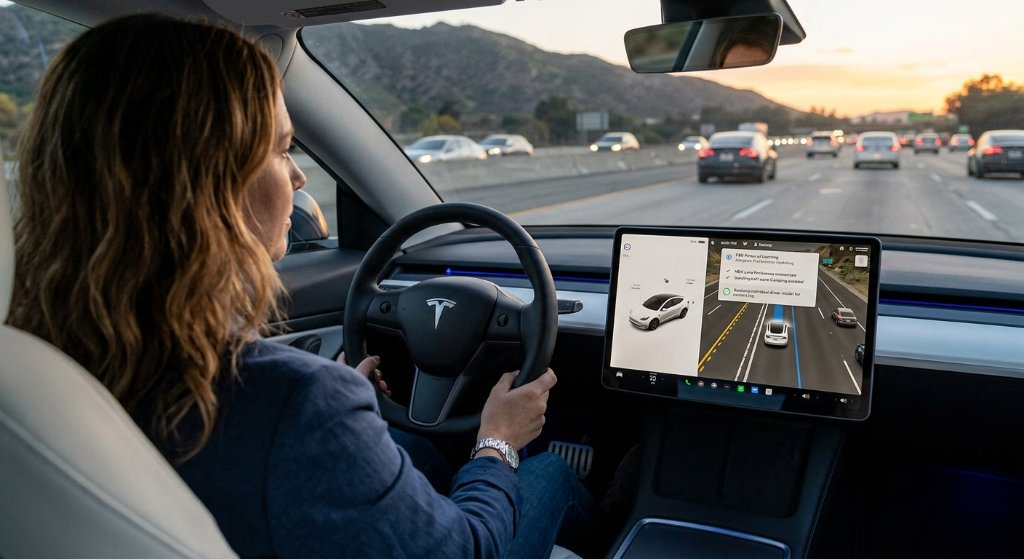
Tesla’s Full Self-Driving (Supervised) is preparing for its most significant behavioral evolution yet. Tesla CEO Elon Musk recently confirmed that upcoming iterations of the FSD software will abandon the rigid, "one-size-fits-all" robotic approach in favor of a highly personalized system that actively learns from individual driver overrides. By shifting from a standardized fleet-wide driving logic to an adaptive, localized model, Tesla is addressing one of the most persistent bottlenecks in the hands-free driving experience: the frustration of repetitive, non-critical interventions.
This development represents a critical leap forward for an autonomous platform that has historically wiped its memory clean after every single trip. While Tesla's transition to "end-to-end" deep learning neural networks (which replaced hundreds of thousands of lines of hardcoded C++ with raw video-trained AI models) dramatically improved the system's human-like driving dynamics, it also highlighted a glaring flaw. FSD has remained incapable of remembering individual preferences, forcing drivers to manually override the exact same annoying—though technically safe—maneuvers day after day, such as exiting a carpool lane too early or parking in the wrong spot.
From Generalized AI to Hyper-Local Memory
Right now, FSD operates on a generalized, averaged model of "good" driving data collected from millions of Tesla vehicles. However, actual human driving is deeply personal and highly regional. Under the new architecture, the vehicle will log your manual interventions and adjust its future path planning accordingly. Rather than ignoring your corrections, the vehicle will recognize them as a blueprint for how you expect to be driven.
Key personalization features rolling out in upcoming releases include:
- Express & HOV Lane Retention: The system will learn to stay in high-occupancy vehicle (HOV) and express lanes per your daily preference, ending the frustrating behavior of prematurely merging back into congested standard lanes.
- Eliminating Left-Lane Camping: If you frequently nudge the car out of the passing lane to let others by, FSD will learn to proactively yield the fast lane based on your style.
- Tailored Parking Choices: The vehicle will memorize your preferred parking orientation (such as backing in versus pulling nose-first into a space).
- Hyper-Local Spot Mapping: FSD will recognize your specific driveway, preferred corporate parking spot, or school drop-off lane, rather than aiming for a generic, GPS-adjacent curb.
Why This Matters:
This is a pivotal milestone in the race for autonomous dominance. For years, the industry has evaluated self-driving systems on a binary scale: "Does it crash, or does it get to the destination?" But as FSD achieves greater safety reliability, the battleground is shifting from baseline safety to driver comfort.
The Winner: The Tesla owner. A massive portion of daily "interventions" are not triggered by impending collisions, but by sheer annoyance. When a car repeatedly makes a move you dislike, it induces cognitive fatigue. By turning every manual override into a localized training session, Tesla will dramatically lower "preference-based" disengagements, making the software feel genuinely premium.
The Loser: Geofenced robotaxis and rigid legacy ADAS. Competitors like Waymo rely on highly expensive, centimeter-accurate high-definition maps that struggle to adapt to localized personal whims, while legacy automakers' Level 2 and Level 3 systems (like GM's Super Cruise or Ford's BlueCruise) are built on pre-programmed heuristics that cannot learn from the driver. Tesla’s ability to run localized edge-learning on its proprietary AI hardware gives it a distinct advantage.
The Catch: This update also places a new responsibility on the driver. Because the system will actively mirror your manual corrections, sloppy, erratic, or overly aggressive interventions could bake poor driving habits directly into your vehicle's local neural profile. Drivers will need to be highly deliberate with their takeovers, knowing that the car is constantly taking notes.
Looking Ahead
By bridging the gap between cold machine logic and highly subjective human behavior, Tesla is redefining what "autopilot" actually means. FSD is evolving from a robotic chauffeur into a digital reflection of your own driving habits. While Tesla has not yet provided a hard release date for the localized learning update, the shift signals a future where your car doesn't just drive—it drives exactly like you.