Tesla's Q1 Delivery Miss Signals Deeper Market Correction, Leaves 50,000 Vehicles Unsold
Tesla, the undisputed titan of electric vehicles, has delivered a sobering first-quarter report for 2026, revealing a significant shortfall in deliver...
Editorial Team
World Of EV
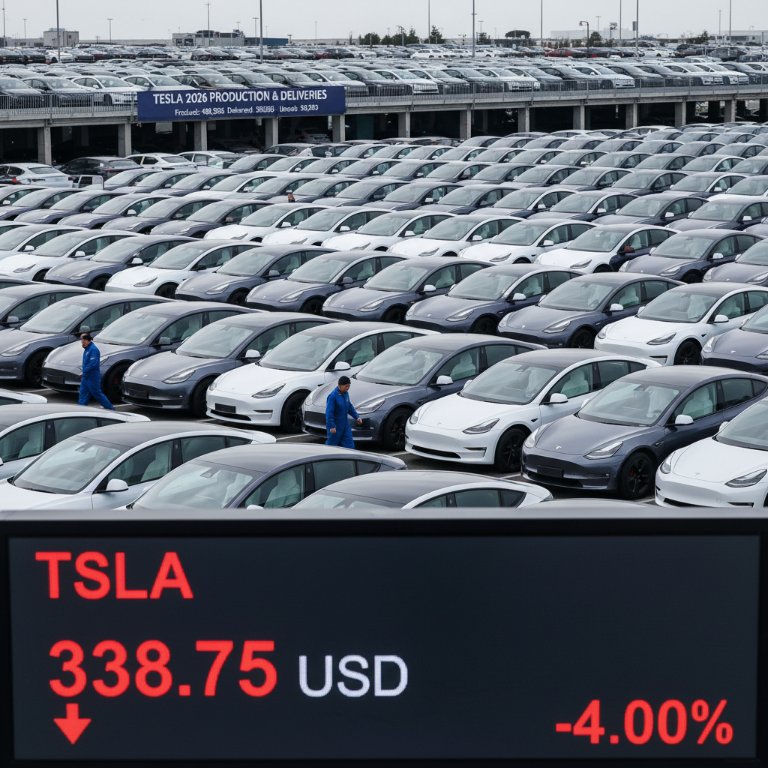
Tesla, the undisputed titan of electric vehicles, has delivered a sobering first-quarter report for 2026, revealing a significant shortfall in deliveries against production and a growing inventory of unsold cars. The company reported 358,023 deliveries, falling notably short of both its impressive production figure of 408,386 vehicles and Wall Street's consensus estimate of 365,000 units. This delta translates to approximately 50,357 vehicles that rolled off the production line but remain undelivered, a stark indicator of shifting market dynamics. The news sent a chill through investors, with Tesla's stock (TSLA) shedding 4% and dropping below the $339 per share mark, fueled by a confluence of concerns ranging from broader EV demand anxieties to the delivery miss itself and lingering uncertainty around a potential SpaceX IPO.
The Numbers Don't Lie: A Stark Reality Check
Tesla's Q1 performance paints a picture of a company facing undeniable headwinds. The nearly 50,000-unit gap between production and deliveries is not merely a statistical anomaly; it represents a significant build-up of inventory that demands immediate attention. For a company that has historically struggled to meet demand, this reversal signals a fundamental shift in the EV landscape. Analysts had already tempered their expectations amidst a global softening of EV demand, but even these revised forecasts proved optimistic against Tesla's actual delivery figures. This miss raises critical questions about Tesla’s pricing strategy, production cadence, and the true elasticity of consumer demand for its vehicles in an increasingly competitive market.
Beyond Vehicles: Energy Storage Falters
Compounding the challenges in its core automotive business, Tesla's energy storage division, often touted as a diversifying asset and a significant growth avenue, also experienced a setback. The segment saw a decline of approximately 15% compared to Q1 2025. This contraction is particularly concerning as the energy division, encompassing products like Powerwall and Megapack, has been a reliable performer, offering a buffer against the cyclical nature of vehicle sales. Its underperformance adds another layer of pressure on Tesla's overall financial health and future growth projections, especially when the automotive sector is also struggling.
A Confluence of Headwinds
The immediate market reaction, with TSLA stock dipping by 4%, underscores the gravity of these figures. The sell-off is not an isolated event but rather a response to several interconnected factors:
- Evolving EV Demand: The broader automotive industry is witnessing a recalibration of EV demand. While long-term growth remains positive, the explosive, seemingly insatiable demand of previous years has plateaued. Higher interest rates, economic uncertainties, and an influx of new, compelling models from legacy automakers and aggressive startups are giving consumers more choices and reason to pause.
- Delivery Miss Impact: A miss of this magnitude against Wall Street expectations invariably erodes investor confidence. It suggests that Tesla may be overproducing relative to current market appetite, a situation that typically leads to discounting, which can in turn squeeze profit margins.
- SpaceX IPO Uncertainty: The speculative nature and potential timing of a SpaceX initial public offering (IPO) add another layer of complexity. Investors often wonder about capital allocation and management focus when a CEO helms multiple high-profile ventures, especially if one of them is gearing up for a major financial event.
Why This Matters:
This quarter’s performance isn't just a blip; it's a critical inflection point for Tesla and a bellwether for the wider EV industry. The accumulation of over 50,000 unsold vehicles signals that Tesla's aggressive production strategy has, for now, outpaced actual consumer demand. This is a fundamental challenge for any automaker, and for Tesla, it means a potential pivot from a 'growth at all costs' mentality to a more disciplined approach focused on inventory management and potentially, more aggressive demand generation tactics.
Who Wins? In the immediate term, competitors like BYD, Hyundai, Kia, and even revitalized legacy players such as General Motors and Ford, which are steadily ramping up their EV offerings and often targeting different price points, could stand to gain. They might capitalize on Tesla's perceived vulnerability and the increasing inventory. Consumers, paradoxically, might also win in the short term, as increased inventory could precipitate price adjustments or incentives from Tesla to move units.
Who Loses? Tesla investors are feeling the pain, particularly those who banked on continued exponential growth. More significantly, the narrative of an 'unstoppable' Tesla, immune to market forces, is being challenged. This is a 'prove it' moment for Elon Musk and his team, requiring a robust response to re-align supply with demand without significantly eroding profit margins or brand prestige.
This quarter signals a maturation of the EV market, where rapid sales growth is no longer a given. It forces a re-evaluation of valuation multiples for EV pure-plays and underscores the importance of a diverse product portfolio and a flexible production strategy. For Tesla, this is a strategic crossroad; the decisions made in the coming quarters will determine its trajectory in an increasingly competitive and demanding EV landscape.
Conclusion:
Tesla's Q1 2026 results undeniably mark a challenging period, highlighting significant headwinds in both vehicle deliveries and its energy storage business. The substantial inventory build-up mandates a careful reassessment of production targets and market strategies. As the EV market continues to evolve, Tesla's ability to adapt to tempered demand, manage its inventory effectively, and invigorate its growth engines will be under intense scrutiny. The upcoming earnings call will be crucial for investors and analysts seeking clarity on the company's path forward in a more competitive and demand-constrained environment.