Tesla’s Quiet Financing Rate Hike Signals the End of the "Almost Free Money" EV Era
In the hyper-competitive EV landscape, promotional financing is the ultimate sleight of hand. It allows automakers to drive massive sales volume witho...
Editorial Team
World Of EV
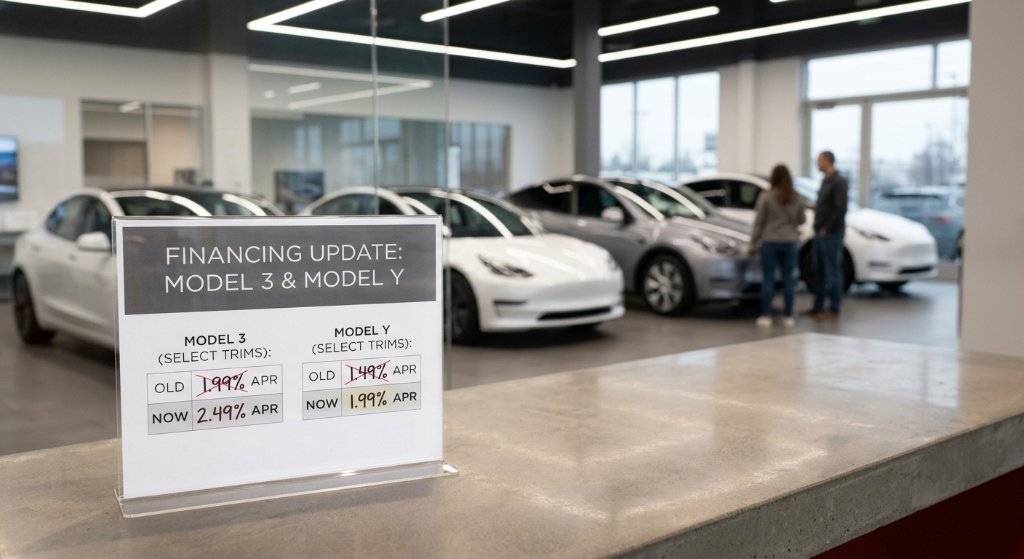
In the hyper-competitive EV landscape, promotional financing is the ultimate sleight of hand. It allows automakers to drive massive sales volume without officially slashing MSRPs—a tactic Tesla has heavily relied upon throughout 2026 to keep its delivery figures afloat. However, just days before its latest round of low-interest incentives was set to expire on September 30, the Texas-based automaker quietly raised promotional interest rates by 50 basis points on select Model 3 and Model Y trims in the United States.
This subtle yet highly strategic pivot signals the beginning of the end for Tesla’s ultra-aggressive, margin-eroding financing schemes. While the company spent the better part of 2023 and 2024 chopping retail prices—sparking an industry-wide price war that decimated its own margins and crushed competitors' residual values—it transitioned to subvented financing in 2026 to stabilize vehicle valuations. This latest rate hike is the clearest sign yet that Tesla is prioritizing profitability over raw delivery numbers as we head into the final stretch of the year.
The New Numbers: What Buyers Will Pay Now
The update, which rolled out quietly, adjusts interest rates across Tesla's most popular mass-market configurations. While the high-performance variants remain unaffected for now, the trims that drive the vast majority of Tesla's volume are getting a little more expensive to finance:
- Model 3 Premium (RWD & AWD): Climbs from 1.99% to 2.49% APR (+50 bps).
- Model Y (Base RWD & AWD): Rises from 1.49% to 1.99% APR (+50 bps).
- Model Y Premium (RWD & AWD): Rises from 1.49% to 1.99% APR (+50 bps).
For prospective buyers, this translates to a narrower window of opportunity and a slight bump in monthly payments. On a typical 72-month loan for a $45,000 Model Y, a 50-basis-point increase adds roughly $12 per month. While that sounds negligible, it adds nearly $900 in additional interest over the life of the loan—real money that might make on-the-fence buyers think twice.
Gently Turning the Demand Dial
To understand where Tesla is heading, we must look at how we got here. Tesla has spent the entirety of 2026 gradually dialing back its interest-rate subsidies. Earlier in the year, the automaker tempted buyers with headline-grabbing 0% APR promotions on the Model Y and highly attractive 0.99% APR financing on the Model 3. But as the market stabilized, Tesla began stepping its rates back up—first to 1.49% for the Model Y in early September, and now to 1.99%.
This methodical phase-out demonstrates a highly coordinated effort to test the limits of consumer demand. Rather than abruptly ending promotions and risking a sharp drop-off in order volumes, Tesla is gently turning the dial. This allows the company to squeeze more margin out of each delivery while still keeping rates comfortably below the typical 5% to 7% bank rates offered by traditional lenders.
Why This Matters:
This is a pivotal moment for Tesla's balance sheet and the broader EV sector, carrying major implications for everyone involved:
- The Margins Win, Deliveries May Suffer: By stepping away from ultra-low subvented loans, Tesla is actively choosing to protect its gross margins. Subsidizing a car loan down to 1.49% or 0.99% is incredibly expensive, often costing the manufacturer thousands of dollars per vehicle in back-end payments to bank partners. Phasing this out will give Tesla's financials a welcome cushion, even if it cools down delivery growth in the short term.
- A Calculated Bet on Organic Demand: Wall Street has been increasingly critical of Tesla's profitability, urging the company to move away from margin-diluting promotions. This rate hike is a calculated bet that the brand has built enough organic momentum—partially fueled by the recently refreshed Model 3 and anticipation for the upcoming Model Y "Juniper" refresh—to sustain sales without relying heavily on "free money" gimmicks.
- Breathing Room for Competitors: For legacy automakers like Ford, GM, and Hyundai—who have struggled to match Tesla's aggressive pricing moves—this retreat is a gift. As Tesla raises the cost of entry, competitors get a rare window of opportunity to pitch their own competitive finance offers and make their priced-to-market EVs look more attractive.
- The Buyer's Loss: The clear loser here is the everyday consumer. The golden window of near-zero financing is rapidly closing. While a 1.99% or 2.49% APR is still vastly superior to traditional market rates, it indicates that the sweet deals of 2026 are officially in the rearview mirror.
Tesla’s quiet rate adjustment is more than a simple clerical update; it is a tactical retreat from the costly incentive war. As the EV leader prepares to close out the year, it is shifting its focus from raw volume expansion to sustainable profitability. Whether consumers will continue to flock to the configurator without the promise of rock-bottom interest rates remains to be seen, but one thing is certain: the era of the "almost free" Tesla loan is drawing to a close.