Tesla's Robotaxi Ambition Accelerates: Cybercabs Descend on Dallas, Paving the Way for Commercial Autonomy
The long-anticipated future of autonomous mobility is no longer a distant promise; it's actively unfolding on the streets of Dallas. Recent observatio...
Editorial Team
World Of EV
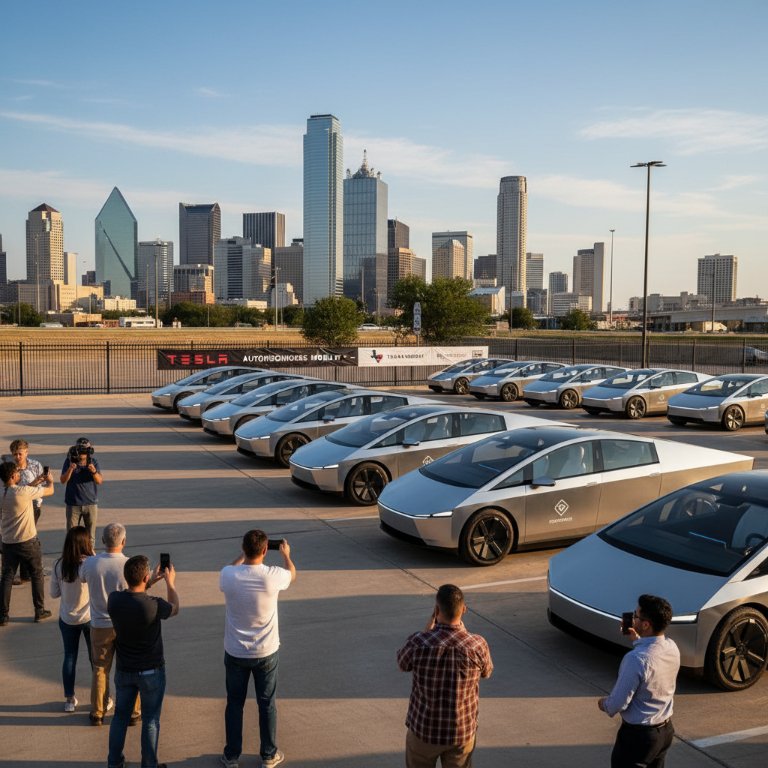
The long-anticipated future of autonomous mobility is no longer a distant promise; it's actively unfolding on the streets of Dallas. Recent observations confirm a burgeoning fleet of Tesla Cybercabs operating within the city, signaling a significant and accelerated progression towards Tesla’s ambitious vision of a widespread commercial Robotaxi network. This pivotal development aligns perfectly with Texas’s forward-thinking legislative stance, specifically Senate Bill 2807, which legalizes fully driverless commercial autonomous vehicles across the state.
For years, Tesla CEO Elon Musk has championed the advent of a Robotaxi service, a concept that has often been met with a mix of excitement and skepticism. From ambitious timelines set years ago to the iterative, often controversial, development of its Full Self-Driving (FSD) software, the journey has been anything but smooth. Now, with dedicated Cybercab units reportedly traversing Dallas, the narrative shifts from theoretical potential to tangible deployment. This isn’t merely FSD beta testing; it represents the early stages of a commercial operation, leveraging the unique platform of the Cybertruck and hinting at a dedicated Robotaxi design on the horizon.
Dallas Becomes Ground Zero for Driverless Deployment
The sightings in Dallas are more than just a curiosity; they represent a crucial operational expansion. Unlike previous FSD testing phases that primarily involved private vehicle owners, these Cybercabs appear to be part of a managed fleet, indicating a structured approach to commercial service deployment. This move allows Tesla to gather extensive real-world data in a controlled yet commercially relevant environment, refining its autonomous stack for scale. The choice of Dallas is strategic, offering diverse urban and suburban driving conditions, ideal for stress-testing the system's robustness and reliability.
Texas Legislation Unlocks Commercial Autonomy
The rapid expansion of the Cybercab fleet in Texas is directly facilitated by the state's progressive regulatory framework. Texas Senate Bill 2807 stands as a landmark piece of legislation, explicitly legalizing the operation of fully driverless commercial autonomous vehicles. This legislative clarity is a game-changer, removing significant hurdles that have plagued autonomous vehicle deployment in other states and offering a clear path for companies like Tesla to launch and scale their services. It signals a governmental embrace of future mobility solutions, positioning Texas as a crucial hub for AV innovation and deployment.
Why This Matters:
This isn't just another news item about Tesla; it's a foundational moment for the entire autonomous vehicle industry and a critical juncture for Tesla's long-term strategy. The deployment of Cybercabs in Dallas under the umbrella of permissive state legislation carries immense implications:
- Validation of Tesla's FSD Ambition: After years of development and significant investment, this marks a tangible step towards monetizing FSD beyond a software upgrade. Success here could fundamentally validate Tesla's entire AI-centric approach to autonomy, proving that their vision can translate into a revenue-generating service.
- A New Revenue Stream for Tesla: A commercial Robotaxi network opens up a massive new market for Tesla, potentially transforming it from primarily an automotive manufacturer to a diversified mobility service provider. This could provide a significant boost to its valuation and unlock unprecedented financial growth.
- Intensified Competition in Mobility: This move puts immense pressure on traditional ride-sharing giants like Uber and Lyft, as well as other AV developers (e.g., Waymo, Cruise). While others have their own pilot programs, Tesla’s ability to leverage its massive vehicle production and integrated software/hardware stack could allow for rapid scaling if the Dallas deployment proves successful.
- Texas as an AV Frontier: The synergy between Tesla’s deployment and Texas’s progressive laws positions the state as a leading jurisdiction for autonomous innovation. This could attract further investment and talent, cementing its role as a hotbed for future mobility.
- Impact on Urban Planning and Infrastructure: A successful Robotaxi network promises reduced traffic congestion, lower parking demands, and potentially more efficient urban transportation systems. Cities like Dallas, embracing these early deployments, will be at the forefront of shaping future smart city initiatives.
Tesla's accelerated Cybercab deployment in Dallas, backed by supportive Texas legislation, represents a critical pivot point in the race for commercial autonomous mobility. It transforms a long-held promise into a burgeoning reality, setting the stage for what could be a profound disruption across the transportation sector. The eyes of the industry are now firmly fixed on the Lone Star State, watching closely to see if Dallas truly becomes the blueprint for the Robotaxi revolution.