Tesla's Robotaxi Ambitions Face Harsh Reality Check in Texas: Waymo Dominates with 13x Larger Fleet
A newly enacted Texas law, effective May 28, 2026, has pulled back the curtain on the state's autonomous vehicle landscape, revealing a stark contrast...
Editorial Team
World Of EV
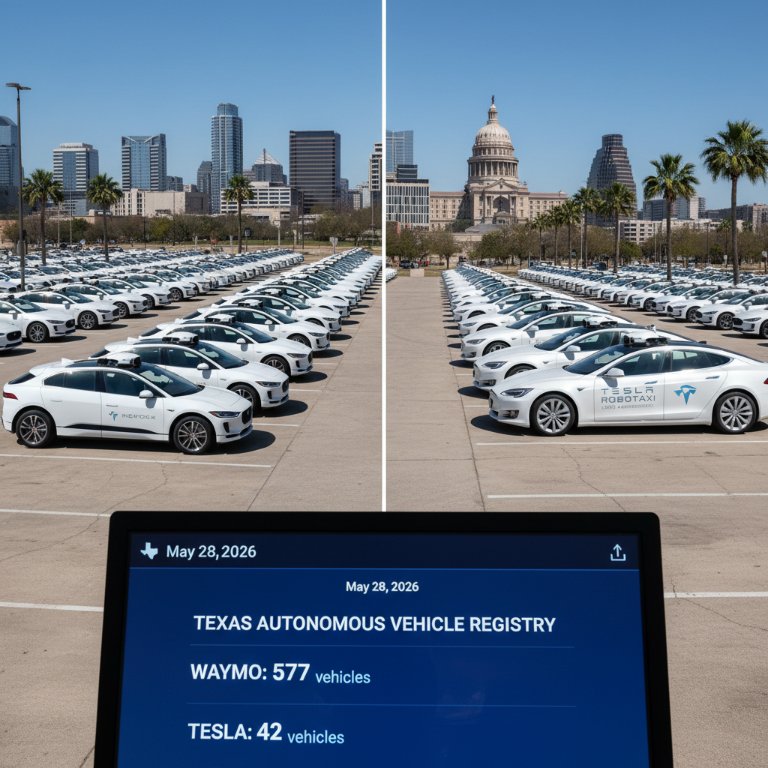
A newly enacted Texas law, effective May 28, 2026, has pulled back the curtain on the state's autonomous vehicle landscape, revealing a stark contrast in robotaxi deployment that casts a critical light on Tesla's long-touted self-driving ambitions. New data from the Texas Department of Motor Vehicles (TxDMV) shows that Tesla has authorized a mere 42 robotaxis for driverless ride-hailing in the state, a figure dwarfed by competitor Waymo's commanding fleet of 577 vehicles. This revelation, made possible by increased regulatory transparency, forces a re-evaluation of Tesla's strategy and capabilities in the fiercely competitive autonomous driving sector.
This immediate comparison highlights not just a numerical disparity but a fundamental difference in approach and maturity. While Waymo has methodically expanded its commercial robotaxi services across Austin, Dallas, Houston, and San Antonio, Tesla's presence appears limited, despite its robotaxi service operating in Austin since June 2025. The data arrives as Tesla's CEO, Elon Musk, has continuously presented an aggressive vision for robotaxis, though actual deployments have lagged significantly behind ambitious timelines.
The Texas Transparency Mandate
The new Texas law, Senate Bill 2807, which became enforceable on May 28, 2026, ushers in a new era of accountability for autonomous vehicle (AV) operators. This legislation mandates that companies providing commercial self-driving services obtain state authorization from the TxDMV and publicly register their fleets, along with providing safety-related disclosures. The law's requirements include:
- Compliance with all applicable Texas traffic and motor vehicle laws.
- Equipping vehicles with a required recording device.
- Utilizing an automated driving system compliant with federal law.
- Ability to achieve a minimal risk condition in the event of system failure.
- Proper titling and registration.
- Maintaining required motor vehicle insurance.
This framework aims to establish statewide standards for safety, reporting, and compliance as AV technology proliferates across Texas.
Tesla's Fleet: A Stark Contrast
The TxDMV's new online database underscores the significant operational gap between Tesla and its rivals. Tesla's authorized fleet of 42 robotaxis pales in comparison to Waymo's 577 vehicles. This makes Tesla's operational presence less than one-tenth the size of Waymo's in the same state.
Furthermore, other significant players also demonstrate a more substantial deployment than Tesla:
- Avride: 317 vehicles
- Nuro: 47 vehicles
- Zoox (Amazon): 35 vehicles
This data point comes despite earlier claims by Elon Musk, who once projected 500 robotaxis in Austin by the end of 2025, a figure later revised down to 60. The actual number of 42 highlights a substantial shortfall against these ambitious targets.
Level 4: A New Regulatory Stance
Under the new Texas law, companies are required to self-certify their vehicles as Level 4 autonomous, meaning they can operate without a human driver within a defined operational design domain (ODD) and achieve a minimal risk condition if the system fails. Tesla has indeed self-certified its robotaxi software as Level 4 compliant for commercial operations in Texas.
This self-certification marks a critical shift for Tesla. For years, the company has predominantly classified its consumer Full Self-Driving (FSD) beta software as a Level 2 driver assistance system, explicitly requiring an attentive human driver. The distinction is crucial:
- SAE Level 2 (Partial Driving Automation): The vehicle controls both steering and acceleration/deceleration, but a human driver must constantly monitor the system and be ready to intervene.
- SAE Level 4 (High Driving Automation): The vehicle handles all driving tasks within specific conditions (the ODD) and does not require human intervention.
Tesla's move to officially certify its commercial robotaxi fleet as Level 4 in Texas, while consumer FSD remains Level 2, signals a strategic decision to assume greater operational liability for these specific vehicles.
Safety Incidents and the Human Factor
The new database also brings into focus the operational safety of Tesla's robotaxi service. Between July 2025 and April 2026, Tesla's robotaxis in Austin experienced 17 known incidents, including two minor injuries and one requiring hospitalization. Crucially, all these incidents occurred while human safety supervisors were onboard the vehicles. Tesla had removed these human safety monitors in January 2026, adding another layer of complexity to the assessment of their Level 4 capabilities.
Why This Matters:
This Texas data dump represents far more than just fleet numbers; it's a critical stress test for Tesla's autonomous narrative and the broader AV industry. The gulf between Tesla's 42 robotaxis and Waymo's 577 in Texas is staggering, signaling that despite the hype, Tesla's operational robotaxi deployment is significantly trailing its most established competitor. This isn't just a matter of scale; it’s a credibility gap.
Tesla's decision to self-certify its robotaxis as Level 4 in Texas, contrasting with its long-standing classification of consumer FSD as Level 2, is a pivotal moment. While it allows for commercial operation, it also forces Tesla to take on substantial liability for its driverless systems within their specified operational design domain. This move might be a necessary regulatory hurdle cleared, but the small fleet size suggests either extreme caution or fundamental challenges in scaling the technology to true Level 4 robustness. For context, Waymo has long operated its vehicles at this threshold.
For savvy EV enthusiasts and prospective buyers, this data should temper expectations. The promise of ubiquitous Tesla robotaxis remains a distant reality when measured against actual deployment. The 17 incidents, even with human supervisors present, underscore the inherent complexities and ongoing safety challenges of achieving true autonomy. This raises questions about the readiness and reliability of the underlying FSD technology for unsupervised operation at scale, particularly given that Level 4 implies no human intervention is required within the ODD.
For industry professionals, Texas's new transparency mandate is a game-changer. It sets a precedent for increased regulatory scrutiny and public disclosure, which could accelerate the safe deployment of AVs by fostering greater accountability across the board. Waymo clearly emerges as the dominant player in Texas's commercial robotaxi market, demonstrating a more mature and scalable deployment strategy. This situation could be a do-or-die moment for Tesla to rapidly scale its operations and prove its Level 4 capabilities, or risk being definitively outpaced by rivals in the race for driverless mobility.
Texas has provided a crucial snapshot into the actual state of autonomous vehicle deployment, revealing a significant imbalance in operational scale and raising pertinent questions about the true readiness of Tesla's robotaxi ambitions. While Tesla has cleared a regulatory hurdle by self-certifying its small fleet as Level 4, the sheer disparity with Waymo’s established presence, coupled with past safety incidents, suggests a challenging road ahead for the EV giant in the commercial robotaxi market. The coming months will be critical in determining if Tesla can bridge this gap and translate its aspirational claims into widespread, safe, and reliable driverless service.