Tesla's Robotaxi Ambitions Hit a Wall: Austin Trial Reveals Glaring Shortcomings
For years, Tesla CEO Elon Musk has painted a vivid picture of a future where millions of Tesla robotaxis autonomously ferry passengers, transforming u...
Editorial Team
World Of EV
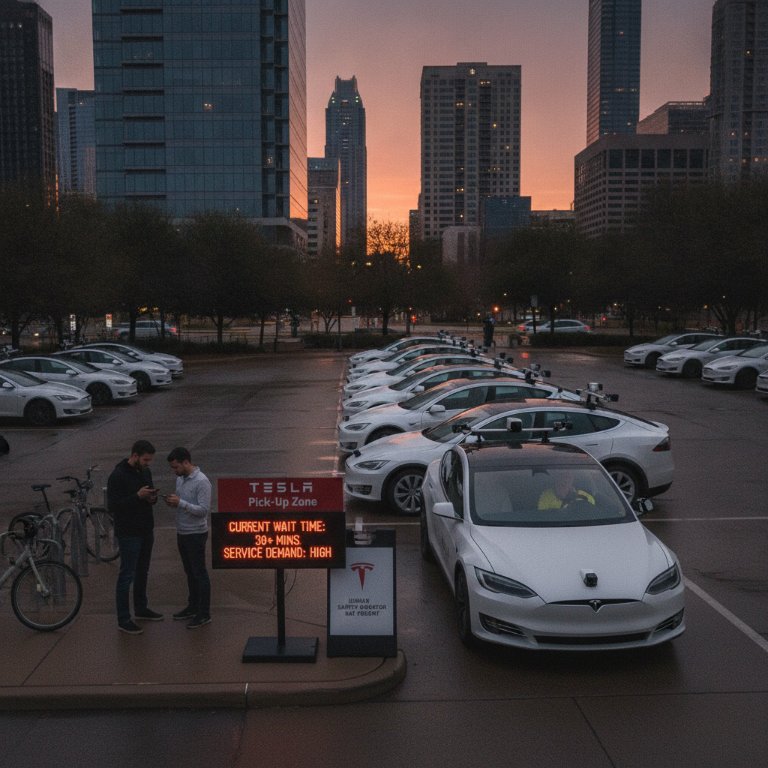
For years, Tesla CEO Elon Musk has painted a vivid picture of a future where millions of Tesla robotaxis autonomously ferry passengers, transforming urban mobility and becoming a significant revenue stream for the automaker. He famously predicted a million robotaxis by 2020, touting the lucrative potential of a fully autonomous ride-hailing network. However, the reality emerging from Tesla's current robotaxi pilot in Austin, Texas, is a stark contrast to these ambitious pronouncements, revealing a service plagued by significant operational hurdles.
The initial rollout, rather than demonstrating a revolutionary leap in autonomous technology, appears to be grappling with fundamental challenges that underscore the immense complexity of true self-driving deployment. This closely watched trial, meant to showcase Tesla's Full Self-Driving (FSD) capabilities in a commercial setting, is instead highlighting the persistent gap between lofty promises and practical execution.
The Reality on the Ground: Delays and Limited Access
Reports from Austin paint a less than optimistic picture of Tesla's robotaxi service. Users are encountering a range of issues that severely impact the user experience and the viability of the service as a practical alternative to traditional ride-hailing:
- Exorbitant Wait Times: Passengers frequently face wait times stretching up to 30 minutes, an eternity in the fast-paced world of on-demand transportation. Such delays render the service impractical for many potential users who expect near-instant availability.
- Frequent Unavailability: The service often experiences periods where ride bookings are simply unavailable, with the app citing 'high service demand'. This indicates a severe mismatch between perceived demand and operational capacity, or perhaps a cautious approach to deployment that limits concurrent rides.
- Continued Human Intervention: Despite the 'robotaxi' moniker, a significant number of rides still require the presence of human safety monitors. This critical detail undermines the notion of fully autonomous operation and points to ongoing limitations in the FSD system's ability to handle all scenarios independently.
A Fleet Far From Futuristic Scale
Perhaps the most telling indicator of Tesla's robotaxi struggle is the diminutive size of its operational fleet. Across three Texas cities – Austin, Dallas, and Houston – Tesla reportedly deploys a mere 59 vehicles for its robotaxi service. This is an incredibly modest number, especially when juxtaposed against Musk's earlier aspirations of millions of robotaxis on the road years ago.
This limited deployment suggests either a highly constrained operational capacity, a slow and cautious testing phase, or perhaps a tacit admission that the FSD technology is not yet robust enough for widespread, unsupervised commercial rollout. For a company that prides itself on rapid scaling, this slow burn raises significant questions about the timeline for genuine mass robotaxi adoption.
Why This Matters:
Tesla's robotaxi woes in Austin are far more than just teething problems; they represent a critical juncture for the company's autonomous driving narrative and have significant implications for the broader EV and AV industries.
Impact on Tesla's Valuation and FSD Narrative: For years, Tesla's valuation has incorporated a substantial premium based on the promise of future revenue streams from FSD and robotaxis. These reported shortcomings directly challenge that narrative. If the FSD system struggles to reliably operate in a relatively controlled environment like Austin's designated robotaxi zones, it casts serious doubt on its readiness for broader Level 4 or Level 5 autonomy. This could lead to a reassessment of Tesla's long-term growth prospects by investors who have eagerly anticipated the robotaxi dividend.
A Reality Check for Level 5 Autonomy: The persistent need for human safety monitors and the operational limitations reinforce a sobering reality: true Level 5 autonomy, where a vehicle can operate anywhere, anytime, without human intervention, remains a distant goal. This serves as a critical reality check for the entire autonomous vehicle industry, tempering some of the more hyperbolic predictions and underscoring the immense technical and regulatory hurdles that remain.
Opportunity for Competitors (and Traditional Ride-Hailing): While companies like Waymo and Cruise have faced their own recent setbacks, their approach, often involving geo-fenced operations with purpose-built or heavily modified vehicles, still appears to be making more measured, albeit slower, progress in commercial autonomous deployment. The struggles in Austin may give competitors an opening to highlight their more cautious, safety-first strategies. Furthermore, traditional ride-hailing services like Uber and Lyft, which rely on human drivers, continue to dominate the market due to their reliability and availability, further highlighting the chasm between current robotaxi performance and mainstream expectations.
Shifts in Consumer Perception: For prospective EV buyers and enthusiasts, the robotaxi's current state could lead to a re-evaluation of Tesla's technological lead. If FSD, a cornerstone of Tesla's advanced tech image, is not delivering on its most ambitious promises, it might temper expectations for other future innovations.
These ongoing challenges signal that while Tesla has made impressive strides in advanced driver-assistance systems, the leap to fully operational, scalable, and profitable robotaxi services is proving to be a far more arduous and time-consuming endeavor than initially projected. The Austin trial, rather than heralding a new era, reminds us that the road to true autonomous mobility is still long and full of unexpected detours.