Tesla's Robotaxi App Update Signals Pragmatic Leap Towards Unsupervised Cybercab Deployments
Tesla's long-standing ambition for a fully autonomous ride-hailing network, often dubbed the "Robotaxi" service, has consistently captivated and, at t...
Editorial Team
World Of EV
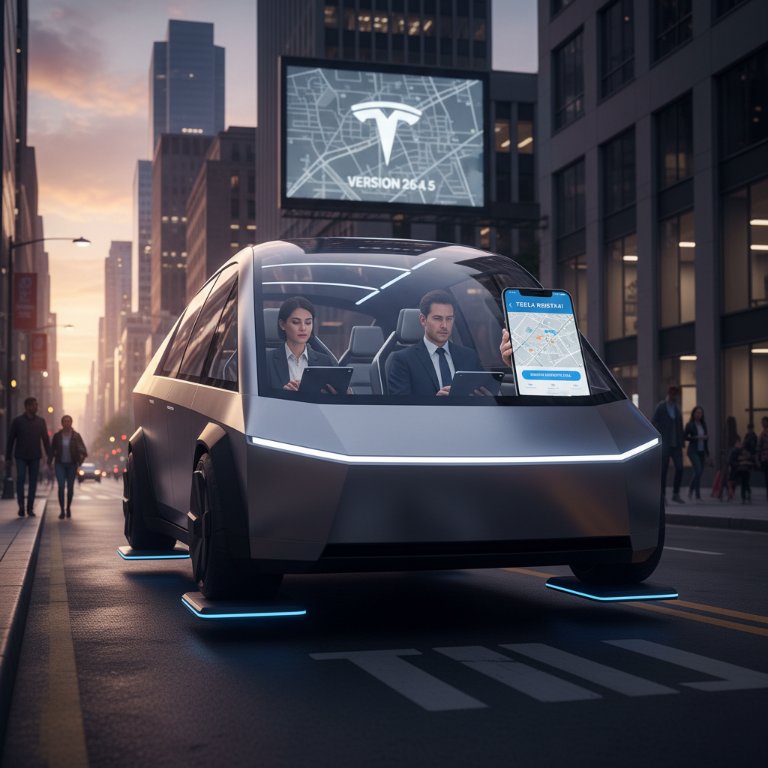
Tesla's long-standing ambition for a fully autonomous ride-hailing network, often dubbed the "Robotaxi" service, has consistently captivated and, at times, frustrated the automotive world. While much of the attention has focused on the evolution of Full Self-Driving (FSD) software, a critical, often overlooked piece of the puzzle is the operational infrastructure supporting these futuristic vehicles. With the recent rollout of version 26.4.5 of its Robotaxi smartphone application, Tesla isn't just tweaking features; it's laying foundational groundwork for a more pragmatic, and potentially imminent, deployment of its Cybercab fleet.
This isn't merely another software patch; it’s a strategic move that signals Tesla's serious intent to bridge the gap between aspirational autonomy and commercial reality. For years, the promise of a Robotaxi service has been a cornerstone of Tesla's valuation and vision, yet mass unsupervised deployment has remained elusive. This update, however, introduces crucial elements designed to manage and monitor a fleet of driverless vehicles, moving beyond pure AI reliance to integrate sophisticated remote operational capabilities.
Critical Enhancements for Autonomous Operations
The version 26.4.5 update to the Tesla Robotaxi app is a comprehensive package aimed at solidifying the remote operational backbone necessary for scaling a truly driverless service. Key features embedded within the new code reveal a multi-faceted approach to safety, efficiency, and passenger experience in an autonomous environment:
- Remote Operator Voice Calls: This feature enables direct, real-time communication between passengers and a human teleoperator. This is a game-changer for addressing unexpected scenarios, providing reassurance, or resolving issues that current AI may not be equipped to handle autonomously. It injects a crucial layer of human oversight and customer service into a driverless system.
- Proactive Remote Assistance: Rather than waiting for a passenger-initiated problem, this system allows remote operators to proactively monitor and intervene. Imagine a Cybercab encountering an unusual road condition or a minor navigation anomaly; proactive assistance means a human can assess and guide the vehicle before it becomes a problem, significantly enhancing safety and reliability.
- Manual Override/Remote Start for Wheel-less Cybercabs: This is arguably the most telling inclusion. The specific mention of "wheel-less Cybercabs" points directly to Tesla's dedicated, purpose-built Robotaxi vehicle, rather than adapted consumer cars. The ability for remote operators to manually override controls or remotely start a Cybercab implies a robust contingency system. This is vital for managing vehicles that might be stuck, need repositioning, or require an intervention beyond the scope of their onboard AI, especially in scenarios where a human driver cannot physically take over.
These improvements collectively point towards a system designed not just for perfect autonomy, but for robust, fail-safe operation in the real world, acknowledging that even the most advanced AI will encounter situations requiring human judgment or intervention.
Why This Matters:
This seemingly technical app update holds immense significance for Tesla, the autonomous vehicle industry, and prospective consumers. This isn't about incremental improvements to FSD; it's about building the operational and safety infrastructure that will underpin a commercial, unsupervised service. Tesla is moving from proving autonomous driving capabilities to proving the viability of a large-scale driverless transportation network.
Who Wins? Tesla, if these systems prove effective, stands to gain a significant first-mover advantage in a truly scalable Robotaxi service. Passengers win through potentially safer, more reliable, and eventually, more affordable autonomous transportation. The integration of human teleoperators suggests Tesla is adopting a pragmatic, rather than purely idealistic, approach to deployment, which could accelerate public trust and adoption. This also signals a win for urban planners looking for efficient, sustainable mobility solutions.
Who Loses? Traditional ride-hailing services like Uber and Lyft face an existential threat if Tesla can deploy a truly driverless, scalable, and cost-effective solution. Other autonomous vehicle companies that have struggled with the "last mile" of operational readiness might find themselves playing catch-up, particularly if they haven't invested as heavily in robust remote operations and human-in-the-loop systems.
Market Signal: This update strongly signals that Tesla is serious about its Robotaxi vision as a future revenue stream that extends beyond vehicle sales. The focus on remote control and oversight indicates a pragmatic understanding of current AI limitations and a strategic plan to bridge the gap until full, unassisted autonomy is consistently achievable in all conditions. This could be a critical "do-or-die" moment, as successful Robotaxi deployment is vital for Tesla to achieve its ambitious valuation and diversify its business model beyond manufacturing.
In conclusion, the Robotaxi app version 26.4.5 is far more than a routine update. It represents a crucial operational and safety layer, integrating human intelligence and remote control capabilities that are essential for the real-world deployment and scaling of unsupervised Cybercab fleets. Tesla is not just chasing autonomy; it's meticulously building the scaffolding necessary to make it a viable, commercial reality, cautiously bridging the gap between cutting-edge AI and the complexities of human-centric service.