Tesla's Stretched Six-Seat Model Y L Arrives in the U.S. to Dominate the Family EV Segment
Tesla is finally tackling one of the most glaring weaknesses in its product lineup: the notoriously cramped third row of its best-selling SUV. With th...
Editorial Team
World Of EV
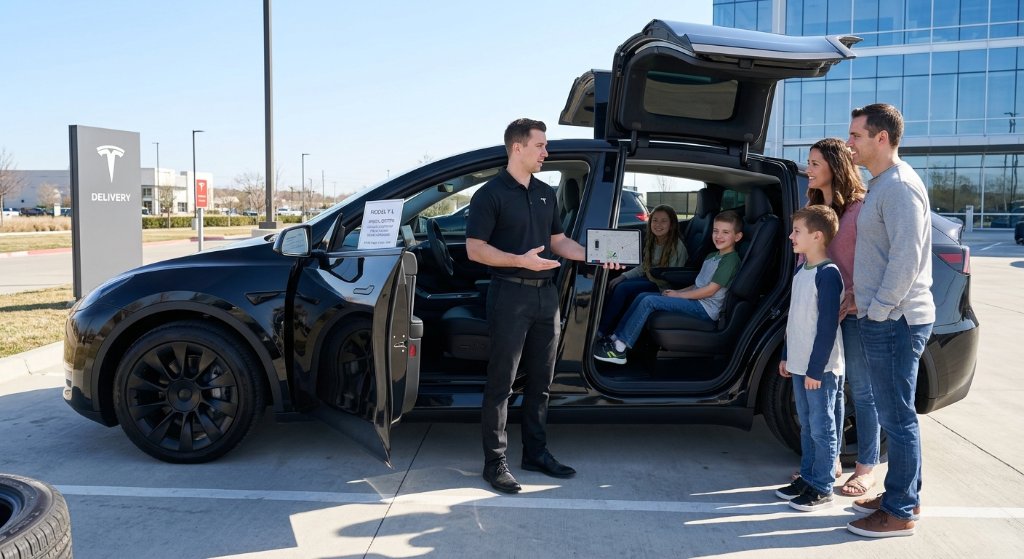
Tesla is finally tackling one of the most glaring weaknesses in its product lineup: the notoriously cramped third row of its best-selling SUV. With the official U.S. and Puerto Rico launch of the long-awaited Model Y L (Long Wheelbase), the automaker has officially delivered a legitimate, three-row family hauler.
Historically, buyers looking for a spacious three-row electric vehicle from Tesla had to choose between the ultra-expensive, aging Model X or a severely compromised optional third-row on the standard Model Y that was virtually unusable for anyone past grade school. The Model Y L changes the calculus entirely, bridging the gap with premium comfort, an extended chassis, and a highly requested seating configuration.
A True Stretched Platform for Real Passengers
The core of the Model Y L's appeal lies in its altered dimensions. Tesla has stretched the wheelbase by 6 inches (with an overall length increase of roughly 7 inches) and raised the roofline by 1.7 inches. Rather than cramming in a tight seven-seat layout, Tesla has opted for a premium 2+2+2 setup, replacing the second-row bench with independent captain's chairs.
Here is what the "Launch Series" AWD version brings to the pavement:
- Generous Cabin Space: A massive 33.2 inches of third-row legroom—putting it on par with midsize internal combustion engine (ICE) staples like the Hyundai Palisade and Ford Explorer.
- Premium Seating Comfort: Second-row heated and ventilated captain’s chairs featuring powered armrests and one-touch folding; the third row gets power-reclining heated seats.
- Punchy Performance & Range: Dual Motor AWD delivering a 0-60 mph sprint in just 4.4 seconds, paired with an impressive EPA-estimated 325 miles of range.
- Advanced Ride Dynamics: An upgraded suspension with electronic adaptive damping to smooth out the extra weight and length, paired with staggered tires.
- Upgraded Tech Suite: A 16-inch primary touchscreen up front, an 8-inch rear passenger display, a 19-speaker premium audio system, and 50W wireless phone chargers with active cooling.
- FSD & Grok Integration: Ships with Full Self-Driving (FSD) Supervised and integrated Grok AI assistant technology.
The Premium Packaging of the Launch Series
Priced starting at $61,990 ($63,380 with destination fees), the Model Y L enters the market with a "Launch Series" package designed to ease the sting of its premium pricing. To sweeten the deal, Tesla is offering 12 months of free FSD Supervised.
Furthermore, the Launch Series waives the usual upcharges for premium paint (including Cosmic Silver), interior colors (like Zen Grey), upgraded 19-inch Machina 2.0 or 20-inch Uberhelix wheels, and the factory tow hitch. This strategy mirrors Tesla’s previous product rollouts, prioritizing high-margin, fully loaded configurations before eventually introducing cheaper, single-motor variants down the road.
Why This Matters:
The Winners: Multi-Child Families and Ride-Share Operators
For families who felt suffocated by the standard Model Y but couldn't justify the $80,000+ price tag of a Model X, the Model Y L is the perfect middle ground. The addition of genuine second-row captain's chairs makes installing rear-facing child seats a breeze while maintaining easy pass-through access to the third row. Uber XL and executive transport drivers also gain a highly efficient, premium six-seat option that will drastically lower operating costs compared to gas-guzzling large SUVs.
The Losers: Three-Row EV Rivals and the Aging Model X
This launch is a direct shot across the bow of automakers who have capitalized on Tesla’s lack of a practical mid-size three-row vehicle—most notably the Kia EV9 and the Hyundai Ioniq 9. While those Korean rivals are larger, the Model Y L fights back with superior efficiency, Tesla's robust Supercharging network, and more advanced software integration. Furthermore, this represents the final nail in the coffin for the aging Model X. With the Model Y L offering superior interior utility, adaptive damping, and a modern cabin at a fraction of the price, the Model X is officially relegated to a niche luxury relic.
The Market Signal: Tesla Moves Upmarket to Protect Margins
This launch signals that Tesla is no longer just competing on price cuts. By extending the wheelbase of its most popular vehicle, Tesla is successfully upselling buyers into a premium, $60k+ tier without needing to develop an entirely new vehicle architecture from scratch. It is a masterclass in platform maximization, proving that Tesla can still capture high-margin family buyers who demand utility without sacrificing the driving dynamics and efficiency that made the Model Y a global best-seller.
Conclusion
The Tesla Model Y L is far more than a simple "stretched" derivative; it is a highly calculated response to changing market demands. By addressing the standard model's biggest utility bottleneck and introducing premium captain's chairs, Tesla has created a highly compelling, efficient family cruiser that bridges the gap between mass-market affordability and executive luxury. Expect this variant to quickly become the new default choice for suburban driveways across America.