Tesla's Unified FSD Update Backfires: Wide v14.3.6 Rollout Triggers Surprising Driving Regressions on AI4 Vehicles and Cybertruck
Tesla’s relentless quest for a unified, fleet-wide autonomous driving stack has reached a pivotal—yet highly turbulent—milestone. The electric vehicle...
Editorial Team
World Of EV
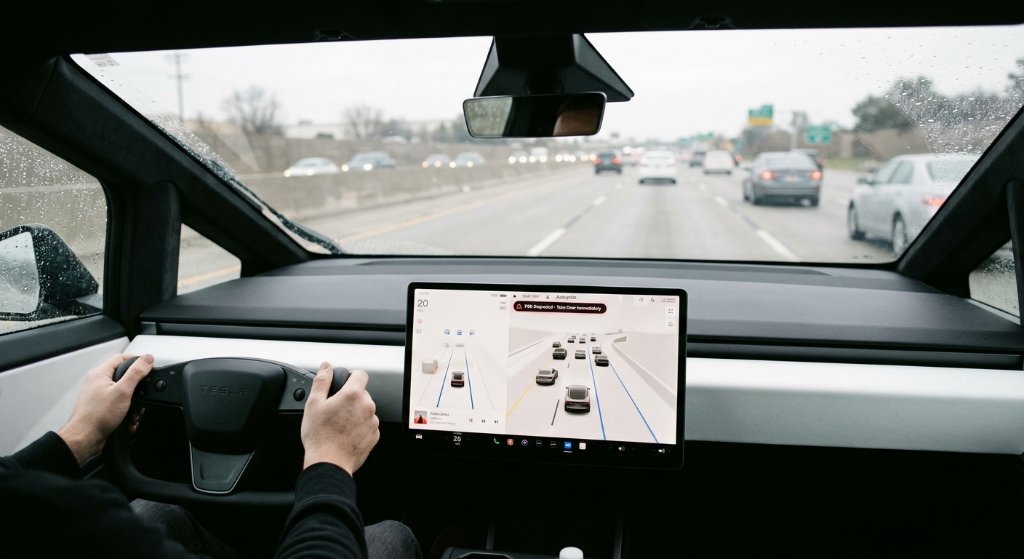
Tesla’s relentless quest for a unified, fleet-wide autonomous driving stack has reached a pivotal—yet highly turbulent—milestone. The electric vehicle giant has officially expanded the rollout of its Full Self-Driving (FSD) v14.3.6 software update (firmware 2026.20.6.11), finally bridging the gap between Hardware 3 (HW3) and Hardware 4 (AI4) vehicles in a single, massive push. But while the update finally brings long-awaited autonomous parity to the fleet, including major additions like Actually Smart Summon (ASS) for the Cybertruck, it has also unleashed a wave of frustrating driving regressions that have left the EV community scratching their heads.
Historically, Tesla has struggled to manage the growing hardware divergence across its fleet. Ever since transitioning from HW3 to the more powerful AI4 architecture, the company has run parallel software tracks, leaving older vehicle owners waiting months for distilled software updates. While the unification of these branches in this latest update is a monumental engineering feat on paper, early real-world feedback on v14.3.6 suggests that cramming multiple hardware requirements into a single codebase has severely compromised the driving behavior of Tesla's flagship vehicles.
The HW3 and AI4 Merge: An Engineering Triumph on Paper
To understand the complexity of firmware 2026.20.6.11, one must look at how Tesla's FSD architecture has evolved. For years, Tesla has promised that HW3 cars would not be left behind despite their severely limited compute capacity compared to the modern AI4 suite. In this update, Tesla has accomplished what many thought impossible: a unified release that simultaneously delivers FSD v14.3.6 to AI4 platforms and the new "FSD v14 Lite" to legacy HW3 cars.
Key milestones of this update include:
- Unified Stack: A single firmware push (2026.20.6.11) that serves both HW3 and AI4 vehicles.
- FSD v14 Lite Debut: Older HW3 cars finally get a distilled version of the advanced v14 stack, bringing massive improvements over the older v12.6 versions.
- Cybertruck Integration: Tesla's futuristic pickup gets its wide-release FSD upgrade alongside "Actually Smart Summon" (ASS) and "Dumb Summon".
The Dark Side of v14.3.6: Frustrating Regressions Unveiled
However, the celebration has been short-lived. Following a highly praised v14.3.5 release that many owners hailed as the smoothest and most human-like iteration to date, the wider rollout of v14.3.6 has introduced severe driving regressions. Multiple AI4 and Cybertruck drivers are reporting that their vehicles have suddenly become hesitant, erratic, and outright frustrating to monitor in real-world traffic.
The most glaring regressions reported by the community include:
- Brake-Stuttering and Shadow Braking: Sudden, jerky micro-braking events on highways and local roads, particularly when dealing with overhead shadows or passing vehicles.
- Left-Lane Camping: An irritating persistence in hogging the passing lane on highways, ignoring navigation settings and the flow of traffic.
- Turn Hesitancy and Jerkiness: Indecisive lane-selection when turning into multi-lane streets, causing the steering wheel to violently jerk back and forth over road lines.
- Highway Exit Errors: Severe navigation blunders and late-lane merges when attempting to exit highways.
Why This Matters:
This is a critical crossroad for Tesla. On one hand, the successful unification of HW3 and AI4 under a single release branch represents a massive logistical win for Tesla's software division. Maintaining separate software pipelines is incredibly expensive and slows down the overall pace of neural network training. By consolidating the fleet, Tesla can train its models faster.
However, the real-world regressions in v14.3.6 expose a deeper, more worrying reality: the cost of hardware compromise. Distilling AI4’s advanced neural nets down to fit into the memory-constrained HW3 computer (hence "v14 Lite") may have forced Tesla's engineers to over-optimize and generalize the core code. By dumbing down or heavily compressing the software stack to keep HW3 relevant, Tesla risks capping the potential of its superior AI4 hardware.
For the consumer, this update is a mixed bag. Legacies are winning: HW3 owners finally have a modern driving stack that feels leagues ahead of the outdated v12 system. But premium AI4 and Cybertruck buyers are losing out; their $100,000+ cutting-edge vehicles are now saddled with a regressed, hesitant driving profile because they are tethered to the lowest common hardware denominator. If Tesla cannot optimize these branches without sacrificing the performance of its best hardware, it could severely damage the credibility of its "unsupervised" autonomy timeline.
While Tesla continues to prove its unmatched speed in over-the-air software deployment, FSD v14.3.6 serves as a stark reminder that true autonomy is not a linear path. Merging hardware generations is a daunting task, and this release shows that bridging the legacy gap has come at a direct cost to the flagship experience. Moving forward, Tesla's engineers must quickly patch these AI4 regressions to prevent consumer fatigue and rebuild confidence in their next-generation vision stack.