The 10% Cliff: Why a GMC Sierra EV's Sudden Range Collapse Exposes a Critical Vulnerability in Electric Towing
General Motors spent the last several years betting its entire electric future on its modular, high-voltage Ultium platform. Promising class-leading p...
Editorial Team
World Of EV
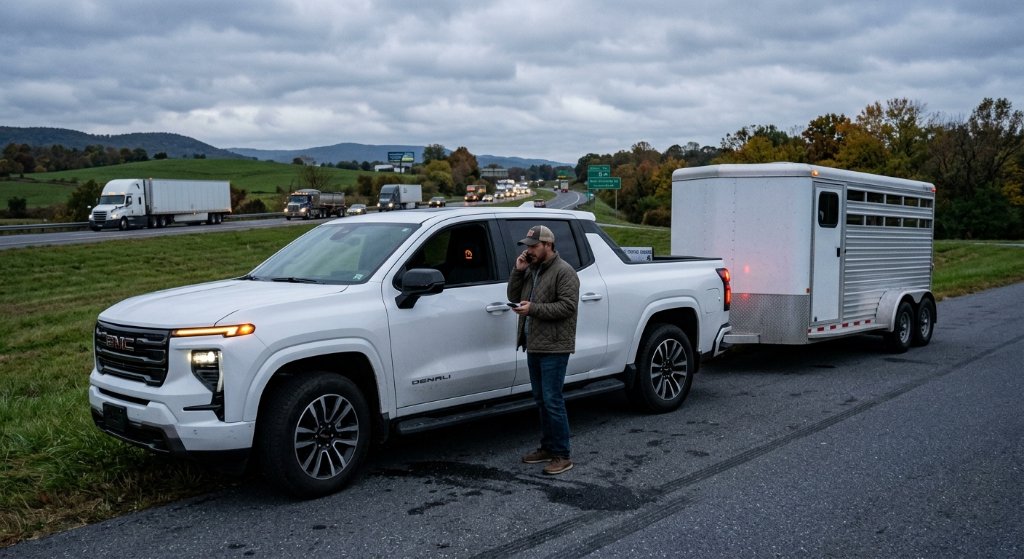
General Motors spent the last several years betting its entire electric future on its modular, high-voltage Ultium platform. Promising class-leading performance, eye-popping range, and serious towing power, flagship vehicles like the $100,000+ 2025 GMC Sierra EV Denali Max Range were supposed to prove that heavy-duty electric trucks could finally replace diesel. However, a jarring roadside incident on Interstate 81 near Harrisonburg, Virginia, serves as a stark reminder that software calculations and real-world physics do not always align when pulling a load.
When a Sierra EV Denali Max Range owner watched their displayed battery state of charge (SoC) instantly plummet from 10% to 0% while towing, the high-tech behemoth was forced into a brief, reduced-power "turtle mode" before shutting down entirely on the highway shoulder. With a fast-charging station a mere 15 miles away, this sudden collapse highlights a critical trust boundary in electric vehicle software that could leave even the most prepared drivers stranded.
The Roadside Breakdown: When 10% Equals Zero
The incident occurred as the Sierra EV was towing an empty horse trailer through the rolling Appalachian grades of Virginia. Despite the truck's massive 205-kWh usable battery pack—engineered to deliver a GM-estimated 460 miles of unloaded range—the vehicle’s predictive software failed to accurately calculate its remaining reserve under load.
- The Illusion of Reserve: The driver observed a steady 10% battery reading, indicating a comfortable margin to reach the next charging station.
- The Instant Recalibration: Without warning, the display plummeted to 0% capacity and 0 miles of range.
- The Minimal Grace Period: The truck triggered a reduced-power "turtle mode," allowing the driver to limp along the highway for only a mile or two before the high-voltage system shut down completely.
- The Towing Resolution: Low-voltage systems remained active just long enough to enable "transport mode" to get the 8,800-pound truck loaded onto a flatbed tow truck.
The Technical Culprit: Voltage Sag and the Ultium BMS
To understand why this happened, we must look beyond the simple "out of juice" explanation. This massive 205-kWh Ultium pack dwarfs competitors like the Ford F-150 Lightning (131 kWh) and the Rivian R1T Max Pack (141-kWh). However, as GM continues to distance itself from early Ultium-platform software gremlins—such as the infamous software glitches that triggered a stop-sale on the Chevrolet Blazer EV—this latest towing incident reveals that raw hardware scale cannot overcome unrefined software calibration.
- Severe Voltage Sag: When dual electric motors draw sustained, heavy current to pull a heavy, high-drag trailer up highway grades, the internal resistance of the battery cells causes their voltage to drop significantly under load.
- BMS Safety Override: Battery Management Systems (BMS) continuously monitor cell-level voltage. If the BMS detects even a single cell or module dropping below a critical voltage threshold to protect the chemistry from permanent, catastrophic degradation, it overrides the estimated "coulomb-counting" calculation and instantly forces the display to 0%.
- The Static Estimation Trap: Because the Sierra EV's software calculates state of charge largely based on standard driving cycles, it struggles to dynamically adjust its safety buffers to reflect the extreme, continuous power demands of heavy-duty towing.
Why This Matters:
This is a pivotal moment for General Motors and the broader EV industry. As electric pickups attempt to win over traditional, highly skeptical truck buyers, reliability under load is a non-negotiable metric. If a buyer paying six figures for a premium workhorse cannot trust the gauge on their dashboard, they will simply stick to diesel.
- Who Wins: Traditional internal combustion engine (ICE) and hybrid heavy-duty trucks. They maintain an undisputed monopoly on towing trust, where a "low fuel" light guarantees a predictable, physical reserve that drivers can rely on.
- Who Loses: General Motors’ marketing machine. Having finally resolved early Ultium battery manufacturing bottlenecks, GM now faces a software trust crisis. A sudden loss of power on an active interstate is a severe safety hazard, and a "turtle mode" that only offers a single mile of grace when a trailer is attached is functionally useless.
- The Long-Term Implication: This is a software and calibration challenge, not a hardware failure. GM must urgently revise its towing software algorithms to dynamically recalibrate the "bottom of the tank" whenever a trailer is connected. Until they do, the immediate takeaway for EV truck owners is clear: when towing, 20% is the new 0%. Relying on the final 10% of an EV battery under load is a gamble no driver should take.
A Reality Check for the Electric Workhorse
The GMC Sierra EV Denali Max Range remains a technological tour de force, boasting 760 horsepower and massive charging capabilities. Yet, this Appalachian breakdown proves that even a giant battery pack cannot escape the laws of physics. Until manufacturers refine their BMS software to offer highly accurate, load-adjusted low-battery calibrations, the dream of seamless electric trailering will remain limited by the fear of a sudden roadside cliff.