E
World Of EVEditorial
News 53 mins ago
The $20-A-Month Advantage: AAA Proves Electric Vehicles Slash Maintenance Costs, But There's A Catch
The long-debated narrative surrounding electric vehicle (EV) ownership costs just received its most authoritative reality check yet. In its newly rele...
E
Editorial Team
World Of EV
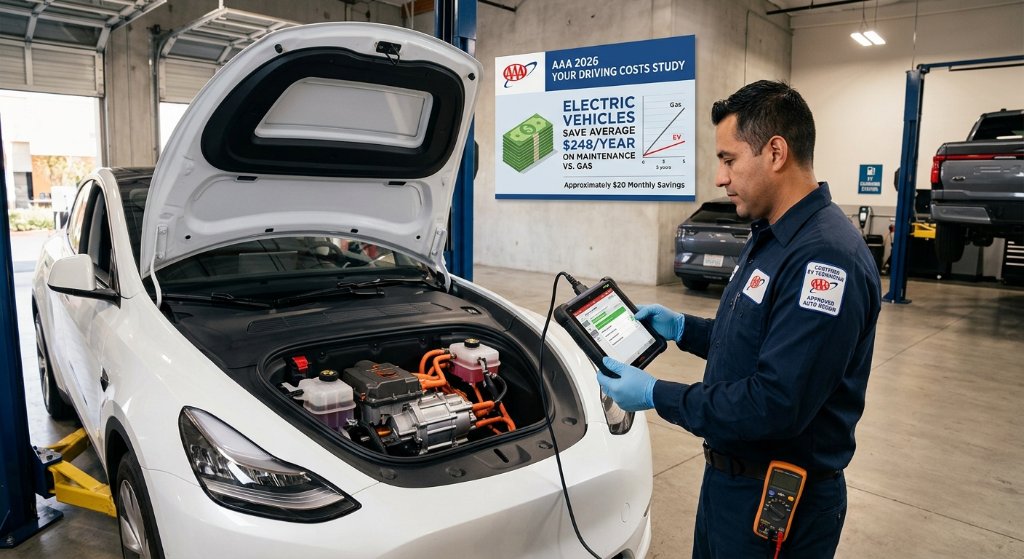
The long-debated narrative surrounding electric vehicle (EV) ownership costs just received its most authoritative reality check yet. In its newly released 2026 "Your Driving Costs" study, the American Automobile Association (AAA) confirms that battery-electric vehicles save owners an average of $248 per year—roughly $20 a month—on maintenance, repairs, and tires compared to traditional internal combustion engine (ICE) vehicles. Evaluated over a typical five-year, 75,000-mile ownership cycle, these savings are no longer just theoretical; they are a statistically backed reality.
For years, early EV adopters have championed the financial upsides of leaving the gas pump behind, while skeptics pointed to the high cost of specialized EV tires and potential battery degradation. This new data highlights the tangible long-term benefits of simpler drivetrains. By eliminating complex mechanical components like spark plugs, catalytic converters, multi-speed transmissions, and routine oil changes, EVs systematically chip away at the constant financial friction of car ownership. However, as AAA's comprehensive annual report reveals, focusing solely on the maintenance bill ignores a much larger, more predatory expense.
### The Maintenance Math: Where EVs Win
When it comes to routine garage visits, the simplicity of an electric powertrain is an undeniable asset. AAA’s rigorous analysis of top-selling vehicles reveals that the mechanical upkeep of an EV is consistently lighter on the wallet.
The primary areas driving these savings include:
* **Fewer Fluid and Filter Swaps:** No engine oil, oil filters, spark plugs, or timing belts mean that standard 10,000-mile service intervals are largely inspection-based.
* **Extended Brake Life:** Thanks to regenerative braking systems, which use the electric motor to slow the vehicle and recapture energy, mechanical brake pads and rotors experience a fraction of the wear seen on traditional ICE cars.
* **Reduced Component Failure:** Without complex exhaust systems, fuel injectors, or multi-gear transmissions, the list of parts that can break down over 75,000 miles is dramatically shorter.
However, these savings aren’t entirely free of trade-offs. The study notes that the heavy curb weight of EV batteries, combined with the instant torque of electric motors, puts immense stress on tires. EV owners must buy specialized, reinforced tires that typically cost more and wear out faster than standard rubber, slightly eroding the mechanical maintenance advantages.
### The Elephant in the Room: Depreciation and the Hybrid Rise
While the $20-a-month maintenance discount is a clear victory for EV engineering, the broader 2026 AAA study delivers a sobering reality check for the average consumer's checkbook. The average annual cost to own and operate a new vehicle has surged to an all-time high of $12,863 ($1,071.92 per month), driven by stubborn inflation, high financing rates, and fluctuating energy costs.
In this wider financial landscape, EVs suffer from a massive Achilles' heel: depreciation.
* **The Depreciation Trap:** According to AAA, depreciation remains the single largest expense of new car ownership, and EVs are losing value at an alarming rate. Medium EV sedans, for example, depreciate at nearly twice the rate of their gas-powered counterparts, which can translate to over $3,000 in additional annual ownership costs.
* **The Energy Equation:** While home charging remains up to 70% cheaper than filling a tank with regular-grade gasoline (even with electricity rates ticking up 7.8% this year), fuel savings alone cannot offset the rapid loss in vehicle residual value.
* **The Hybrid Sweet Spot:** This massive depreciation gap is why traditional hybrids emerged as the true financial champions of the 2026 study. Hybrids successfully bridge the gap, offering substantial fuel savings with minimal depreciation trade-offs, outperforming both gas and pure electric models in overall annual costs.
### Why This Matters:
This study fundamentally shifts the EV ownership conversation from "Do they save money?" to "When and how do they save money?"
For automakers, the AAA data is a glaring warning sign. Industry giants like Ford, General Motors, and Hyundai can no longer simply market EVs as "maintenance-free money savers" and expect buyers to swallow steep MSRPs. They must aggressively address the residual value crisis. Until battery health transparency improves and a robust, predictable used EV market establishes itself, buying a brand-new EV on a traditional finance plan is a highly risky financial move.
The clear winners of this shift are used EV buyers. By letting the first owner absorb the brutal 50% depreciation curve, secondary buyers can step into a gently used EV and fully exploit the $248 annual maintenance discount and low charging costs without the financial overhang. Conversely, legacy automakers who dragged their feet on hybrid technology are losing ground. Toyota's stubborn, long-held bet on hybrid powertrains looks incredibly vindicated by AAA's findings, while companies that rushed to go pure-electric are left scrambling to re-introduce hybrid models to keep practical, budget-conscious buyers in their showrooms.
### Conclusion
AAA’s 2026 study proves that the electric vehicle maintenance discount is a tangible, enduring benefit of zero-emission technology. Saving $248 a year on mechanical upkeep is a solid win, but it cannot be viewed in a vacuum. As long as rapid depreciation and high purchase prices dominate the balance sheet, pure EVs will remain a tough sell for mainstream buyers looking for absolute bottom-line savings. Until the industry stabilizes EV resale values, the smart money for new car buyers may reside in the hybrid middle ground, while savvy bargain hunters should head straight to the used EV lot to reap the true rewards of electric efficiency.