The $3,000 Reality Check: Why Cheaper Charging Can't Save EVs From the Depreciation Trap
### **A Grim Wake-up Call for the EV Transition** AAA’s newly released 2026 "Your Driving Costs" report has delivered a sobering blow to the narrativ...
Editorial Team
World Of EV
A Grim Wake-up Call for the EV Transition
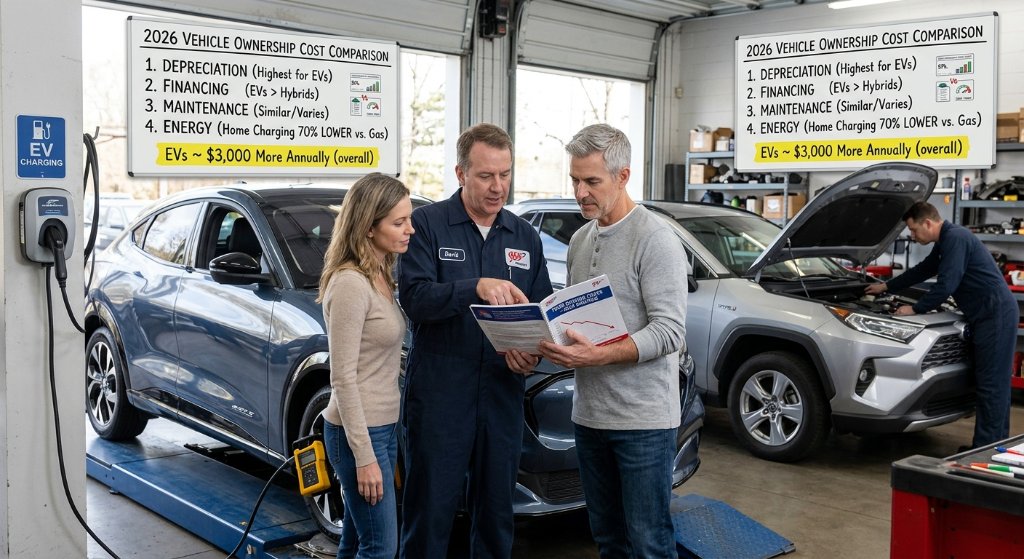
AAA’s newly released 2026 "Your Driving Costs" report has delivered a sobering blow to the narrative surrounding the economics of electric vehicles. For years, EV advocates have championed the massive savings at the plug. While that fuel advantage has actually widened this year, a more ruthless financial reality has caught up with battery-electric vehicles (BEVs). According to AAA’s data, higher depreciation and steep financing fees make EVs roughly $3,000 more expensive to own annually than their hybrid counterparts.
This year’s study marks a historic shift in how we measure automotive costs. AAA has retired the standalone "EV" and "hybrid" categories, choosing instead to integrate these powertrains directly into mainstream category comparisons like medium sedans and compact SUVs. This methodology update reflects how modern buyers actually shop, and it lays bare a painful truth: while charging your EV at home is up to 70% cheaper than filling a gas tank, the back-end financial hit of depreciation completely erases those gains.
The Charging Paradox: Fuel Savings vs. The Depreciation Cliff
At first glance, the energy math heavily favors the electric driver. With regular gasoline averaging $4.15 per gallon (a whopping 31.8% spike from last year) and home electricity averaging a stable 18 cents per kilowatt-hour, EVs are more fuel-efficient and cheaper to run than ever. However, AAA's comprehensive cost-per-mile analysis proves that fuel economy alone does not dictate the total cost of ownership.
The real budget killer for EV owners comes down to two inescapable factors:
- Brutal Depreciation: This remains the single largest cost of vehicle ownership across the board, with vehicles losing a weighted average of $4,422 per year. However, EVs are getting hit hardest. AAA found that EV medium sedans depreciate at twice the rate of traditional gas-powered models.
- Hefty Financing and Fees: Because EVs still command higher initial purchase prices—factoring into a sales-weighted average MSRP of $39,376 across the study—buyers face significantly higher financing charges, sales taxes, and insurance premiums.
- The Hybrid Goldilocks Zone: Hybrids emerged as the undisputed financial champions of 2026. By marrying meaningful fuel savings with mild, gas-like depreciation curves, hybrids cost less annually than traditional gas-powered models across medium sedans, compact SUVs, and pickup trucks.
Powertrains Go Head-to-Head: The Real Cost Per Mile
By dispersing electrics and hybrids into traditional vehicle categories, AAA's 2026 data provides a stark, realistic look at how much you actually pay to drive 15,000 miles a year:
- Medium Sedans: Electric sedans cost an eye-watering $0.911 per mile, compared to $0.705 for gas-powered equivalents and a lean $0.680 for hybrids.
- Compact SUVs: Electric SUVs average $0.793 per mile, while hybrids lead the category at $0.747.
- Pickup Trucks: EVs cost $1.161 per mile, outpricing both gas ($1.108) and hybrids ($1.074).
For years, the industry promised that EV ownership would reach price parity with gas. Instead, when looking at the complete five-year, 75,000-mile ownership lifecycle, the rapid loss in EV resale value and higher borrowing costs are creating a wider, not narrower, financial gap.
Why This Matters:
This report is a flashing red light for pure-play EV manufacturers like Tesla, Rivian, and Lucid, while serving as a massive validation for legacy automakers—chiefly Toyota—that faced immense criticism for slow-rolling their pure EV transitions in favor of hybrids.
The Winners: Toyota, Honda, and Hyundai. Their diversified portfolios are perfectly positioned to capture mainstream buyers who want electrified efficiency without the financial volatility of full-electric depreciation.
The Losers: Pure-play EV makers and legacy giants who went "all-in" on BEVs too early. Every time an EV maker slashes new-car prices to boost sales volume, they unintentionally deal a devastating blow to the residual values of their existing customers' cars. This creates a vicious cycle: high depreciation scares off retail buyers, forcing manufacturers to rely on heavy leasing subsidies just to move metal.
The Market Signal: This is a do-or-die moment for EV residual values. If automakers want to unlock the mass market, they must pivot their focus away from simply increasing battery range or adding screen real estate. The priority must shift to stabilizing the used EV market. This means standardized, transparent battery health certifications, robust certified pre-owned (CPO) programs, and lower-cost battery repairability. Until a second-hand buyer can purchase a used EV with the same confidence they have in a used hybrid, the $3,000 annual premium will remain a major roadblock to widespread EV adoption.
Looking Ahead
The 2026 AAA report makes it clear that the EV transition is no longer a technology challenge—it is a financial one. While early adopters were willing to look past high depreciation for the novelty of electric drive, the pragmatic mass-market buyer will not ignore a $3,000 annual penalty. For EVs to truly win, the industry must solve the back-end economics of ownership with the same urgency they used to solve charging networks and battery range.