The $450 Road Trip: Why Large Electric Pickups Are Exposing the Public Fast-Charging Cost Trap
When EV owner Gary Brown set out on a 1,300-mile road trip from Florida to Michigan in his brand-new 2026 GMC Sierra EV AT4, he expected a smooth, hig...
Editorial Team
World Of EV
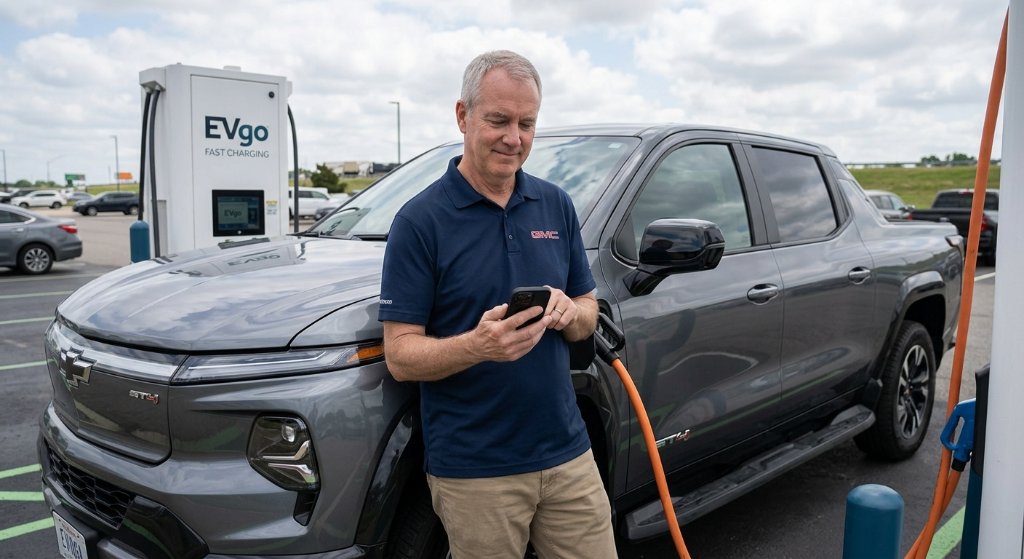
When EV owner Gary Brown set out on a 1,300-mile road trip from Florida to Michigan in his brand-new 2026 GMC Sierra EV AT4, he expected a smooth, high-tech journey. Instead, he got a shocking wake-up call at the cash register. Across six EVgo fast-charging sessions at Pilot and Flying J travel centers, Brown racked up a staggering bill of $453.64—including a single stop that cost an eye-watering $93.85. The grueling journey proved a harsh truth for the heavy EV segment: while massive electric pickups are incredibly cheap to power when charging at home, their lower highway efficiency turns public fast-charging into a financial money pit.
This high-profile road-trip disaster highlights a structural flaw in the current electric vehicle landscape. For years, manufacturers have chased massive range figures by stuffing gargantuan battery packs into heavy, aerodynamically challenged trucks like the GMC Sierra EV and its sibling, the Chevrolet Silverado EV. But as early adopters are finding out, a massive battery pack coupled with premium public charging rates is a recipe for highway robbery.
GM's Ultium Ambitions Meet the Laws of Physics
This roadblock comes just as General Motors is finally finding its footing with its modular Ultium platform. After years of high-profile struggles—including severe battery-cell production bottlenecks, software glitches that temporarily halted sales of the Blazer EV, and the launch of the notoriously inefficient, 9,000-pound GMC Hummer EV—GM has finally scaled up volume production. However, as trucks like the Sierra EV AT4 enter the wild, they are exposing a fundamental efficiency crisis.
- Low Highway Efficiency: On the interstate, Brown averaged a meager 1.8 miles per kilowatt-hour (mi/kWh), a far cry from the 3-4 mi/kWh achieved by aerodynamic crossover EVs.
- Massive Energy Consumption: Over the 1,300-mile trip, the Sierra EV consumed approximately 722 kWh of electricity to push its massive frame through the air.
- The Charging Premium: At an average cost of nearly $0.63 per kWh on EVgo's premium DC fast chargers, the cost-per-mile skyrocketed to roughly 35 cents.
In comparison, driving a conventional V8-powered GMC Sierra getting 20 mpg on the highway with gas at $3.50/gallon would have cost roughly $227 for the same distance. This makes the electric truck nearly twice as expensive to run on a long trip as its gas-powered counterpart.
The Tesla Contrast and the Public Charging Reality
Brown noted that driving his Tesla on the same route would have saved him approximately $500 in overall charging and operating costs. This contrast highlights a massive divide in the EV ecosystem. While Tesla's lighter, highly aerodynamic vehicles squeeze maximum mileage out of smaller batteries—and benefit from Tesla’s cheaper, highly integrated Supercharger network—heavy EV trucks are entirely at the mercy of third-party public networks.
Without a premium charging subscription to discount the rates, or a meticulous route-planning strategy to avoid peak pricing, truck owners are paying an absolute premium to fast-charge. The hardware at the GM-branded Pilot Flying J stations performed as promised, delivering high-speed CCS charging up to 350 kW, but the seamless technology was utterly overshadowed by the painful financial toll.
Why This Matters:
This road trip isn't just an isolated incident of bill shock; it is a critical warning sign for the future of the electric pickup truck market.
- Who Wins: Legacy internal combustion and hybrid trucks. For truck buyers who regularly tow or take long-distance road trips, traditional V8 and diesel drivetrains remain vastly superior in both cost and convenience. Highly efficient, aerodynamic passenger EVs like Tesla's Model 3/Y or Hyundai's Ioniq 6 also win, proving that road-tripping is only economical when your vehicle isn't a heavyweight brick.
- Who Loses: General Motors and third-party charging networks like EVgo. GM has bet its entire future on the Ultium platform and large, premium EV trucks. If the buying public realizes that road-tripping these trucks costs double the price of gas, mainstream adoption will grind to a halt. EVgo and other networks also risk a backlash from consumers who feel gouged by premium per-kWh highway rates.
- The Market Signal: This reveals that the economic viability of electric trucks is highly regional and situational. If you charge your GMC Sierra EV overnight at a home rate of $0.12/kWh, it is incredibly cheap to operate for local daily driving. But if you plan to use it as a long-distance road-tripper, the financial math completely falls apart. This will likely relegate electric pickups to local fleet duty and suburban daily commutes, rather than the heavy-duty, long-haul roles they were marketed to conquer.
Until charging networks introduce bulk-pricing discounts for heavy-duty vehicles, or battery and aerodynamic technologies make massive leaps, the dream of the cheap electric road trip is dead for truck buyers.
Conclusion:
Gary Brown’s $450 interstate journey is a necessary reality check for prospective EV buyers who assume that 'electric' always translates to 'cheaper'. The 2026 GMC Sierra EV AT4 is an engineering marvel in terms of power, utility, and home-charging convenience, but its sheer size makes it a liability on the open highway. If the EV transition is to succeed in the heartland of America, manufacturers and charging networks must work together to make long-distance heavy hauling economically viable—otherwise, the classic gas pickup will retain its crown for a long time to come.