The 'Airbnb on Wheels' Dream Is Dead: Why JPMorgan Says Your Tesla Won't Make You Rich
For years, Tesla CEO Elon Musk championed a revolutionary pitch to car buyers: purchase a Model 3 or Model Y, shell out for Full Self-Driving (FSD), a...
Editorial Team
World Of EV
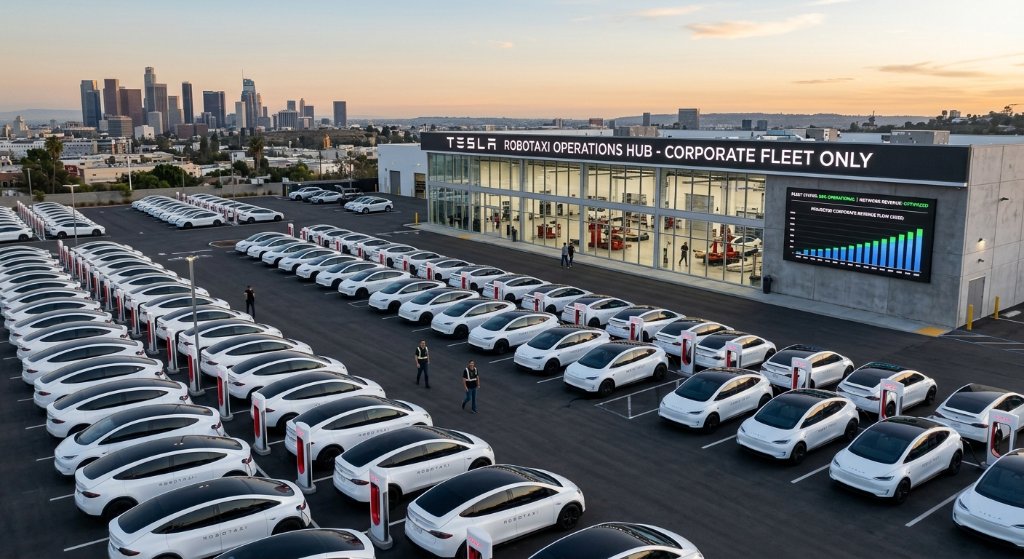
For years, Tesla CEO Elon Musk championed a revolutionary pitch to car buyers: purchase a Model 3 or Model Y, shell out for Full Self-Driving (FSD), and let your vehicle earn up to $30,000 a year as an autonomous robotaxi while you sleep. Musk frequently described the concept as an "Airbnb on wheels"—an asset-light, crowdsourced network that would turn depreciating personal cars into cash-generating machines. However, a major new financial model from JPMorgan has effectively shattered that dream, exposing a stark corporate reality behind the hype.
According to a research note circulated by lead automotive analyst Rajat Gupta, the economics of autonomous ride-hailing are heavily skewed toward centralized corporate control. While Gupta projects that Tesla's robotaxi network could pull in an astronomical $320 billion in annual revenue by 2035, the analysis estimates that a whopping $314 billion of that total will flow directly to a corporate-operated, Tesla-owned fleet. This leaves individual retail owners fighting over a meager $6 billion crumb, fundamentally dismantling the long-promised retail "Tesla Network".
The Pivot From Crowdsourcing to Corporate Control
Rather than relying on a messy, decentralized network of privately owned cars—where vehicle maintenance, cleanliness, and charge levels are impossible to guarantee—Tesla is shifting its strategy toward vertical integration. Gupta’s report highlights that the company’s economic and operational incentives strongly favor owning the fleet outright. This allows Tesla to pocket 100% of the passenger fares rather than sharing them with retail drivers. Key indicators of this pivot include:
- Prioritizing the Cybercab: Tesla has intentionally held back deploying consumer Model Ys into its active robotaxi pilot programs (currently running in Austin, Dallas, and the San Francisco Bay Area) to clear the runway for its purpose-built, pedal-less Cybercab.
- Managing a Hard-Heavy Asset Model: Operating a dedicated corporate fleet forces Tesla to handle its own charging hubs, maintenance, and cleaning depots. This is a capital-intensive shift that aligns Tesla closer to Alphabet’s Waymo than the asset-light, software-only platform investors once envisioned.
- Unbeatable Fleet Economics: Tesla is targeting an ultra-low total cost of ownership (TCO) of roughly $0.30 per mile for its corporate Cybercabs. It is an aggressive target that an individual retail owner operating a consumer-grade EV simply cannot compete with.
The Quiet Death of the P2P 'Tesla Network'
The crowdsourced "Tesla Network" was first laid out in Elon Musk’s 2016 "Master Plan, Part Deux." The promise of passive income served as a key selling point for FSD, helping Tesla lock in billions in high-margin software sales. Yet, JPMorgan's modeling indicates that the peer-to-peer (P2P) segment will amount to a mere rounding error of around $5 billion by 2035. The transition away from consumer-led robotaxis is driven by several hard truths:
- Liability and Regulation: Commercial insurance and accident liability are far easier to manage with a uniform corporate fleet than with privately owned vehicles under personal insurance policies.
- Hardware Discrepancies: Consumer vehicles equipped with Hardware 4 (HW4) or the upcoming AI5 system are designed for human drivers first. Conversely, the Cybercab is built from the ground up for commercial ride-hailing, stripping out steering wheels and pedals to maximize passenger space and minimize manufacturing costs.
- The Software Moat: Tesla has accumulated over 10 billion miles of FSD data. Because the company owns the AI and the network architecture, it holds all the pricing power. Sharing that massive revenue with retail owners makes little financial sense when Tesla can keep the lion's share of the profit margins for itself.
Why This Matters:
This structural shift represents a massive paradigm change that redefines who wins and who loses in the autonomous future:
- The Winners: Tesla’s corporate balance sheet and institutional shareholders. While running a physical fleet is capital-heavy and cash-intensive—likely depressing near-term free cash flow—it turns Tesla into a highly lucrative transport utility. The long-term recurring revenue potential is immense, which is why JPMorgan upgraded Tesla to Neutral and significantly lifted its valuation targets.
- The Losers: Everyday Tesla buyers. Millions of retail owners paid thousands of dollars for FSD under the assumption that their vehicles would eventually pay for themselves. Now, it is clear that consumer-owned Teslas will remain personal, depreciating assets. The dream of your car paying your mortgage while you sleep is dead.
- The Market Signal: Tesla is abandoning the "software aggregator" model to become a full-scale physical AI and logistics operator. If investors want to profit from the robotaxi revolution, they must do so by holding TSLA stock, not by buying a Tesla car. It is a do-or-die pivot that risks alienating Tesla's most loyal consumer base, but one that Wall Street is increasingly eager to fund.
Conclusion
Ultimately, JPMorgan’s analysis forces a reality check on the romanticized, decentralized future of autonomous driving. While a $320 billion robotaxi market by 2035 proves that autonomous driving is indeed Tesla’s ultimate golden goose, the golden eggs are going straight to corporate headquarters in Austin, Texas. For the retail buyer, the message is clear: the autonomous revolution is coming, but you are the customer, not the operator.