The Charging Turnaround: OEM Networks Dethrone Tesla as Fast-Charging Reliability Hits Historic High
For years, the public EV charging experience in the United States resembled a high-stakes gamble. Drivers pulled up to chargers praying the screen wou...
Editorial Team
World Of EV
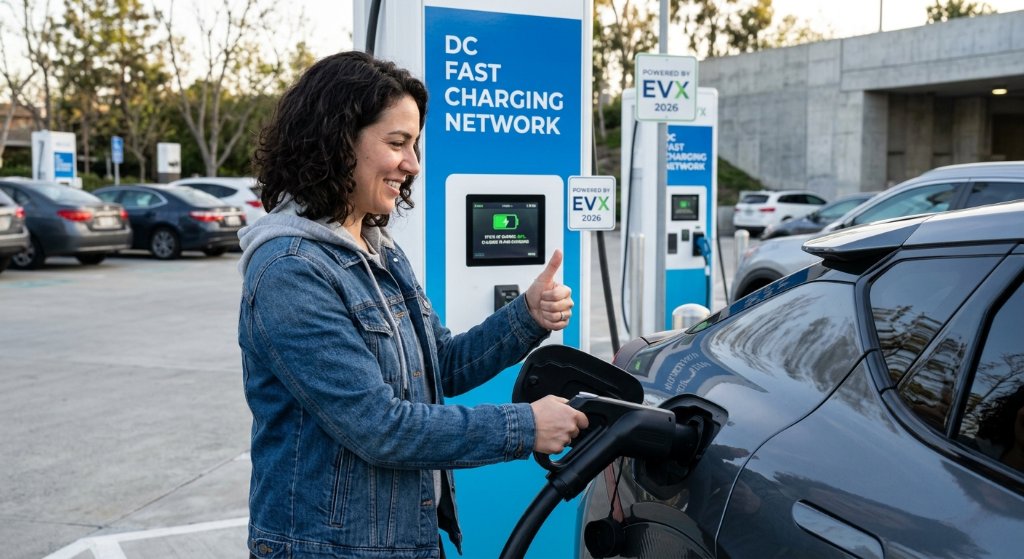
For years, the public EV charging experience in the United States resembled a high-stakes gamble. Drivers pulled up to chargers praying the screen would light up, the credit card reader would function, and the cable would actually deliver the promised power. Peak failure rates hovered near an unacceptable 19% in 2024, cementing "range anxiety" and "charger anxiety" as the ultimate roadblocks to mass EV adoption.
But the tide is finally turning. J.D. Power's 2026 U.S. Electric Vehicle Experience (EVX) Public Charging Study reveals a major shift in public charging dynamics. Driven by massive investments in direct-current (DC) fast-charging infrastructure and the entry of premium, OEM-backed networks, customer satisfaction is surging, and failed charging attempts have plunged to an all-time low of 12%. Yet, while road-trippers have reason to celebrate, everyday suburban drivers face a frustrating paradox: Level 2 public charging satisfaction is actively backsliding.
A Record-Low Failure Rate Redefines Road-Tripping
The most critical metric for any EV driver is simple: Does the charger work? Historically, public charging infrastructure was notoriously unreliable. In 2024, nearly one in five public charging attempts failed. That number dropped to 14% in 2025, and has now hit a historic low of 12% in 2026. While still far from the single-digit reliability of traditional gas pumps, this steady march toward stability signals that massive private and federal infrastructure investments are finally yielding dividends. J.D. Power attributes this dramatic improvement to:
- Higher-speed chargers: Next-generation high-speed architectures are rapidly replacing slower, legacy DC units.
- Destination-style plazas: Stations are expanding with more stalls, better lighting, enhanced security, and retail amenities.
- Fewer 'non-charging' visits: Better diagnostic software and preemptive maintenance are cutting down on dead chargers.
The New Guard: OEM-Backed Networks Dethrone Tesla
For a decade, Tesla’s Supercharger network was the gold standard, unchallenged in its seamlessness. However, the 2026 landscape tells a radically different story. Fresh, automaker-supported networks have stormed the gates, snatching the crown from Tesla. In its very first year of eligibility, IONNA—the joint-venture charging network backed by BMW, GM, Honda, Hyundai, Kia, Mercedes-Benz, and Stellantis—took the top spot in DC fast charger satisfaction, scoring a massive 807 out of 1,000 points.
- IONNA: 807 points (1st place)
- Mercedes-Benz Charging Network: 797 points (2nd place)
- Rivian Adventure Network: 755 points (3rd place)
Meanwhile, the overall satisfaction index for DC fast-charging climbed 12 points to 666, proving that intense competition is forcing legacy charging providers to either shape up or ship out.
The Level 2 Slump: Slow Speeds and Payment Friction
While DC fast charging enjoys a golden era, public Level 2 (AC) chargers—the slow-fill stations found at hotels, municipal parking garages, and shopping centers—are dragging the overall EV experience down. Satisfaction in this category plummeted by 12 points, landing at a lackluster 595. The culprits behind this decline are painfully familiar:
- Snail-like charging speeds: As newer EVs feature larger battery packs, older Level 2 public stations feel agonizingly slow, failing to meet modern consumer expectations.
- Frustrating payment processes: Users are increasingly fatigued by a fragmented ecosystem that requires downloading a separate app, creating an account, and pre-loading funds for every individual network.
- Poor physical upkeep: Broken plugs and unresponsive screens continue to plague these low-margin stations, which operators often neglect in favor of high-margin fast chargers.
Why This Matters:
This study marks a critical watershed moment for the electric vehicle transition. For years, skeptics pointed to America's broken public charging ecosystem as proof that EVs weren't ready for primetime. By slashing the failure rate to 12% and introducing hyper-premium, reliable networks like IONNA and Mercedes-Benz, the industry is successfully dismantling the "reliability barrier".
The Winners: Legacy automakers like GM, Hyundai, and Mercedes-Benz. By bypassing traditional third-party charging networks and building their own high-standard stations, they have successfully wrestled control of the customer experience. IONNA’s spectacular debut proves that when automakers collaborate on infrastructure, they can beat Tesla at its own game.
The Losers: Low-effort charging networks and regional municipal Level 2 operators. The decline in Level 2 satisfaction is a clear warning sign. If operators continue to treat slow public chargers as "install-and-forget" amenities with clunky, proprietary apps, they will face obsolescence. Furthermore, Tesla’s monopoly on public charging satisfaction is officially dead. While opening the Supercharger network to other brands was a win for EV adoption, it has diluted Tesla's exclusive brand cachet, leaving room for ultra-premium experiences like Mercedes' and Rivian's to win over high-spending buyers.
The Market Signal: We are entering the "plug-and-play" era. EV shoppers demand frictionless, high-speed charging. The rise in DC fast-charging satisfaction will act as a major catalyst for those on the fence about EV ownership. However, if the industry doesn't fix the clunky, app-heavy payment nightmare of Level 2 chargers, it risks alienating urban apartment dwellers and commuters who rely heavily on public curbside charging.
Conclusion
Ultimately, the 2026 J.D. Power study proves that building public charging infrastructure is no longer just about quantity; it is about quality. As failed charging attempts decline and ultra-reliable, automaker-backed networks redefine the road-trip experience, the excuses for rejecting an EV are rapidly evaporating. If the industry can apply this same relentless focus on reliability and seamless payment integration to local Level 2 chargers, the complete normalization of electric driving will be closer than ever.