The 'EV Fatigue' Myth Shattered: Plug In America's 2026 Survey Proves EV Loyalty is Near-Permanent
For the past several years, mainstream media and hesitant legacy automakers have loudly repeated a single, pessimistic narrative: "EV fatigue" has set...
Editorial Team
World Of EV
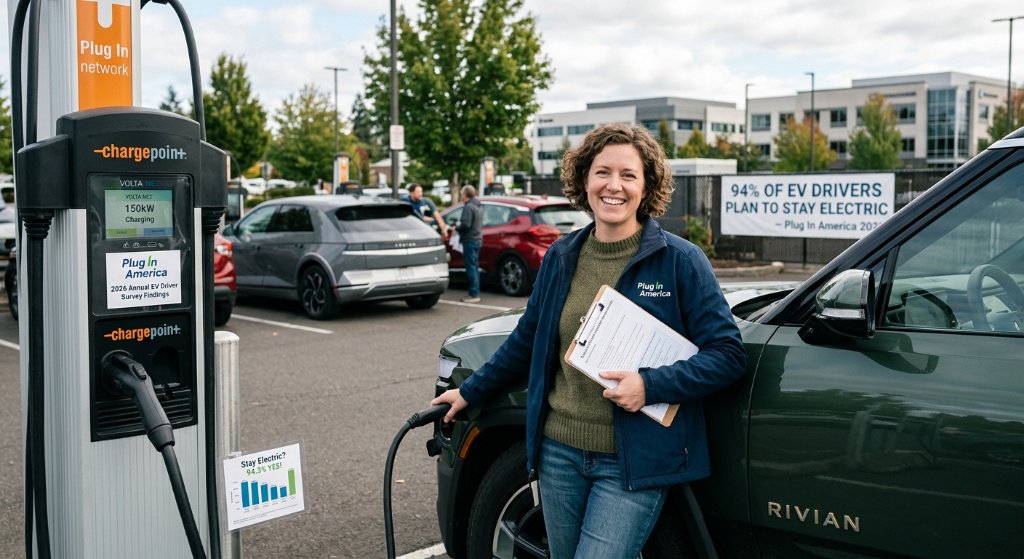
For the past several years, mainstream media and hesitant legacy automakers have loudly repeated a single, pessimistic narrative: "EV fatigue" has set in. Heavyweight OEMs like Ford, General Motors, and Mercedes-Benz have used this alleged slowdown to walk back their ambitious electrification targets, pivoting heavily toward hybrids while claiming consumer demand simply isn't there.
But the hard data tells a vastly different story. Plug In America has released its highly anticipated 2026 Annual EV Driver Survey, and the results act as a reality check for the entire automotive industry. Surveying 4,205 participants—including 3,809 active EV drivers—the study proves that once consumers cross the electric threshold, there is virtually zero desire to ever return to internal combustion engines (ICE).
The Unmatched Stickiness of the EV Experience
The most striking revelation from the 2026 survey is the near-total loyalty of current electric vehicle owners. A staggering 94.3% of EV owners expect their next vehicle purchase to be another EV. Conversely, a microscopic 0.5% of respondents stated they would actually switch back to a traditional gasoline or diesel vehicle if they were buying a car today.
This extreme retention rate is driven by real-world satisfaction, not ideological loyalty. According to the survey:
- Cost-Efficient Fueling: Over 90% of respondents consider their EVs significantly cheaper to fuel than gasoline vehicles.
- Effortless Ownership: More than 90% report that their EVs are far easier to maintain, free from the constant burden of oil changes, spark plugs, and complex transmission services.
- Superior Dynamics: Upwards of 90% state their EVs are simply more enjoyable to drive, citing instant torque, quiet cabins, and smooth acceleration.
Redefining the 'Commuter Car' Myth
For years, skeptics dismissed EVs as secondary household vehicles—glorified commuter cars meant only for short grocery runs while a "real" gas-powered SUV handled the heavy lifting. The 2026 data thoroughly dismantles this assumption.
In dual-vehicle households (homes owning both an EV and an ICE vehicle), 75% of respondents report that the EV is driven more frequently than the household's gasoline-powered alternative. Far from being a niche luxury or a secondary runabout, the electric car has cemented itself as the primary household workhorse, capturing the vast majority of family miles.
Charging Infrastructure Finally Finds Its Footing
Historically, the non-Tesla public charging experience has been the Achilles' heel of the EV transition, plagued by broken screens, failed handshakes, and offline dispensers. However, the 2026 survey brings much-needed positive news on this front.
Reports of broken chargers on non-Tesla networks decreased by nearly 10% year-over-year. This improvement points to a maturation of the charging ecosystem, likely catalyzed by two key factors:
- The NACS Transition: The industry-wide shift toward Tesla’s North American Charging Standard (NACS) has forced third-party operators to modernize their hardware and communication protocols.
- Federal Push for Reliability: Under NEVI (National Electric Vehicle Infrastructure) formula program guidelines, federal funding is strictly tied to a 97% uptime requirement, forcing third-party networks like Electrify America and EVgo to aggressively repair and maintain their existing footprints.
Why This Matters:
This survey is a devastating blow to the narrative that the EV transition is stalling. The findings send a crystal-clear signal to the market: the demand problem isn't a consumer problem; it's a product and pricing problem.
- The Winners: EV-first manufacturers like Tesla, Rivian, and Hyundai-Kia, who have kept their feet firmly on the accelerator. They are capturing a highly loyal customer base that will never buy a gas car again. When these drivers re-enter the market, they will look exclusively at electric options.
- The Losers: Legacy automakers who paused their EV programs to focus on short-term hybrid profits. By scaling back their EV roadmaps, these companies are actively ceding their future market share. If 94% of EV buyers refuse to go back to gas, legacy brands without compelling, affordable EVs will find themselves shut out of the most profitable customer segment of the next decade.
- The Market Signal: The transition is an asymmetrical doorway. Once a driver passes through, the door locks behind them. The automakers who fail to realize this are building vehicles for a past that is rapidly disappearing.