The EV Repair Bottleneck: Why Battery and ADAS Complexities Are Driving Insurance Premiums to the Brink
Electric vehicles were supposed to represent a triumph of simplified engineering—fewer moving parts, lower maintenance, and a cleaner footprint. But b...
Editorial Team
World Of EV
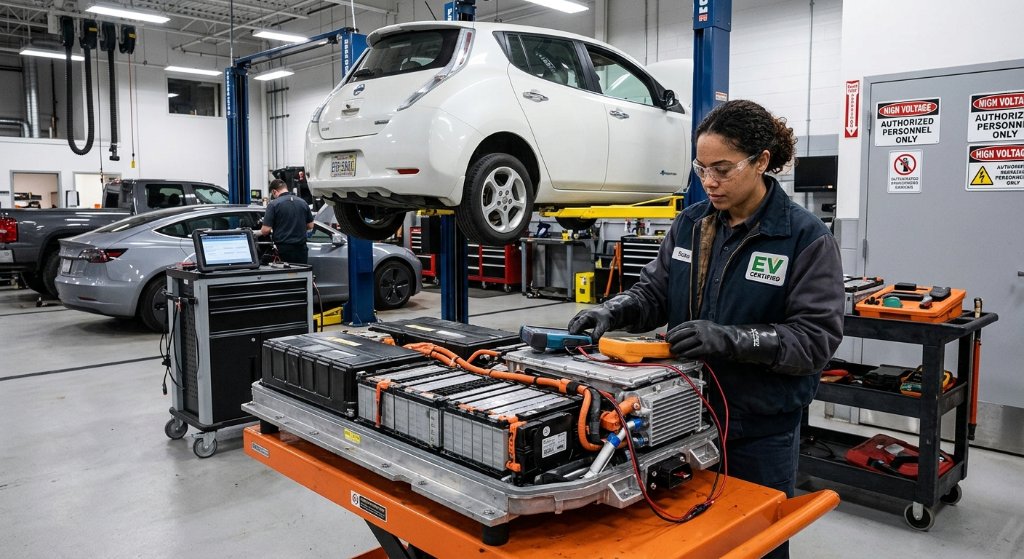
Electric vehicles were supposed to represent a triumph of simplified engineering—fewer moving parts, lower maintenance, and a cleaner footprint. But beneath the sleek sheet metal of today's cutting-edge EVs, a complex storm is brewing that threatens to derail the cost-of-ownership equation. A groundbreaking global study released by the international Research Council for Automobile Repairs (RCAR) has sounded a clear alarm: the rapid advancement of EV structural batteries and advanced driver assistance systems (ADAS) is creating an unprecedented repair bottleneck, leaving insurance carriers with little choice but to write off vehicles over minor accidents.
This isn't a localized issue. Compiling data from over 20 insurer-backed research centers across five continents—including prominent bodies like the US's Insurance Institute for Highway Safety (IIHS) and the UK's Thatcham Research—the RCAR report highlights a widening disconnect between automotive design and post-crash reality. Historically, minor fender-benders resulted in simple cosmetic fixes. Today, structural integration trends (such as Tesla’s 4680 structural battery packs and megacastings) alongside hyper-sensitive safety sensors are turning routine collisions into financial write-offs.
The High-Voltage Headache: Battery Repairability vs. Total Loss
The heart of the issue—both financially and structurally—is the EV traction battery, which typically represents up to 40% of the vehicle’s total value. Early-generation EVs utilized modular battery packs where damaged or defective cells could be easily serviced or swapped. However, modern manufacturing has shifted toward structural, cell-to-chassis architectures. While this saves weight and improves range, it makes diagnostic testing and physical repairs nearly impossible for third-party workshops.
Key battery repairability findings from the global research include:
- The Structural Trap: Structural battery packs integrate the battery case directly into the vehicle's floor pan. Minor underbody scrapes or minor side-impact collisions can compromise the battery casing. Because these units are sealed, insurers are forced to replace the entire pack rather than repair a small section, often writing off the entire car.
- Diagnostic Blind Spots: Independent repair shops and insurers lack access to real-time, granular battery health data from OEMs, making it incredibly difficult to safely determine if a pack has suffered internal damage.
- The 'Replace over Repair' Default: Due to strict liability rules, safety concerns around thermal runaway, and a lack of standardized testing protocols, repairers are default-replacing complete high-voltage systems.
The ADAS Conundrum: Minor Dents, Major Calibration Costs
Advanced Driver Assistance Systems (ADAS)—ranging from lane-keep assist to autonomous emergency braking—have undeniably reduced crash frequencies. However, when collisions do occur, the complexity of restoring these systems is causing claims costs to skyrocket. Cameras, radar units, and LiDAR sensors are routinely embedded in high-impact zones like front bumpers, grilles, and windshields.
The study outlines several critical ADAS repair challenges:
- Hyper-Sensitive Component Placement: A simple bumper scuff that used to cost $500 to paint now requires a multi-thousand-dollar repair bill because the underlying radar sensors must be replaced and meticulously calibrated.
- Calibration Complexity: Static and dynamic calibration processes require specialized, highly expensive alignment targets, pristine workshop conditions, and specialized technician training that many independent shops cannot afford.
- System Interdependence: A minor misalignment in a rear-quarter radar can cause front-facing safety systems to throw error codes, dramatically increasing diagnostic times.
Labor Time Methodologies: A Broken Yardstick
Beyond hardware, the RCAR report highlights a fundamental flaw in how repair labor is billed. Standard labor-time guides, developed over decades for internal combustion engine (ICE) vehicles, are completely unsuited for high-voltage EVs. Safe EV repair demands a multi-step 'depowering' and 're-powering' safety protocol before any work can begin. This process alone can add hours of highly paid, specialized labor to a bill, completely skewing traditional repair estimates. Without globally standardized labor time frameworks for EVs, insurers are struggling to accurately forecast claims costs, leading to erratic underwriting and higher premiums.
Why This Matters:
This global study signals a critical crossroads for the EV transition. We are witnessing a classic conflict between manufacturing efficiency and consumer ownership viability.
- The Losers: Consumers and Insurers. EV buyers are already seeing their insurance premiums spike—sometimes up to double the rate of equivalent gas cars—as insurers scramble to offset the high rate of total losses. If minor cosmetic damage continues to result in $20,000 battery replacement bills, EVs will quickly become uninsurable for the mass market, stalling adoption.
- The Winners (Eventually): Modular and Repair-Friendly OEMs. Automotive giants who design with repairability in mind stand to win big. For instance, BYD’s recent efforts to balance structural integrity with accessible service points, and GM’s Ultium platform’s modular design, could become major selling points. Meanwhile, pioneers of radical integration, like Tesla, face a 'do-or-die' moment to provide modular repair paths for their structural packs before high insurance costs scare away mainstream buyers.
- The Regulatory Outlook: Expect insurance consortiums and safety advocates to aggressively lobby governments for 'Right to Repair' legislation specifically targeting EV battery diagnostics and ADAS calibration. OEMs will likely be pressured to standardize battery state-of-health (SOH) data access to prevent premature vehicle scrapping.
Conclusion
The RCAR report makes one thing abundantly clear: the automotive industry can no longer design vehicles in a vacuum. True sustainability is not just about tailpipe emissions; it is about circularity and keeping vehicles on the road. Until automakers align with insurers and repair networks to prioritize repairability over pure manufacturing cost-cutting, the dream of affordable, mass-market EV ownership will remain hostage to skyrocketing insurance premiums.