The EV 'Ticking Time Bomb' Myth Is Dead: New Data Reveals Modern Batteries Are Outlasting the Cars Themselves
For years, the loudest skeptics of the electric vehicle transition chanted a familiar, ominous refrain: "Just wait until you have to replace that $15,...
Editorial Team
World Of EV
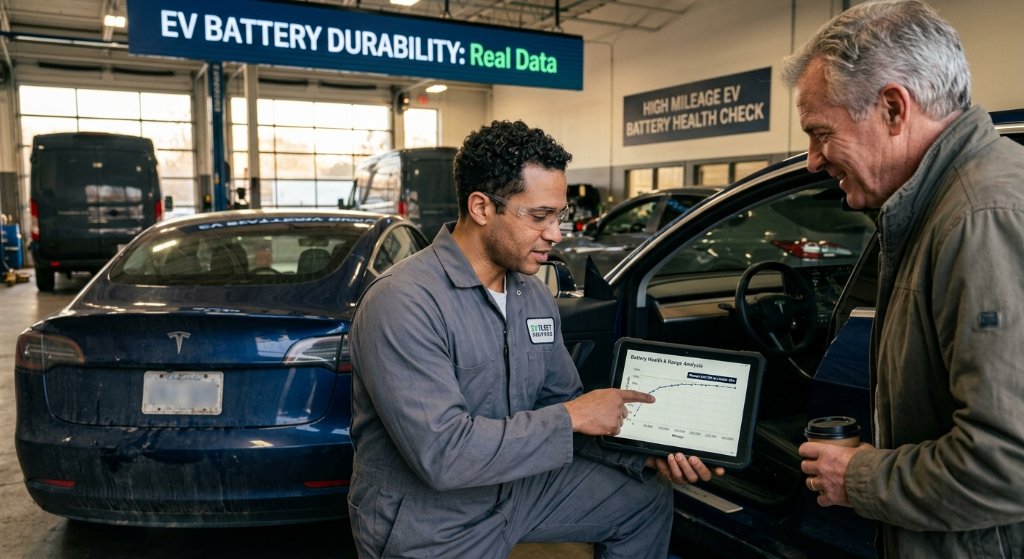
For years, the loudest skeptics of the electric vehicle transition chanted a familiar, ominous refrain: "Just wait until you have to replace that $15,000 battery." This ultimate boogeyman has cast a long shadow over the industry, fueling range anxiety and paralyzing prospective buyers with the fear of owning a costly, out-of-warranty brick.
But a massive wave of real-world fleet data has finally exposed this narrative as a relic of the past. In the early days of electrification—exemplified by the first-generation Nissan Leaf, which lacked active liquid cooling and suffered rapid battery degradation—such anxieties had a kernel of truth. Today, the landscape is completely unrecognizable. According to groundbreaking new studies from battery-analytics leader Recurrent and telematics giant Geotab, modern EV batteries are not just meeting expectations—they are vastly outperforming them, proving to be far more durable than almost anyone projected.
The Hard Numbers: Inside the Death of Battery Anxiety
The data paints an undeniably optimistic picture of EV longevity. Recurrent’s extensive tracking of tens of thousands of vehicles reveals that the average modern EV retains up to 95% of its original driving range after five years on the road. The rate of catastrophic battery failures has plummeted to near-insignificance thanks to sophisticated thermal management systems, mature chemistry, and protective software buffers.
To put the technological leap into perspective, look at how battery replacement rates have cratered over the last decade:
- 2011–2016 (The Early Pioneers): Approximately 8% of vehicles (1 in 12) required a battery replacement, heavily weighted by early models lacking active liquid cooling.
- 2015–2024 (The Transition Era): Replacement rates dropped to roughly 2% as liquid cooling and improved chemistries became standard.
- 2022 Onward (The Modern Standard): Only 0.3% of vehicles (a mere 3 in 1,000) have required a battery replacement so far.
Real-World Torture Tests and Fast-Charging Realities
This durability isn't just theoretical; it's being proven daily by high-mileage road warriors. Consider the real-world case of a five-year-old Tesla Model 3 operated by a UK used-EV dealer that has safely logged over 247,000 miles on its original pack, yet still effortlessly completes long-distance road trips.
Meanwhile, Geotab’s analysis of 22,700 EVs across 21 different models reveals an average battery degradation rate of just 2.3% per year. Even under the harshest conditions, the cells hold strong:
- The DC Fast Charging Penalty: While plugging into ultra-fast chargers (>100 kW) is the single greatest operational stressor on lithium-ion cells, Geotab's data shows that vehicles frequently fast-charged still retain roughly 89.7% of their original capacity after several years.
- The Climate Factor: Vehicles operating in hot climates experience only a minor penalty, degrading just 0.4% faster per year than those in mild climates—a testament to modern active liquid-cooling systems that protect the cells from extreme heat.
Why This Matters:
The revelation that EV batteries will likely outlast the chassis of the cars they power triggers a massive ripple effect across the entire automotive ecosystem.
- The Used EV Market Finally Ignites: Historically, brutal depreciation has plagued used EVs because buyers feared inheriting a dying battery. Reliable, easily verifiable battery health data will stabilize residual values, making pre-owned EVs highly attractive, affordable options for mainstream buyers.
- Legacy Dealership Models Face an Existential Crisis: Franchise dealerships make the bulk of their profits on service and maintenance. If an EV requires zero engine maintenance and its battery comfortably lasts 20 years, the traditional service-bay business model is effectively dead.
- The "Disposable Tech" Narrative is Crushed: For years, critics compared EVs to smartphones, claiming they would end up in landfills after a few years. Instead, these highly durable packs will fuel a lucrative second-life battery economy, acting as stationary grid storage units for decades after the car itself is retired.
- The Shift in OEM Warranties: Currently, federal law mandates an 8-year/100,000-mile battery warranty. With failure rates below 1%, look for forward-thinking automakers to start offering 10- or 15-year warranties as a competitive marketing weapon.
Conclusion
The "ticking time bomb" of EV ownership has officially been defused. The transition from crude, air-cooled packs to highly sophisticated, liquid-cooled, software-managed energy systems has successfully transformed the battery from a liability into the most durable component of the vehicle. As consumer awareness catches up to this statistical reality, the final psychological barrier to mass EV adoption will crumble.