The Garage Bottleneck: J.D. Power's 2026 Study Proves Dealerships Are Failing the EV Transition
For years, the mainstream narrative around electric vehicle adoption has focused heavily on public fast-charging networks—whether celebrating the open...
Editorial Team
World Of EV
For years, the mainstream narrative around electric vehicle adoption has focused heavily on public fast-charging networks—whether celebrating the opening of Tesla's Superchargers to other brands or tracking the rapid rise of OEM-backed joint ventures like IONNA. Yet, this public-charging fixation ignores a fundamental truth of electric vehicle ownership: the transition lives and dies in the driveway. According to the newly released J.D. Power 2026 U.S. Electric Vehicle Experience (EVX) Home Charging Study, a massive 86% of all EV charging occurs at home. But as electricity costs rise, a critical bottleneck has emerged, and it is not the electrical grid—it is the dealership floor.
The study paints a sobering picture of rising consumer frustration. Average monthly home charging costs have climbed to $63, dragging overall satisfaction with charging costs down by 11 points to 687 on a 1,000-point scale. While drivers can easily mitigate these costs using smart-scheduling features to charge during off-peak hours, a shocking dealership education gap is keeping them in the dark. Only 20% of EV buyers received any instructions or advice from their dealer on how to properly optimize home charging.
The High Cost of the Scheduling Gap
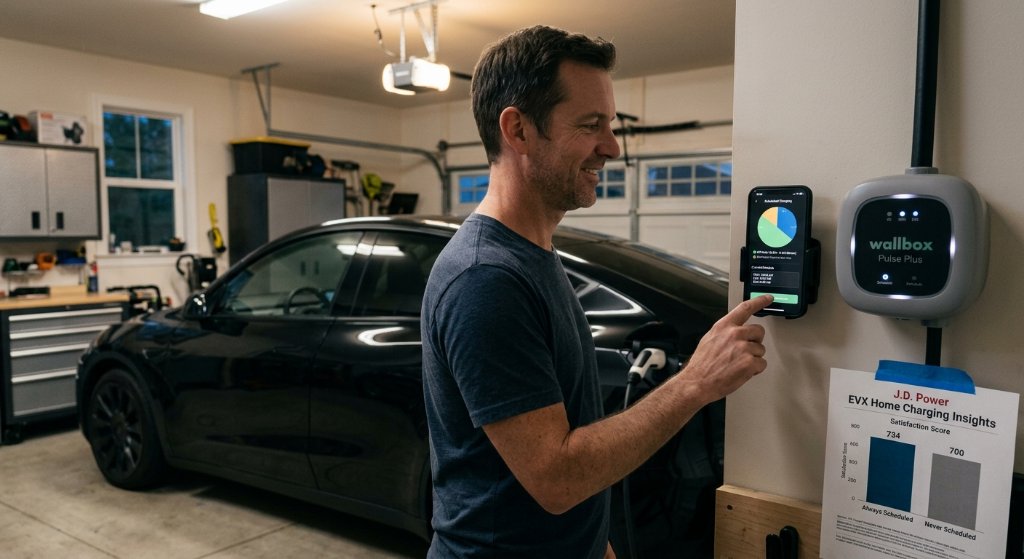
Failing to schedule charging is actively costing EV owners money, yet the majority are completely missing out on this low-hanging fruit. J.D. Power's data highlights a massive satisfaction divide between those who actively manage their home charging and those who simply plug and pray:
- The Satisfaction Dividend: EV owners who always schedule their home charging to off-peak hours reported a satisfaction score of 734 (on a 1,000-point scale), compared to just 700 for those who never schedule.
- The Silent Majority: Despite clear cost benefits, only 38% of EV owners always schedule their home charging, while a staggering 46% never schedule.
- Regional Disparities: The financial impact is highly geographic. In New England, where electricity rates are notoriously high, average monthly charging costs hit $99, resulting in a miserable cost satisfaction score of 552. By contrast, Mountain region owners enjoy $36 monthly bills and a satisfaction score of 771.
Why Traditional Dealerships Are Failing the EV 101 Test
Legacy auto dealers are still treating EV deliveries exactly like internal combustion engine (ICE) handoffs—handing over the keys, pairing a phone to Bluetooth, and wishing the customer luck. But an EV is not just a car; it is a high-voltage appliance that interacts with a home's electrical panel and local utility grid. By failing to educate 80% of buyers on optimizing home charging, dealers are directly damaging the long-term EV ownership experience.
- The Utility Disconnect: While 69% of EV owners are aware of utility-sponsored smart-charging incentive programs, only 12% actually participate in them. Without dealer guidance at the point of sale, buyers simply do not take the final step to register.
- Hardware Choice Matters: Level 2 permanently mounted home chargers continue to deliver the highest satisfaction (733), holding steady even as Level 1 (-12 points) and Level 2 portable (-4 points) satisfaction slips. Yet, dealers are failing to guide buyers toward these superior permanent solutions at the time of purchase.
Why This Matters:
This is a flashing red warning light for legacy automakers. For decades, the franchised dealer model has insulated OEMs from the day-to-day hassles of customer service. Today, that lack of control is actively hurting EV adoption. When an owner receives a sky-high utility bill because they plugged in their vehicle at 5:00 PM during peak grid demand, they do not blame their local electric utility—they blame their EV.
The Winners: Tesla and direct-to-consumer digital natives like Rivian. Tesla has ranked highest in Level 2 permanently mounted charger satisfaction for six consecutive years because their ecosystem is entirely integrated. Tesla's app actively prompts users to set up scheduled charging based on their local utility, effectively bypassing the need for a human dealer to explain it.
The Losers: Legacy OEMs like Ford, GM, and Hyundai, who rely entirely on independent dealer networks. If these dealer groups refuse to retrain sales staff to act as "energy consultants" rather than transactional order-takers, they will continue to bleed customers to brands that offer a seamless, automated software experience.
The Long-Term Play: To save the transition, the point-of-sale experience must change. Automakers must either force dealers to implement mandatory EV delivery checklists or—more realistically—bypass the dealer entirely by building robust, location-aware software that automatically detects local utility rates and configures off-peak charging schedules straight out of the box.
Conclusion
The J.D. Power 2026 home charging study proves that the hardest part of EV ownership is no longer the vehicle itself, but the surrounding ecosystem. As electricity costs climb, legacy automakers can no longer afford to let uneducated dealerships serve as the primary ambassadors to the electric age. If the industry does not bridge this education gap with smarter, automated software and better dealer training, rising utility bills will continue to sour the mainstream consumer's appetite for electric vehicles.