The Great Electric Pivot: Why 53% of US Drivers Are Warming to EVs as Gas Pain Drives a Massive Sentiment Shift
After a year of hand-wringing over a supposed "EV winter"—exacerbated by the rolling back of federal tax credits and a dip in market share to just 5.3...
Editorial Team
World Of EV
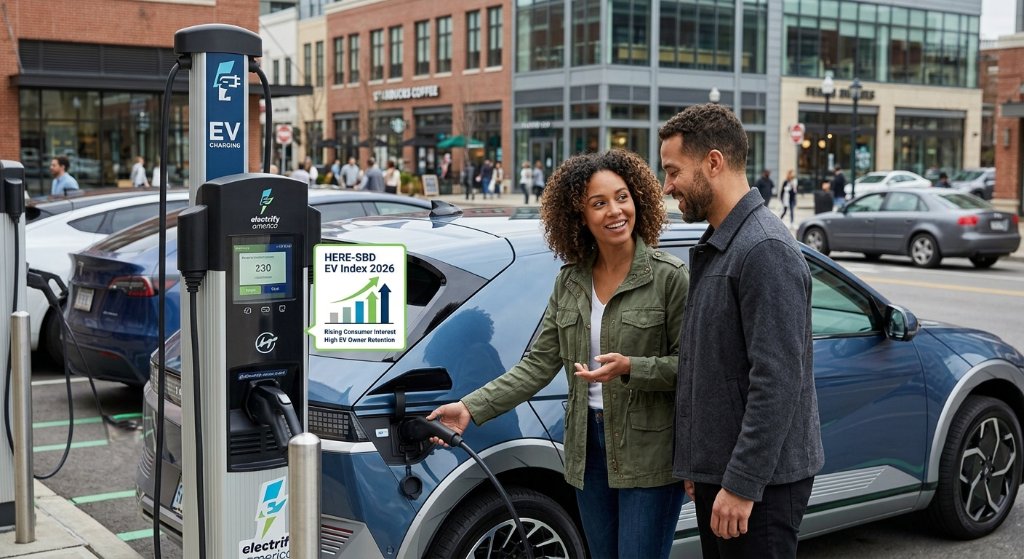
After a year of hand-wringing over a supposed "EV winter"—exacerbated by the rolling back of federal tax credits and a dip in market share to just 5.37%—the American consumer is quietly undergoing a major transformation. The newly released HERE-SBD EV Index 2026 delivers a powerful, data-backed reality check to the naysayers. Far from abandoning the electric transition, 53% of U.S. drivers report they are more open to considering an electric vehicle than they were just twelve months ago.
Driven by a combination of punishingly volatile fuel prices and a massive expansion in charging infrastructure, consumer sentiment is diverging sharply from current sales figures. It is a classic leading indicator: while automaker showrooms might feel the temporary chill of high interest rates and regulatory shifts, the underlying dam of consumer resistance is beginning to crack.
The One-Way Street: EV Owners Refuse to Go Back
The most damning indictment of the internal combustion engine (ICE) in this year's index isn't what non-EV drivers think—it’s what current EV owners know. A staggering 80% of current EV drivers declare they will never return to gas-powered vehicles. Once a driver experiences the instant torque, whisper-quiet cabin, and the sheer convenience of waking up to a "full tank" via home charging, going back to the gas station feels like a technological demotion.
For legacy carmakers who have hesitated, paused, or completely rolled back their electrification plans—such as General Motors delaying key battery plants or Toyota continuing its heavy reliance on hybrids—this 80% retention rate is a flashing red warning light. EV adoption is a one-way valve; once consumers cross over, they do not return to the ICE fold.
Gas Pain Meets Charging Gains
While rising fuel prices are acting as the primary catalyst—with 57% of respondents noting that volatile pump prices spiked their interest in electric alternatives—the rapid build-out of the charging grid is providing the reassurance needed to convert that interest into consideration.
Key takeaways from the HERE-SBD EV Index 2026 infrastructure data include:
- The Charging Grid Surge: Over the past year, the U.S. added 31,600 new public charging points, representing a 13% expansion of the nationwide footprint.
- The Power Play: Total public charging capacity skyrocketed by 47%, jumping from 14.1 gigawatts (GW) to 20.7 GW, proving that faster DC fast-charging is rapidly becoming the norm.
- Warming Perceptions: Positive consumer perception of public charging availability nearly doubled, soaring from 28% last year to 47% in 2026.
- Zero Barriers: The segment of drivers who see absolutely zero barriers to adopting an EV doubled year-over-year, climbing from 6% to 12%.
Why This Matters:
This data signals a profound market shift that legacy OEMs ignore at their peril. The short-term dip in EV market share to 5.37% has lulled several traditional automakers into a false sense of security, leading them to revive ICE investments and delay dedicated EV platforms. But the HERE-SBD EV Index reveals this "slump" is a temporary bottleneck of supply, pricing, and transition friction, not a lack of consumer desire.
The big winners in the next 24 to 36 months will be the automakers who stayed the course. Companies like Hyundai-Kia—with their highly praised E-GMP architecture—and Tesla, which continues to dominate the public fast-charging landscape via its newly opened NACS network, are perfectly positioned to capture this wave of "EV-ready" buyers. Conversely, the losers will be the OEMs that paused development to milk hybrid sales, only to find themselves without competitive, affordable, next-generation pure EVs when these 53% of open-minded buyers flock to showrooms. High gas prices are the hook, but the growing maturity of the charging network is the sinker.
Conclusion
The HERE-SBD EV Index 2026 shows that the narrative of a dying EV market is flat-out wrong. What we are witnessing is the difficult, messy middle of a major technological transition. As charging anxiety recedes and pump prices continue to pinch wallets, the gap between consumer interest and actual sales will inevitably close. The road to electrification is no longer a question of "if," but how fast automakers can scale to meet a massive wave of pent-up demand.