The Great Rebalancing: Tesla Loses Majority U.S. EV Share as Price Wars Intensify
For the first time since the fourth quarter of 2017, Tesla's dominant grip on the U.S. electric vehicle market has loosened, with its market share fal...
Editorial Team
World Of EV
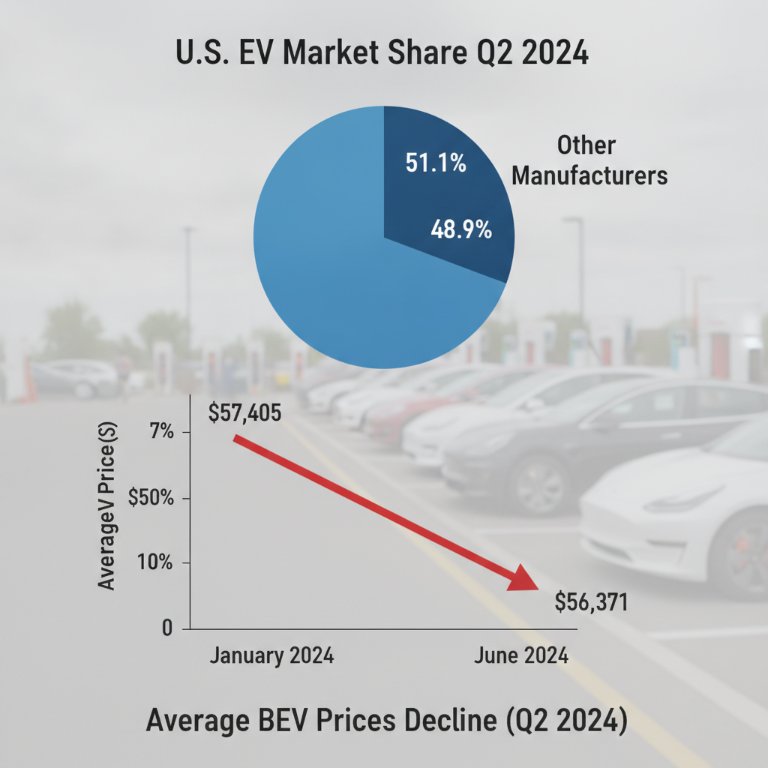
For the first time since the fourth quarter of 2017, Tesla's dominant grip on the U.S. electric vehicle market has loosened, with its market share falling below the majority threshold to 48.9% in the second quarter of 2024. This seismic shift not only signals a new era of intensified competition but also coincides with a notable decline in the average transaction price for battery electric vehicles (BEVs), reflecting a rapidly maturing and diversifying automotive landscape.
Tesla's Shifting Sands
Tesla’s dip below 50% market share is more than just a statistical blip; it marks the definitive end of an unchallenged reign. For years, Tesla was synonymous with electric vehicles, often representing the only viable or desirable option for many early adopters. Their pioneering efforts in EV technology, charging infrastructure, and direct-to-consumer sales created a formidable lead. However, as the EV ecosystem expands, so too does the competition. This reduction in market share isn't necessarily a sign of Tesla's decline, but rather a robust indicator of other manufacturers finally gaining significant traction and offering compelling alternatives that resonate with a broader customer base.
The Price Correction Continues
Accompanying this market share recalibration is a clear trend of declining EV prices. According to data from Cox Automotive, the average transaction price for BEVs in the U.S. moved from $57,405 in January 2024 to $56,371 in June 2024. This isn't just a minor fluctuation; it represents a strategic pivot across the industry. Manufacturers, including Tesla itself with various price adjustments, are increasingly focused on achieving economies of scale and appealing to the mainstream buyer who demands more competitive pricing. This sustained downward pressure on prices is a natural progression as the market matures and production capacities increase, moving EVs from a niche luxury item to a more accessible transportation option.
Legacy Automakers Gain Traction
The most significant beneficiary of Tesla's shrinking market share appears to be the collective of legacy automakers. After years of criticism for their cautious, and sometimes lackluster, approach to electrification (think early efforts like the Mazda MX-30, which struggled with range and appeal), traditional automotive giants are now delivering on their multi-billion-dollar investments. Models from Ford, GM, Hyundai, Kia, and others are proving increasingly competitive in terms of range, features, charging capability, and, crucially, availability. Consumers are now spoiled for choice, with a diverse array of body styles, price points, and brand loyalties catering to nearly every segment.
Why This Matters:
For Consumers: This is unequivocally good news. More competition means more innovation, better features, and, as the data clearly shows, more aggressive pricing. The days of paying a premium just for an EV badge are fading, ushering in an era of genuine value propositions. The market is evolving to offer something for every budget and preference.
For Tesla: This marks a critical inflection point. While still the leading EV brand, Tesla can no longer rely solely on its first-mover advantage. The company must intensify its focus on innovation, cost efficiency, and customer experience to maintain its edge. This could spur faster development of next-generation platforms, more aggressive pricing strategies, or even a renewed emphasis on services like its Supercharger network.
For Legacy Automakers: This is a crucial validation of their electrification strategies. Their sustained investment is paying off, signaling that they can, and will, compete effectively against the EV pioneer. This newfound momentum will likely accelerate their future EV development and market penetration efforts, potentially leading to an even more diverse and competitive landscape.
For the Industry: The entire market is signaling a shift from early adoption to mainstream integration. The 'EV premium' is eroding, and the emphasis is moving towards total cost of ownership, practicality, and direct comparison with internal combustion engine (ICE) vehicles. This competitive environment will drive technological advancements and accelerate the overall transition to electric mobility.
Conclusion:
The second quarter of 2024 will be remembered as a pivotal moment in the U.S. electric vehicle market. Tesla's move below a majority market share, coupled with declining average transaction prices, unequivocally signals the maturation of the EV sector. What was once a nascent market dominated by a single innovator has transformed into a vibrant, highly competitive arena benefiting consumers with greater choice and more affordable options. The road ahead promises continued innovation, strategic pricing battles, and an exciting push towards a fully electrified automotive future.