The Invisible Bottleneck: Why EV Chargers Stay Broken for Weeks Before Anyone Even Grabs a Wrench
For years, the Achilles' heel of the electric vehicle transition has been the public charging experience. While legacy automakers like Ford, GM, and R...
Editorial Team
World Of EV
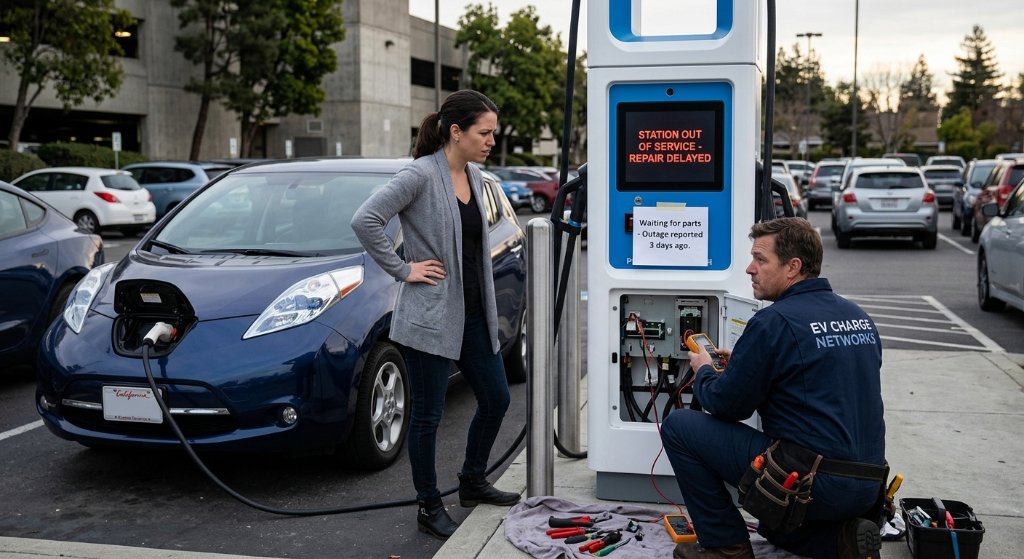
For years, the Achilles' heel of the electric vehicle transition has been the public charging experience. While legacy automakers like Ford, GM, and Rivian have rushed to adopt Tesla's NACS connector to bypass their own software and hardware headaches, a massive hurdle remains: the sheer, agonizing downtime of broken non-Tesla fast chargers. Just when recent J.D. Power studies suggested public charging satisfaction was starting to tick upward, a sobering new report highlighted by Kelley Blue Book reveals a damning truth. The reason that fast charger down the street has been covered in a trash bag for a month isn't because of a complex physical breakdown. It is because of a bureaucratic and logistical logjam that occurs long before a technician ever sets foot on site.
The Pre-Repair Black Hole
According to the 2026 Reliability Report by EV maintenance specialist ChargerHelp, the bulk of a broken charger's downtime is spent in a state of administrative limbo. While frustrated drivers blame slow technicians, the study reveals that diagnosing the issue remotely, securing system approvals, coordinating with site hosts, and waiting for parts account for the vast majority of outages.
Key findings from the data include:
- The Coordination Trap: In a sample analysis of lengthy delays, parts shortages and "access coordination" (gaining permission to work on site hosts' property) accounted for a staggering 92% of the delays.
- The Multi-Visit Penalty: Nearly 36% of charger outages required multiple technician visits. While they represent about a third of all cases, these complex issues consumed 48% of total downtime days—taking an average of 39 days to resolve compared to just 18 days for single-visit fixes.
- The Waiting Game: The median time to resolve a charger issue is nine days, but the mean is 22 days. This discrepancy is driven by a "long tail" of deeply troubled stations; 11% of broken chargers remain offline for more than 60 days.
Bureaucracy Over Wrenching
The report shifts the critical industry metric from simple "uptime" (which can be easily simulated or misleading) to Mean Time to Repair (MTTR) and First-Time Charge Success Rate (FTCSR). It highlights that even when a single work order is all that is required, a median of two days is wasted simply waiting to dispatch a technician after the failure is identified. For more complex cases requiring multiple work orders, the median resolution time balloons to 32 days.
This isn't a problem of unskilled labor; it is a fragmented ecosystem where hardware manufacturers, network operators (like Electrify America or ChargePoint), third-party maintenance providers, and retail site hosts (like Walmart or local gas stations) fail to communicate efficiently.
Why This Matters:
This report is a wake-up call for the entire EV infrastructure industry, signaling a shift from a "build-it-and-forget-it" land grab to a "do-or-die" phase of operational maturity.
- Who Wins: Tesla remains the undisputed victor. Because Tesla vertically integrates its Supercharger network—controlling the hardware manufacturing, software development, site licensing, and dedicated maintenance crews—it completely bypasses the multi-party coordination trap that plagues competitors. Consequently, Supercharger uptime and reliability continue to set the industry gold standard.
- Who Loses: Third-party Charge Point Operators (CPOs) and EV drivers. As federal funding from programs like the National Electric Vehicle Infrastructure (NEVI) formula program mandates strict 97% uptime requirements, operators who cannot streamline their repair pipelines will lose out on millions in government subsidies. Meanwhile, mainstream buyers will continue to experience "range anxiety" transformed into "charger anxiety"—which remains the single biggest deterrent to widespread EV adoption.
- The Strategic Shift: For network operators, throwing more technicians or deploying more redundant chargers at a site is no longer a viable fix. To survive, companies must transition to predictive maintenance models, establish standardized digital ticketing systems, and secure ironclad service-level agreements (SLAs) with land hosts and parts distributors. Without these operational upgrades, the public charging network will continue to crumble under its own administrative weight.
Conclusion
Ultimately, the physical repair of an EV charger is the easy part—it's the red tape and supply-chain friction that is keeping America's charging network in the dark. As EV adoption moves past early adopters and into the mass market, drivers expect public chargers to work with the seamless reliability of a traditional gas pump. Bridging the gap between a broken screen and a dispatched technician is no longer just a customer service issue; it is the definitive operational challenge that will decide which charging networks survive the decade.