The Peer-to-Peer Veto: Why Word-of-Mouth is Deciding the Winners of the EV Charging War
For years, Charge Point Operators (CPOs) have safely hidden behind shiny, corporate-approved "99% uptime" metrics. Meanwhile, EV drivers have quietly ...
Editorial Team
World Of EV
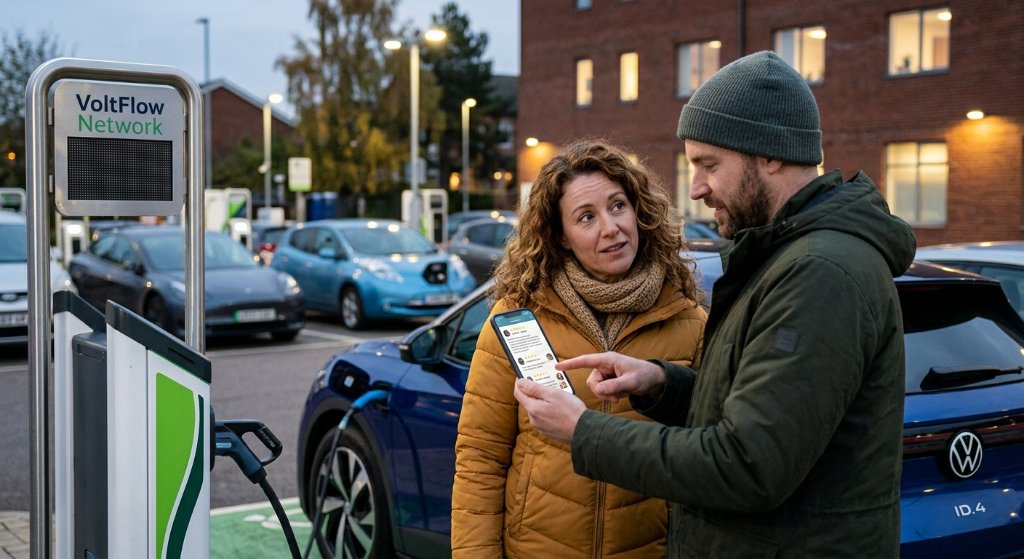
For years, Charge Point Operators (CPOs) have safely hidden behind shiny, corporate-approved "99% uptime" metrics. Meanwhile, EV drivers have quietly suffered through the harsh reality: broken screens, payment failures, and the dreaded red ring of a dead dispenser. But the era of greenwashing public charging reliability is officially over. A landmark study of over 3,000 EV drivers across North America and Europe, released on World EV Day (September 9, 2026) by EV software leader Driivz, reveals that drivers have completely lost faith in corporate promises. Instead, they are turning to a powerful new weapon: each other.
The transition of the North American market to the NACS (North American Charging Standard) plug and Europe’s frantic buildout under strict infrastructure mandates have elevated charging from a logistical detail to a high-stakes competitive battlefield. As we move past early adopters and into the mass-market phase of EV ownership, the industry is shifting from "range anxiety" to "charge anxiety". This new data proves that the social grapevine is now the ultimate gatekeeper of public charging.
The Power of the Peer-to-Peer Veto
The headline statistic from the Driivz survey should send shivers down the spines of underperforming network executives: a staggering 76% of EV drivers will completely avoid a specific charging network based solely on negative warnings from friends or family. In this hyper-connected, crowdsourced ecosystem, a poor charging experience is no longer a private inconvenience. It is an immediate, infectious brand killer.
The survey highlights just how fast bad news travels on the electric highway:
- 79% of drivers who experience a charging failure will actively warn friends or family to stay away.
- 76% of drivers will immediately report the issue through a charging app to warn the wider community.
- 65% of drivers will go a step further and leave a scorching online review.
- On the flip side, positive experiences do breed loyalty, but at a slower rate, with only 42% of drivers likely to recommend a charger that exceeded expectations.
Detouring for Quality: The 91% Club
Convenience is no longer measured in absolute distance; it is measured in peace of mind. Driivz discovered that 91% of EV drivers are willing to make a physical detour to use a charging station recommended by another driver. Even more striking, 55% of respondents are willing to drive more than five minutes out of their way to reach a trusted plug.
This behavioral shift is completely upending how drivers navigate:
- Peer Reviews Over Premium Maps: When hunting for an unfamiliar charging location, drivers trust dedicated EV charging discovery apps (33%) and word-of-mouth recommendations (32%) far more than standard satellite navigation systems or general mapping apps (27%).
- The Trust Silo: Among those who rely on specialist apps and personal recommendations, approximately 80% actively distrust standard OEM or dashboard navigation tools to point them toward a working charger.
Why This Matters:
This data signals a tectonic shift in the EV ecosystem. The days of "build it and they will come" are dead. We are entering the era of "intelligent profitability," where a charging network’s survival depends entirely on its actual, real-world utilization rates rather than the sheer quantity of its red-tape-wrapped installations.
The Winners: Ultra-reliable, vertically integrated networks like Tesla's Supercharger network and forward-thinking retail partnerships (such as BP Pulse and Shell Recharge) that are hyper-focused on uptime and amenities. Additionally, specialist platforms like PlugShare and A Better Routeplanner solidify their roles as the true navigators of the electric revolution, bypassing the often-clunky built-in nav systems of legacy automakers.
The Losers: Low-performing legacy networks that treat chargers like "install-and-forget" kiosks. Because a single bad experience triggers a cascade of peer warnings, underperforming networks face a high risk of being collectively blacklisted. Once a charging site gains a bad reputation on the grapevine, its utilization rate will plummet, turning expensive hardware installations into stranded, unprofitable assets.
The Market Signal: CPOs can no longer get away with reporting technical uptime (which often just means the charger is "plugged into power" but still unable to initiate a charge). Drivers expect a first-time success rate. If operators want to capture NEVI funding or stay afloat in a highly competitive market, they must invest heavily in automated diagnostics, AI-driven predictive maintenance, and seamless plug-and-charge capabilities. Reputation is now a currency, and the community holds all the keys.
Conclusion
As we look to the future, the Driivz study makes one thing abundantly clear: EV drivers have formed a tight-knit digital community to insulate themselves from the industry’s infrastructure teething issues. For charging operators, the margin for error has shrunk to zero. To survive, CPOs must stop selling electricity and start selling trust—because on the electric highway, word of mouth is the only map that matters.