The Point of No Return: Why 94% of EV Owners Are Never Going Back to Gas
While mainstream media headlines paint a picture of "EV fatigue" and legacy automakers scale back their electrification plans in favor of stopgap hybr...
Editorial Team
World Of EV
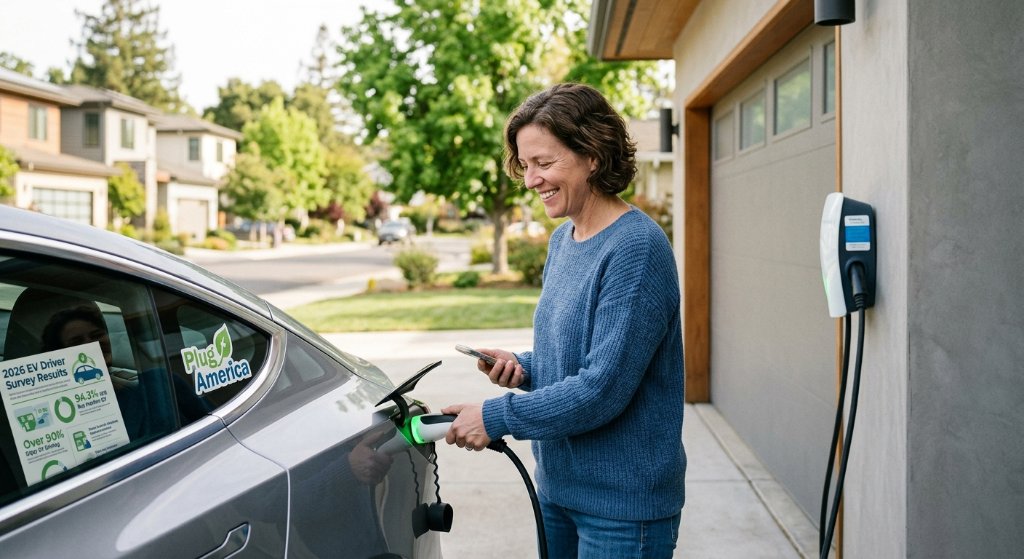
While mainstream media headlines paint a picture of "EV fatigue" and legacy automakers scale back their electrification plans in favor of stopgap hybrids, a quiet revolution has already solidified. Real-world electric vehicle drivers aren't just satisfied—they are fiercely loyal. According to the newly released 2026 EV Driver Survey from the nonprofit Plug In America, an astonishing 94.3% of EV owners plan to purchase another electric vehicle for their next ride, up from 92% in 2025.
This overwhelming consensus comes at a critical juncture for the automotive industry. Fielded between January and March 2026, the sixth annual survey compiled the experiences of over 4,200 respondents—including 3,809 active EV drivers—during a highly volatile period. Notably, the data was gathered just after federal tax credits were eliminated by Congress and as national gas prices fluctuated wildly, proving that consumer enthusiasm for electric mobility has completely decoupled from government subsidies.
Unrivaled Loyalty in the Face of Headwinds
The standout revelation of the report is not just that EV owners want another electric car; it's how few of them would ever consider returning to internal combustion engines (ICE). Only a microscopic 0.5% of surveyed EV owners expressed a desire to switch back to gasoline. This suggests that once a consumer crosses the electric threshold, the transition is virtually permanent.
This stickiness is driven by tangible, daily benefits rather than idealistic environmentalism. Key highlights from the survey reveal that over 90% of drivers rate their EVs superior to gas cars in almost every category:
- Cheaper to Fuel: 95% of respondents reported their EV is cheaper to fuel than a gas car, with 91% confirming direct, noticeable savings on their monthly energy bills.
- More Enjoyable to Drive: Over 90% of drivers agreed that the instant torque, low center of gravity, and silent operation of an EV make it significantly more fun to drive than comparable ICE vehicles.
- Easier to Maintain: By eliminating spark plugs, oil changes, timing belts, and complex transmissions, over 90% found maintenance to be a breeze.
- Inherent Reliability: More than 94% of respondents rated their electric vehicles as convenient, reliable, and safe.
The Power of Firsthand Experience and Home Charging
A key theme of the 2026 report is that "to know an EV is to love one." The survey highlights a massive disparity between prospective buyers' anxieties and actual owners' realities. Pre-purchase concerns regarding battery degradation, range anxiety, and public charging reliability largely evaporate once drivers get behind the wheel.
The unsung hero of this high satisfaction rate is home charging. Having a reliable, dedicated Level 2 charger at home transforms the ownership experience from a public-charging scavenger hunt into a seamless overnight routine. Drivers are no longer plugging in daily; instead, modern battery capacities allow them to charge only a few times a week, treating their cars like smartphones. This shifts the focus away from spotty public DC fast-charging networks and places the value directly on residential electrical infrastructure.
Why This Matters:
The Plug In America survey serves as a reality check for the entire automotive sector.
First, the clear winners are EV-first brands (like Tesla, Rivian, and Hyundai-Kia) that have spent the last decade building dedicated EV architectures. These manufacturers are poised to capture a highly captive, repeat-buyer market.
Conversely, the losers are legacy OEMs pulling back on EV investments. Brands like Ford and GM, which have recently delayed several EV programs to lean back on hybrids, are playing a dangerous game. If nearly 95% of EV owners refuse to buy another gas car, any brand that fails to offer a competitive, compelling EV lineup will be completely locked out of their next vehicle purchase. It is a do-or-die moment: scale back on EVs to save short-term capital, and you permanently alienate a highly affluent, fiercely loyal customer segment.
Furthermore, this data highlights a massive gold rush for residential electrical contractors. With home charging identified as the ultimate anchor of EV satisfaction, the demand for home panel upgrades and Level 2 charger installations will continue to surge.
Ultimately, this report proves that the "EV slowdown" is a supply and perception problem, not a demand problem. Once the keys are in the customer’s hand, the gas car becomes a relic of the past.