The Screen Apocalypse: Why Drivers Are Rejecting Flashy Passenger Displays in Favor of 'Invisible' Tech
For years, automakers have engaged in a literal arms race of glass, turning the humble dashboard into a multiplex cinema. From Mercedes-Benz’s sprawli...
Editorial Team
World Of EV
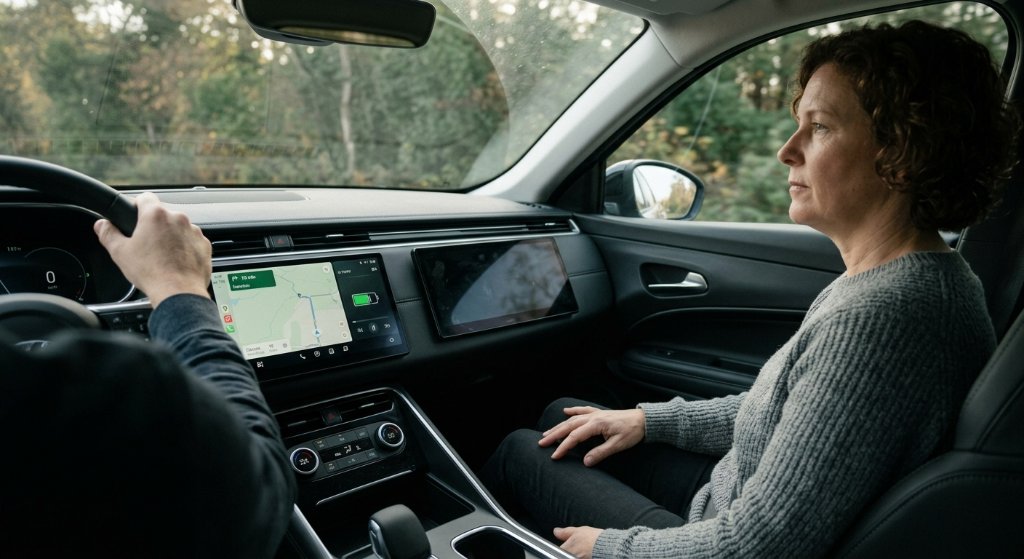
For years, automakers have engaged in a literal arms race of glass, turning the humble dashboard into a multiplex cinema. From Mercedes-Benz’s sprawling Hyperscreen to BMW’s mandatory front passenger displays, the industry's reigning assumption has been simple: more screens equal more luxury. However, the newly released J.D. Power 2026 U.S. Tech Experience Index (TXI) Study delivers a devastating reality check to car designers.
The data proves that consumers are reaching a breaking point with digital bloat. Rather than appreciating the multi-thousand-dollar passenger displays that automakers are aggressively pushing, the vast majority of owners are actively ignoring them. Instead, a quiet revolution is taking place, with drivers giving their highest marks to seamless, "invisible" background technologies that automate the cabin experience without requiring a single menu tap.
The Passenger Screen Paradox: A Solution in Search of a Problem
The study—which surveyed 68,084 owners of new 2026 model-year vehicles—highlights a massive disconnect between what product planners build and what buyers actually use. Passenger screens, once a novelty reserved for ultra-luxury flagships like the BMW 7 Series, have trickled down to mainstream SUVs. Yet, the novelty has officially worn off:
- Zero Engagement: A staggering 35% of owners whose vehicles are equipped with front passenger screens have never turned them on.
- Minimal Utility: Only a measly 6% of owners report using the passenger screen on every drive.
- Constant Headaches: Far from being a seamless addition, passenger screens generated a frustrating 21.3 problems per 100 vehicles (PP100), making them a primary source of infotainment glitches and customer complaints.
This pushback shouldn't surprise anyone. The industry has spent billions trying to replicate the smartphone—a device that already rests, perfectly optimized and highly personalized, in every passenger's pocket. Forcing occupants to navigate clunky, proprietary car menus to stream videos or adjust settings adds friction, not value.
The Triumph of 'Invisible' Tech
While high-end displays are failing to win over owners, low-profile, zero-touch technologies are quietly scoring massive victories. Drivers are expressing the highest satisfaction with less flashy "life hacks" that operate quietly in the background, minimizing cabin clutter and cognitive load.
- Smart Ignition: Systems that automatically start and shut off the vehicle based on driver presence (pioneered by EV leaders like Tesla and now widely adopted) earned the highest satisfaction score across the entire study, logging a nearly flawless 2.4 PP100.
- Smart Climate Control: Utilizing AI and cabin sensors to automatically adjust temperature and airflow without requiring the driver to dive into digital menus.
- Smart Driver Preference Systems: Intuitively recalling individual seat, mirror, and media settings the moment the driver enters the vehicle.
This shift in consumer preference highlights a critical lesson: true luxury in the electric age is a cognitive load of zero.
Why This Matters:
The J.D. Power 2026 TXI Study is a loud warning siren for the entire automotive industry, signaling that the era of "tech for tech’s sake" is officially dead.
The Winners: Pragmatic automakers like Hyundai—which secured the highest innovation ranking among mass-market brands for the seventh consecutive year—understand the delicate balance between high-tech and high-usability. Brands that prioritize background automation, intuitive software-defined architecture, and clean cabins will win long-term customer loyalty. Furthermore, safety regulators like Euro NCAP win; their new 2026 protocol, which docks safety rating points from cars lacking physical controls for core functions, is already forcing a return to tactile sanity.
The Losers: Premium legacy giants like Mercedes-Benz and BMW. By making complex screen setups standard or pushing them heavily as options, these brands are incurring massive manufacturing and software development costs for features their customers actively dislike and disable.
The Market Signal: This is a do-or-die moment for EV startups and legacy giants alike. If automakers continue to design cabins like rolling consumer electronics stores, they risk driving buyers toward simpler, less complex alternatives. The future of the premium EV market belongs to the "silent assistant"—vehicles that leverage artificial intelligence to automate the journey, rather than demanding attention through an endless sea of glowing glass.
Ultimately, the 2026 J.D. Power study serves as a necessary course correction. As the EV transition matures, the benchmark for advanced engineering is no longer how many screens you can fit on a dashboard, but how effortlessly the car anticipates your needs. It is time for car designers to dim the displays and focus on the quiet power of seamless, invisible technology.