The Service Bay Battleground: Why VinFast's Dealer Victory Signals a New Era for EV Ownership
India's electric vehicle market is growing up, and fast. Electric passenger-vehicle registrations surged a massive 50% year-over-year in August 2026, ...
Editorial Team
World Of EV
India's electric vehicle market is growing up, and fast. Electric passenger-vehicle registrations surged a massive 50% year-over-year in August 2026, reaching 30,325 units and driving EV market penetration to 7.4%. But this explosive volume hides a brewing crisis. Historically, foreign automakers entering highly competitive retail landscapes have stumbled by treating dealerships as transactional endpoints rather than strategic partners—think of the costly, high-profile retreats of Ford and General Motors from the subcontinent.
Today, Vietnamese EV newcomer VinFast is actively rewriting that playbook. In the latest Federation of Automotive Dealers Associations' (FADA) 2026 Dealer Satisfaction Study, VinFast clinched the #1 spot in the electric passenger vehicle category. It is a stark reminder that building a robust, dealer-first support network is the ultimate weapon for long-term survival.
The Friction Points of the New Ownership Era
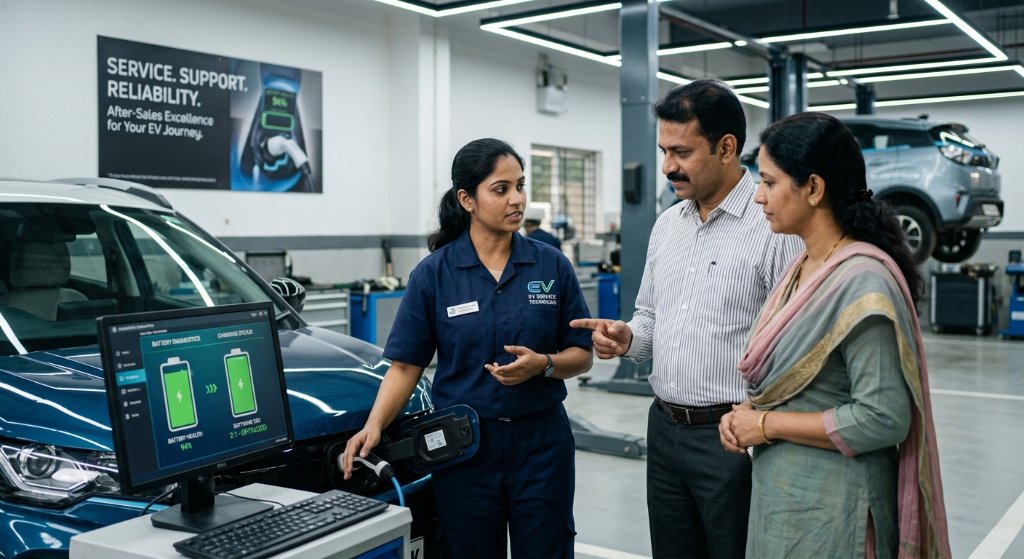
With electric vehicles moving swiftly beyond early tech-adopters into conservative mass-market territory, the dealership's role has radically shifted. A traditional car buyer walks in knowing how an engine works, but EV buyers present a complex matrix of anxieties. FADA's latest study highlights that managing the post-purchase ownership experience is now the critical differentiator for brands. Dealers are under immense pressure to resolve highly specialized consumer concerns, specifically:
- Battery Charging Logistics: Guiding first-time buyers through home charger installations and navigating localized public charging networks.
- Software Integration Support: Troubleshooting over-the-air (OTA) update bugs, infotainment lag, and advanced driver assistance systems (ADAS) calibration.
- Localized Maintenance & Diagnostics: Handling complex high-voltage architectures, which require entirely different workshop safety protocols and technician training than traditional mechanical powertrains.
VinFast's Playbook: Forging Alliances, Not Just Outlets
To address these hurdles, VinFast secured the top spot in the pure-EV segment with an impressive score of 858 out of 1,000. While legacy OEMs often squeeze dealer margins or leave them to bear the brunt of expensive high-voltage diagnostic equipment, VinFast has taken a collaborative approach.
Rather than treating retail partners as franchise-fee cash cows, VinFast's strategy focuses on shared investment and deep training. As they aggressively build out "3S" (Sales, Service, and Spare parts) hubs across the territory—including their recently opened 60th facility in Patna—the automaker has structured its dealership agreements around:
- Co-Shared Training Costs: Offsetting the steep expense of certifying local technicians to work on high-voltage systems.
- Direct Software Hotlines: Giving dealerships direct engineering support lines to address software bugs instantly rather than leaving vehicles stranded on service lifts.
- Sustained Parts Availability: Prioritizing supply chains for spare parts to slash service turnaround times, a primary driver of dealer dissatisfaction across competitors.
Why This Matters:
This is a watershed moment for the global EV ecosystem. Historically, the "EV war" was fought on spec sheets—who had the longest range, the biggest touchscreen, or the quickest 0-60 mph time. This latest data proves the battlefield has officially moved to the service bay.
- The Winners: VinFast and its early dealer network. By establishing unprecedented trust and financial viability for its retail partners before flooding the market with mass-market models, the Vietnamese brand is building a moat that money alone cannot buy. Dealers who feel supported are far more likely to passionately convert hesitant legacy car buyers to electric.
- The Losers: Legacy automakers who treat EV sales like traditional internal combustion engine (ICE) distribution. If an OEM refuses to share the financial burden of transitioning workshops from oil pans to high-voltage diagnostic bays, their dealer network will push back—or worse, alienate customers with substandard service.
- The Broader Market Signal: The transition to electric mobility is only as fast as its local mechanics. If an OEM cannot fix a software bug or a charging fault within 48 hours, the car is effectively bricked in the customer's mind. Do-or-die time has arrived: automakers must pivot capital away from flashy marketing campaigns and directly into workshop enablement.
In Summary:
As the EV market matures, the shiny novelty of battery power is wearing off. Consumers want seamless, long-term reliability. As VinFast has masterfully demonstrated, the key to unlocking that reliability lies in the hands of the local dealer.