The Subscription Flywheel: How Tesla’s Bold FSD Pivot Generated $800M and Hooked 1.48 Million Active Drivers
When Tesla permanently killed the option to buy Full Self-Driving (FSD) outright for $8,000 back in February 2026, skeptics claimed that forcing owner...
Editorial Team
World Of EV
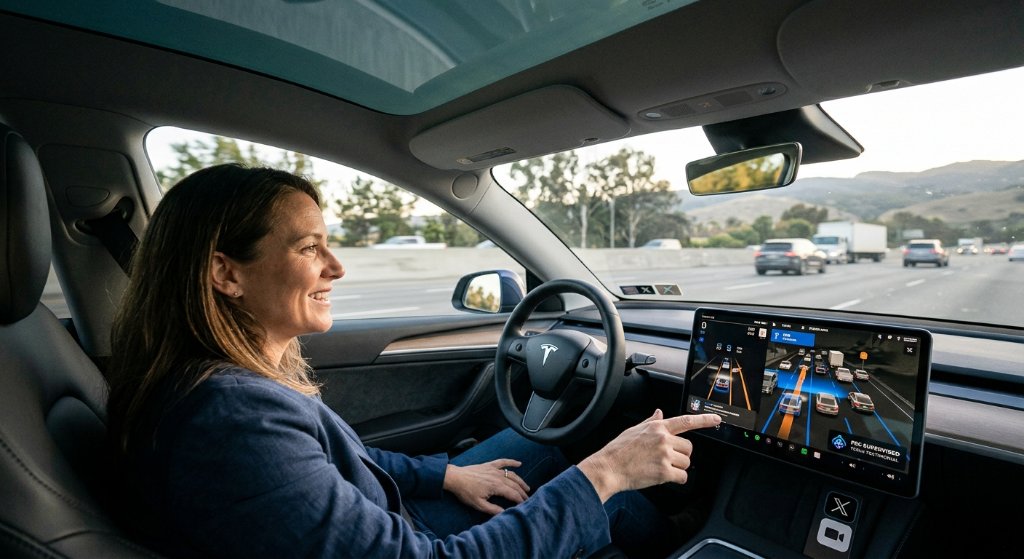
When Tesla permanently killed the option to buy Full Self-Driving (FSD) outright for $8,000 back in February 2026, skeptics claimed that forcing owners into a monthly subscription model would tank consumer adoption. Instead, the opposite has occurred. By dropping the entry barrier to a highly digestible $99 per month, Tesla has successfully transformed its controversial driver-assistance suite from an expensive luxury add-on into a high-margin software juggernaut.
As of August 14, 2026, Tesla launched a massive promotional owner testimonial campaign on X to further accelerate the adoption of Full Self-Driving (Supervised). Accompanying figures released alongside the campaign paint a stunning picture of growth: Tesla has officially reached 1.48 million active FSD users globally as of the end of Q2 2026. This means approximately 15.2% of its entire global fleet is now navigating roads with active AI assistance, a staggering scale that legacy competitors like General Motors (with Super Cruise) and Ford (with BlueCruise) are struggling to match.
The North American Breakthrough: FSD Goes Mainstream
For years, FSD was treated by mainstream buyers as an expensive, experimental beta. However, the shift to a $99 monthly subscription has completely rewritten the consumer psychology. According to Tesla's latest figures, over 55% of new vehicle deliveries in North America now include an active FSD subscription at delivery. Rather than viewing self-driving as a permanent, depreciating $8,000 hardware gamble, buyers now treat it as a flexible utility—subscribing for road trips, daily commutes, or month-to-month trials.
This high adoption rate has unlocked an incredibly lucrative, high-margin revenue stream for the Texas-based automaker:
- Nearly $800 Million in Annualized Revenue: FSD subscriptions are now generating predictable, recurring cash flow that directly impacts Tesla's bottom line.
- 1.48 Million Active Users Globally: Out of a cumulative fleet of roughly 9.7 million vehicles, 15.2% are actively running the software.
- EAP Transition Discounts: Legacy owners who previously purchased the Enhanced Autopilot package can access FSD for just $49 per month, further incentivizing older vehicles to join the modern AI pipeline.
The Data Flywheel That Drives Autonomy
Tesla’s commercial success with FSD isn't just about padding its balance sheet; it is directly funding and accelerating its machine learning capabilities. By expanding its active user base to nearly 1.5 million drivers, Tesla’s neural networks are absorbing real-world driving scenarios at an unprecedented rate. Earlier in 2026, the company crossed its massive 10-billion-mile milestone for FSD Supervised, satisfying the exact data threshold Elon Musk specified as necessary for safe unsupervised self-driving.
Unlike rival systems that rely on expensive LiDAR hardware and meticulously pre-mapped, geofenced highways, Tesla's vision-only approach relies purely on cameras and end-to-end neural networks. The massive real-world testing fleet acts as a continuous learning machine, digesting millions of miles daily to solve the 'long tail' of highly complex, rare road edge-cases.
Why This Matters:
This is the inflection point where Tesla begins to look less like a traditional automotive manufacturer and more like a high-margin Software-as-a-Service (SaaS) powerhouse. For years, Wall Street analysts have debated whether Tesla deserved its astronomical tech-company valuation. These Q2 2026 figures offer concrete proof that the software monetization thesis is finally playing out in real time.
Who Wins: Tesla and its long-term investors are the obvious winners. A predictable, recurring revenue stream of nearly $800 million—boasting margins that dwarf physical vehicle manufacturing—insulates Tesla against cyclical EV price wars. Furthermore, every additional subscriber actively trains the neural network, widening the technological gap between Tesla’s autonomous capabilities and those of legacy OEMs.
Who Loses: Legacy car manufacturers who are still struggling to build competent software stacks are the clear losers. While competitors rely on third-party software partners and geofenced mapping, Tesla's end-to-end AI is running on any road, anywhere, supported by an active subscriber base larger than the entire global EV sales of some rivals.
The Market Signal: This milestone signals a point of no return for the automotive industry. A vehicle is no longer just a depreciating asset of metal and batteries; it is a platform for ongoing digital services. If legacy automakers cannot build their own software ecosystems to generate post-sale recurring revenue, they risk being relegated to low-margin hardware suppliers in a rapidly electrifying world.
Ultimately, Tesla’s FSD subscription model has successfully cracked the consumer adoption code. By turning a high luxury barrier into a mainstream commodity, Tesla has established a self-sustaining flywheel of massive subscription revenue and unparalleled AI training data. As Tesla targets the rollout of fully unsupervised FSD and a broader robotaxi network, these 1.48 million active users are not just customers—they are the foundational pillars of Tesla's autonomous future.