The Tipping Point: Why Owning an EV in Europe Is Now One-Third Cheaper Than Gas
The transition to electric mobility has officially crossed the threshold from an environmental crusade to a pure, hard-nosed economic choice. A ground...
Editorial Team
World Of EV
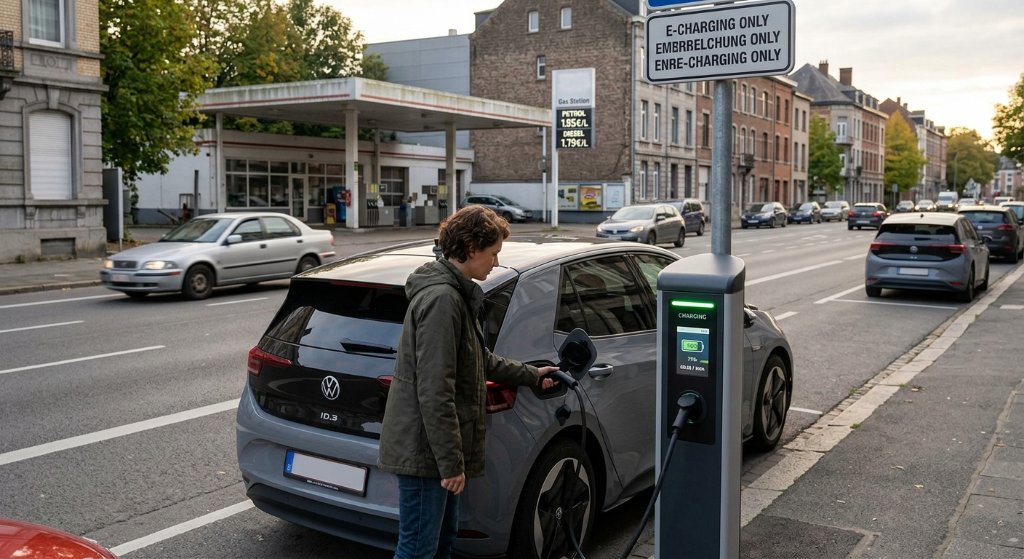
The transition to electric mobility has officially crossed the threshold from an environmental crusade to a pure, hard-nosed economic choice. A groundbreaking report published by the International Council on Clean Transportation (ICCT)—the "EV Transition Check 2026"—reveals that battery-electric vehicles (BEVs) are now on average one-third (33%) cheaper to operate and maintain in Europe than traditional gasoline or diesel cars. For years, skeptics claimed that high upfront premiums and the complexities of public charging would cripple the consumer appeal of electric cars. This new data systematically dismantles those objections, showing that the total cost of ownership (TCO) advantage has shifted definitively in favor of electrons.
This financial divergence has only grown since a massive global oil crisis in February 2026 sent conventional fuel prices soaring to nearly €2 per liter ($9 per gallon) across the European Union. While gas and diesel drivers faced an immediate 12% to 36% spike in their day-to-day energy bills, electric vehicle owners remained largely insulated, enjoying stable charging tariffs. In a market historically defined by volatility, the EV has emerged as the ultimate financial hedge for the everyday commuter.
Dismantling the Public Charging Myth
One of the most persistent arguments against EV adoption has been that drivers without home charging—those relying entirely on public infrastructure—would be penalized by high commercial electricity tariffs. The ICCT report thoroughly debunks this. Even under worst-case scenarios, the economic edge remains:
- Public Charging Advantage: Drivers in the EU who charge exclusively at public stations still pay 28% less to run their vehicles than their fossil-fuel counterparts.
- The Power of Stability: While the 2026 oil crisis hammered combustion vehicle costs, public and private electricity rates held remarkably flat, widening the cost-per-kilometer gap even further.
- Macroeconomic Dividend: Beyond the individual wallet, the mass transition to EVs is saving the European Union an estimated €4.5 billion annually in imported fossil fuels, keeping capital within the European economy.
The Death of the Upfront Price Premium
For years, the high initial purchase price of an EV was the primary barrier for prospective buyers. However, the ICCT’s analysis of 100,000 vehicles in Germany—Europe's bellwether automotive market—confirms that upfront cost parity has already arrived.
Thanks to rapid advancements in manufacturing and supply chain scaling, the financial landscape looks completely different today:
- Segment Parity: BEVs have achieved upfront price parity with gasoline cars in Europe's three largest vehicle segments: medium, upper-medium, and luxury.
- Plunging Battery Costs: Global battery cell costs plummeted by 35% between 2020 and 2025, which represents the single largest factor in closing the purchase price gap.
- Real Price Divergence: Between 2020 and 2025, the inflation- and feature-adjusted price of BEVs in Germany fell by 18%, while the cost of comparable combustion vehicles actually rose by 2%.
- Quadrupled Choices: Consumers are no longer restricted to niche options. The number of available BEV models in Germany grew from just 40 in 2020 to roughly 160 in 2025, with at least 35 models now priced in the highly affordable under-€30,000 bracket.
Why This Matters:
This is a critical, do-or-die moment for European legacy carmakers. For the last half-decade, legacy giants like Volkswagen, Stellantis, and BMW have attempted to balance on a fence, keeping one foot in the internal combustion engine (ICE) grave while tentatively stepping into electrification. The ICCT's data proves they can no longer afford to hesitate.
With EVs proving 33% cheaper to operate and upfront price parity already realized in mainstream segments, the consumer pull is becoming irresistible. Consumers are smart; when the math clearly dictates that buying a gas car is essentially accepting a 33% operating premium, the market will shift rapidly. The winners here are the clear-cut EV-first movers—Tesla and highly aggressive Chinese conglomerates like BYD—who have optimized their vertical integration and can survive on tighter margins as price parity consolidates. The losers will be the legacy auto brands that drag their feet on dedicated EV skateboard platforms and continue to rely on compromised, multi-energy platforms. If European OEMs retreat to hybrid safety nets now, they risk losing the mass market permanently to overseas players who are already delivering affordable, highly efficient EVs.
Furthermore, this economic reality is rapidly spilling over into the commercial sector. The ICCT highlights that long-haul electric trucks in Germany are already 11% cheaper to own and operate than diesel equivalents, fueled by road toll exemptions and lower maintenance. Once the fleet management sector—where purchasing decisions are driven purely by spreadsheets—fully absorbs these TCO savings, the transition will move at a breakneck speed that policy mandates alone could never achieve.
In short, the debate over whether EVs are ready for the mainstream is officially over. The numbers have spoken, and they are overwhelmingly electric.