The Ultimate Mobility Aid: How Tesla's FSD is Quietly Restoring Freedom for Aging Drivers
For years, the public discourse surrounding Tesla’s Full Self-Driving (FSD) capability has been dominated by technical debates, regulatory battles, an...
Editorial Team
World Of EV
For years, the public discourse surrounding Tesla’s Full Self-Driving (FSD) capability has been dominated by technical debates, regulatory battles, and stock market speculation. Critics pointing to federal scrutiny and defenders championing safety statistics have left many everyday consumers wondering if the technology is truly ready for prime time. But beyond the polarized headlines, a quiet revolution is taking place on public roads. FSD—now officially designated as a "Supervised" system—is transitioning from a high-tech novelty into an essential accessibility tool for a rapidly aging population.
Historically, Tesla's driver-assist platform faced severe backlash for being a rigid, rule-based system prone to sudden phantom braking and unpredictable maneuvers. However, the software’s dramatic shift toward an end-to-end neural network architecture in recent updates has transformed it into a far more fluid, human-like driver. This technological evolution is opening the doors to a massive, overlooked demographic: senior citizens who are using the system to reclaim their driving independence.
A Cognitive Safety Net for the Silver Tsunami
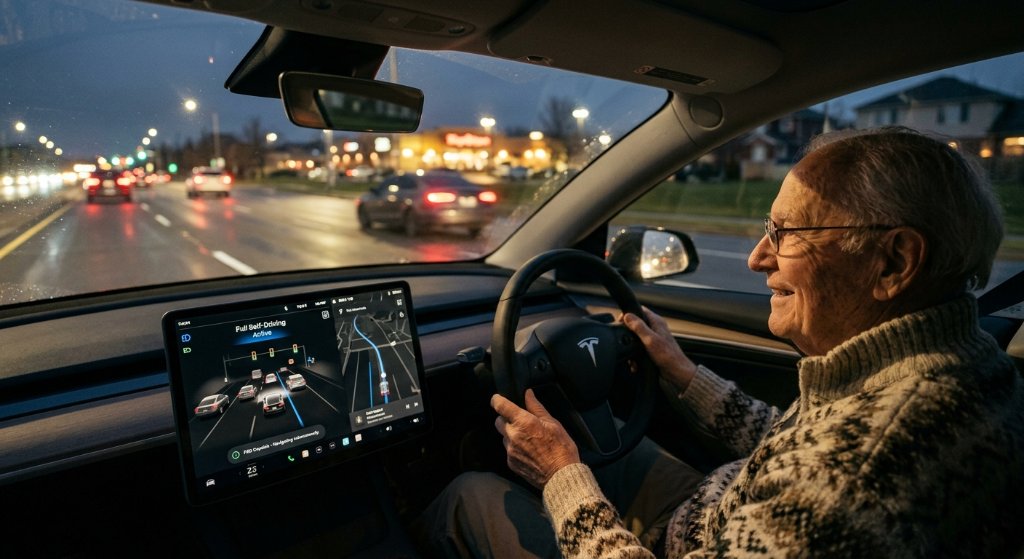
A powerful real-world example of this shift recently emerged in a heartfelt personal testimonial from an 80-year-old Tesla Model Y owner. For this driver, FSD was not a gimmick to show off to friends, but a life-altering development that restored their personal independence. The driver noted that the automated driving system operates far more safely and predictably in challenging conditions—such as pouring rain or pitch-black nights—than they could ever manage manually. By resolving the deep-seated anxiety of driving after dark, FSD allowed them to maintain active social connections and run daily errands without the constant fear of losing their mobility.
This testimonial highlights how advanced driver-assistance systems (ADAS) are stepping in to compensate for the natural declines in human biology. Rather than forcing seniors to surrender their keys, technology is acting as a cognitive safety net.
The Features Driving Senior Adoption
While younger drivers might focus on FSD’s ability to navigate complex highway interchanges, older owners are leveraging the software for comfort and safety. Several key elements make the combination of a Model Y and FSD particularly appealing to seniors:
- Enhanced Low-Visibility Navigation: High-resolution cameras and neural-net processing analyze environmental cues during heavy rain or dark nights far faster than aging human eyes, drastically reducing driving stress.
- Physical Ergonomics: The Model Y’s crossover ride height makes entering and exiting the vehicle physically easier for those with joint pain or mobility issues, unlike low-slung electric sedans.
- Continuous Safety Cushion: Active collision avoidance, automatic emergency braking, and lane-keep assist act as an instantaneous backup for naturally slowing human reaction times.
- Conversational Navigation: The integration of AI assistants like Grok allows users to speak destination commands naturally, eliminating the need to navigate complex on-screen menus while driving.
The Dual-Edged Sword of Level 2 Independence
However, this growing trend is not without its controversies. Safety advocates point out that because Tesla’s FSD remains a Level 2 "Supervised" system, the driver must remain alert and ready to take control at a moment's notice. This creates a psychological paradox: the very drivers who benefit most from the system’s physical relief are also those who might struggle most with the rapid-fire cognitive demands of a sudden manual takeover.
If the car makes an unexpected error at highway speeds, can an 80-year-old with slower reflexes intervene in time? It is a complex safety debate that automakers and regulators must address as autonomous systems become more integrated into the lives of vulnerable road users.
Why This Matters:
This trend represents a massive shift in how the automotive industry views autonomous vehicle (AV) technology.
- The Winners: Tesla is the clear victor here. By demonstrating that FSD has high utility for the wealthy, rapidly expanding Baby Boomer demographic, they are widening their Total Addressable Market (TAM). Furthermore, framing FSD as an accessibility tool helps soften regulatory resistance and shifts the public narrative away from "reckless tech trials" toward genuine social good.
- The Losers: Legacy automakers who are lagging behind in advanced Level 2 and Level 3 software suites. Brands like Lexus and Toyota, which have historically captured older buyers through reputation and reliability, risk losing massive, brand-loyal cohorts if they cannot offer comparable driving assistance features.
- The Market Implications: This shift signals a pivot away from the hyper-focused "Robotaxi" dream toward consumer-owned assistive technology. If ADAS platforms can statistically prove they reduce senior-involved accidents, we could see a dramatic restructuring of auto insurance policies, with premiums dropping for seniors who operate supervised AVs rather than driving fully manually. It is a do-or-die moment for competing OEMs to prioritize software-defined safety, or risk being shut out of a graying market entirely.
A Future of Boundless Mobility
Ultimately, the testimonial of this 80-year-old Model Y driver reminds us that the true power of electric and autonomous vehicles lies not in their 0-60 mph times, but in their ability to democratize freedom. As the global population ages, assistive driving software will transition from a premium luxury to a fundamental human necessity. The future of transportation is not just about replacing the driver—it is about ensuring that no one is left behind.