The 'Zero Maintenance' EV Myth Is Dead: Why Software and Battery Diagnostics Now Dictate Vehicle Lifespan
For years, the automotive industry sold a compelling, albeit simplistic, promise to prospective electric vehicle buyers: say goodbye to spark plugs, t...
Editorial Team
World Of EV
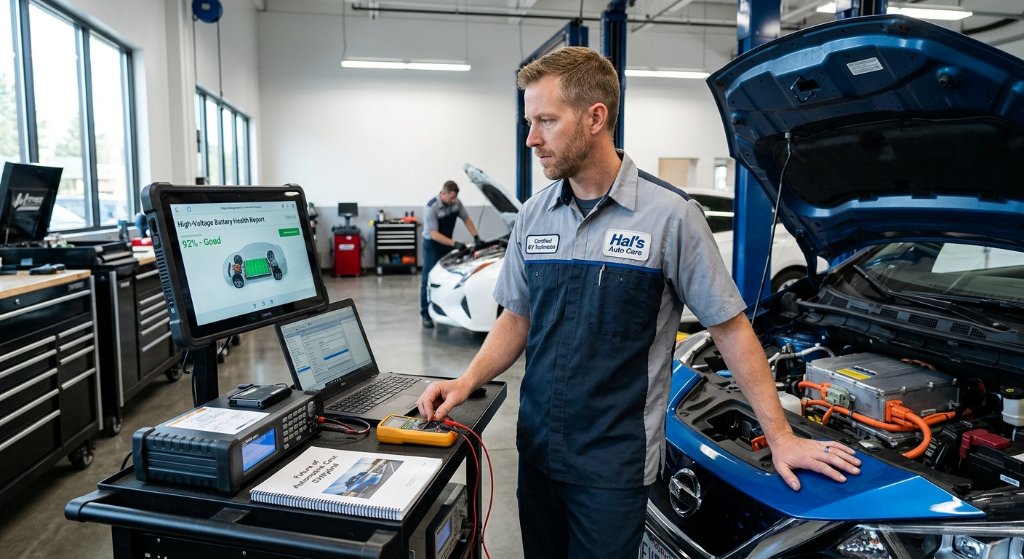
For years, the automotive industry sold a compelling, albeit simplistic, promise to prospective electric vehicle buyers: say goodbye to spark plugs, timing belts, and oil changes, and hello to a future of "zero maintenance." However, as the global EV fleet matures, this narrative is rapidly dissolving. A newly published automotive care guide by Hal's Auto Care highlights a crucial paradigm shift: while EVs bypass the greasy mechanical failures of legacy internal combustion engine (ICE) vehicles, their longevity, range, and efficiency now depend on a highly specialized, digital-first maintenance regimen.
This isn't just about rotating tires and topping off windshield washer fluid. The transition to software-defined vehicles (SDVs) means that vehicle neglect today looks very different than it did a decade ago. If early adopters bought into the "set-it-and-forget-it" dream—partially fueled by early compliance cars like the short-range Mazda MX-30 that required minimal thermal oversight—the modern EV landscape demands a highly proactive approach to prevent catastrophic battery degradation and software instability.
The Three Pillars of Modern EV Maintenance
Traditional garages are no longer equipped with just wrenches; they need advanced diagnostic suites, oscilloscopes, and high-voltage training. According to the Hal's Auto Care guide, EV and hybrid maintenance has consolidated around three critical vectors that replace the traditional 3,000-mile oil change:
- High-Voltage Battery Health Checks: The battery pack is an EV's single most expensive component. Regular health checks monitor cell degradation, voltage balance, and internal resistance to catch premature wear before it compromises range or safety.
- Software and Firmware Updates: Unlike legacy ICE vehicles, modern EVs require constant software optimization. Over-the-air (OTA) and manual dealer updates govern everything from power delivery and regenerative braking to critical battery thermal management algorithms.
- Specialized Diagnostic Inspections: High-voltage cabling, inverter coolant loops, and cabin-isolation monitoring systems require specialized tools to detect micro-leaks or electrical resistance anomalies that standard OBD-II scanners simply cannot read.
The Software-Defined Reality
Consider the contrast: if you neglected a traditional vehicle's transmission or oil level, you eventually heard a physical knock or felt a slip. In a modern EV, a failing thermal management sensor or an outdated Battery Management System (BMS) profile might silently degrade your battery chemistry over months without throwing a single dashboard warning light.
Software updates are the new "tune-ups." Manufacturers like Tesla (with its advanced 4680 cell integration) and BYD (with its thermal-sensitive Blade battery) frequently push BMS updates that recalibrate charging curves to extend battery lifespan. Neglecting these updates doesn't just lock you out of the latest infotainment features; it actively accelerates hardware degradation and limits your charging speeds at public DC fast chargers.
Why This Matters:
This evolution signals a massive shift in how we value, service, and resell electric vehicles. It creates distinct winners and losers while reshaping the entire automotive aftermarket.
- The Death of the 'Grease Monkey' Era: The traditional local mechanic who refuses to invest in high-voltage certification and advanced diagnostic tooling is facing an existential crisis. Independent shops must adapt and train their technicians to handle 400V and 800V systems, or face obsolescence as EVs capture more market share.
- Resale Value and the 'Battery Passport': In the pre-owned EV market, a vehicle's value is entirely tied to its battery's State of Health (SoH). Buyers will soon demand certified diagnostic logs showing regular battery checks and software compliance. A neglected battery could instantly vaporize thousands of dollars in resale value, while a certified, well-maintained pack will command a massive premium.
- The OEM vs. Third-Party Battleground: By making software updates and specialized diagnostics central to EV health, manufacturers are attempting to lock consumers into proprietary service networks. Comprehensive guides like the one from Hal's Auto Care are vital because they lay the groundwork for independent operators to break this monopoly, keeping maintenance costs competitive for the everyday consumer.
Ultimately, transitioning to electric driving does not eliminate vehicle care; it completely rewrites the rules. The future of EV ownership belongs to those who treat their vehicles less like simple appliances and more like high-performance, wheel-bound supercomputers.