Why 5 Years of EV Ownership Proves the Battery-Size Arms Race is Dead—And V2G is the New Frontier
### The New Reality of Electric Motoring In 2021, adopting an electric vehicle still felt like a pioneering, slightly risky venture. Fast forward to ...
Editorial Team
World Of EV
The New Reality of Electric Motoring
In 2021, adopting an electric vehicle still felt like a pioneering, slightly risky venture. Fast forward to 2026, and the landscape has completely shifted. Industry veteran and technical editor Jesse Crosse recently marked a half-decade of driving electric, tracing his journey from a first-generation 64kWh Kia e-Niro to today’s hyper-efficient ecosystem. His core takeaway is clear: the early days of 'range anxiety' and blind consumer speculation are officially over. EV ownership has evolved from a simple driving alternative into a highly strategic, financially optimized way of life.
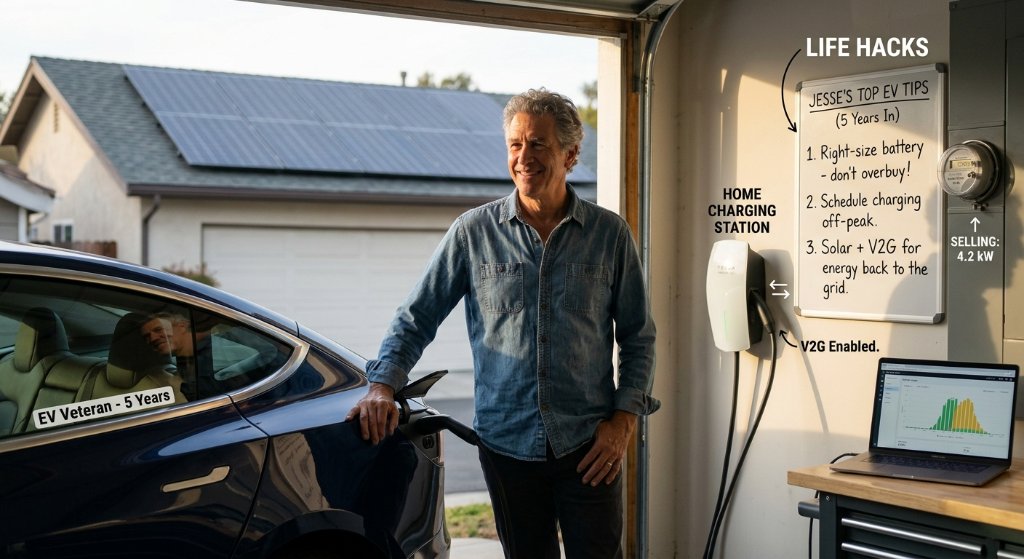
For years, automakers used massive battery packs as a security blanket for nervous first-time buyers. However, Crosse’s real-world data demonstrates that matching battery capacity directly to actual daily use cases—rather than worst-case road-trip scenarios—is the secret to maximizing value. With public charging infrastructure vastly improved, overbuying battery capacity is now the single biggest financial mistake a new EV buyer can make.
Stop Overpaying for Excess Battery Capacity
A battery pack represents between 25% and 35% of an electric vehicle's total retail price. Buying a massive 100kWh-plus pack just for the peace of mind on an annual long-distance road trip is a classic, expensive misstep.
- Match Battery to Real Needs: If a 64kWh battery delivering roughly 260 miles of range can easily handle occasional 700-mile trips with just a few short coffee-and-charge breaks, paying a premium for a heavy, oversized battery makes zero financial sense.
- Rapid Charging Overrides Large Packs: Modern EVs—like the new Kia EV3—utilize high-speed architectures capable of reclaiming over 200 miles of range in just 30 minutes, rendering massive, heavy batteries obsolete for all but the most extreme drivers.
- The 'Banger' Second Car Strategy: Crosse highlights how older, cheap, short-range EVs (like a first-generation 24kWh Nissan Leaf or Renault Zoe) are perfect as secondary local runabouts, easily monitored for battery health via OBD apps like Leaf Spy.
Optimizing the Home Energy Ecosystem
The true financial magic of EV ownership isn’t found at public fast-chargers; it happens right on your driveway. By integrating smart home solar setups and taking advantage of dynamic utility pricing, EVs transition from energy consumers to active grid assets.
- Solar Trickle-Charging: Utilizing a modest 5kW home solar array paired with a 10kWh home storage battery allows owners to 'fuel' their EVs entirely with free sunshine. Crosse recommends using a slower 3kW 'granny charger' during peak daylight hours to capture excess solar energy without drawing from the grid.
- Exploiting Off-Peak Tariffs: For overnight charging, scheduling charging sessions to align with super-cheap off-peak hours (sometimes as low as 8p/kWh) significantly undercuts traditional fuel costs.
- Vehicle-to-Grid (V2G) Profitability: The future lies in bilateral energy flow. Integrating solar systems with V2G-capable vehicles transforms the car into a mobile power bank that can sell electricity back to the grid during peak high-tariff hours, effectively generating passive income.
Why This Matters:
This milestone analysis highlights a profound paradigm shift: the automotive and energy sectors are fusing together.
For consumers, this means the financial calculation of buying a car has changed forever. An EV is no longer just a depreciating asset; when integrated with home solar and V2G systems, it becomes a crucial component of a household's microgrid. Consumers who understand this will reap immense savings, while those who continue to shop for EVs using the old 'maximum range at all costs' mental model will overpay upfront for battery capacity they will never use.
The Winners:
- Automakers focusing on charging speed over sheer size: Brands like Hyundai, Kia, and Porsche, who have invested heavily in 800V fast-charging architectures, will win the efficiency war. They can sell lighter, cheaper vehicles that charge in minutes, outcompeting those relying on heavy, expensive chemical packs.
- Smart Energy Providers and Home Solar Installers: Companies offering dynamic, bidirectional home charging software and integrated solar/storage ecosystems will see demand skyrocket.
The Losers:
- Automakers stuck in the 'Oversized Battery' mindset: Legacy manufacturers relying on brute-force range (like GM’s massive, ultra-heavy Hummer EV or early adapted combustion-to-EV platforms) will struggle to defend their high price points against lighter, highly efficient alternatives.
- Monolithic Utilities: Traditional power grids that fail to adapt to decentralized, bilateral power distribution models will face severe stress, while agile networks that leverage the collective battery storage of millions of parked EVs will thrive.
Conclusion
Five years of real-world EV data from industry insiders proves that the secret to a successful EV transition isn't waiting for a 500-mile battery. Instead, it lies in embracing smarter charging habits, investing in home energy integration, and refusing to pay for battery capacity you don't actually need. As vehicle-to-grid tech matures from a pilot concept into a household standard, the electric car is poised to become the most profitable appliance in your home.