Zero Interventions: Tesla's FSD v14.3.2 Completes Cross-Country Epic, Reshaping Autonomy's Future
A silent revolution just unfolded on American highways, marking a pivotal moment in the evolution of autonomous driving. A Tesla Model 3 recently comp...
Editorial Team
World Of EV
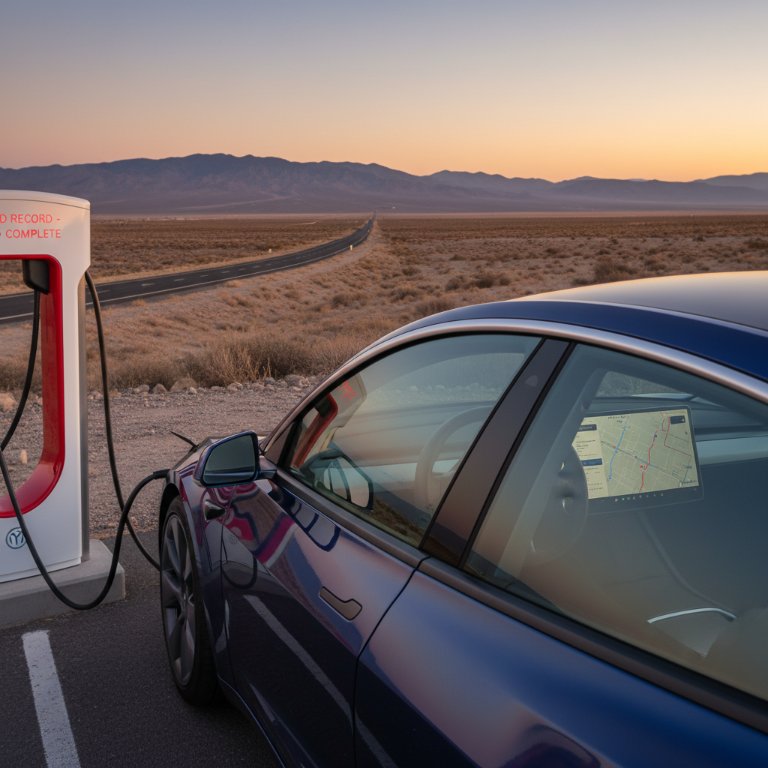
A silent revolution just unfolded on American highways, marking a pivotal moment in the evolution of autonomous driving. A Tesla Model 3 recently completed an astounding 2,833-mile coast-to-coast journey from New York City to Los Angeles, operating entirely on Full Self-Driving (Supervised) software version 14.3.2 with zero human interventions. This monumental trip, taking just 49 hours and 55 minutes, didn't just showcase advanced highway navigation; it notably included autonomous parking at every Supercharger stop, demonstrating an unprecedented level of real-world capability.
For years, the promise of true self-driving has been a hotly debated topic, often met with skepticism and cautious optimism. While Tesla has consistently pushed the boundaries with its FSD beta program, this zero-intervention cross-country feat, openly embraced by Tesla's official X account, moves the needle significantly. It stands as a powerful testament to the rapid advancements in AI and machine learning that are transforming the automotive landscape.
The Unprecedented Journey
The 2,833-mile traverse from the Red Ball Garage in Manhattan to the Portofino Inn in Redondo Beach, California, shattered previous zero-intervention coast-to-coast benchmarks by over eight hours. The Model 3, piloted solely by FSD (Supervised) v14.3.2, navigated diverse driving conditions, adhering strictly to the Cannonball Run route's traditional start and finish lines. The seamless integration of autonomous parking at each Supercharger stop highlights FSD's growing competence beyond mere highway cruising, extending its utility to more complex, everyday scenarios that traditionally require human input.
FSD v14.3.2: A Quantum Leap in Autonomy
Released in late April 2026, FSD (Supervised) version 14.3.2 is far from a minor iteration. This update represents a significant architectural overhaul, unifying three previously siloed software stacks—the core FSD driving model, Smart Summon, and the Robotaxi operational model—into a single, more robust neural network. Key enhancements driving this remarkable performance include:
- Upgraded Reinforcement Learning (RL): Significant improvements in training the FSD neural network, leading to better performance across a wide array of driving scenarios.
- Improved Neural Network Vision Encoder: Enhanced understanding in rare and low-visibility situations, stronger 3D geometry perception, and expanded traffic sign recognition.
- Rewritten AI Compiler and Runtime: A ground-up rewrite using MLIR, resulting in a 20% faster reaction time and accelerated model iteration speed.
- Mitigated Unnecessary Lane Biasing and Tailgating: Addressed long-standing user feedback regarding these behaviors, leading to a smoother and more natural driving experience.
- Increased Decisiveness in Parking and Emergency Response: Improved parking spot selection and maneuvering, enhanced response to emergency vehicles, school buses, and right-of-way violators.
This version, currently rolling out primarily to Hardware 4-equipped vehicles, is not just an incremental step but a fundamental shift in how the FSD system perceives and interacts with the world.
Why This Matters:
This zero-intervention cross-country drive is more than a viral video; it's a profound statement that reverberates across the entire automotive and technology sectors. For Tesla, it offers critical validation of its long-term, vision-only strategy for autonomous driving. Critics who have questioned the pace and safety of FSD development now face undeniable real-world proof of its advanced capabilities, even if it remains a supervised system (SAE Level 2) for regulatory purposes. This achievement strengthens Tesla's narrative, potentially boosting FSD take rates and solidifying its position as a leader in AI for automotive applications. It also brings the company's ambitious Robotaxi vision closer to reality, demonstrating the underlying tech is maturing rapidly.
For the broader industry, this demonstration sets a new, incredibly high benchmark. Competitors relying on lidar or complex mapping solutions, such as Waymo and Cruise, or traditional automakers developing their own advanced driver-assistance systems like Mercedes's Drive Pilot or GM's Ultra Cruise, must now contend with Tesla's demonstrated end-to-end performance. While their approaches differ, the tangible success of FSD v14.3.2 intensifies the pressure to showcase comparable real-world robustness. This could ignite a new phase in the autonomous driving arms race, shifting focus even more towards sophisticated AI and software intelligence rather than just sensor suites.
For EV enthusiasts and prospective buyers, this news is transformative. It fundamentally alters the perception of long-distance EV travel, showcasing how FSD can alleviate driver fatigue and enhance convenience. The idea of an EV autonomously navigating thousands of miles, handling everything from highway speeds to complex Supercharger parking, transforms the driving experience from an active chore to a supervised journey, freeing up mental bandwidth for other tasks. This isn't merely about convenience; it's about a tangible improvement in the quality of travel, making EVs even more appealing for diverse use cases.
Conclusion:
The successful coast-to-coast FSD journey with zero human interventions marks a significant inflection point in the journey toward widespread autonomous mobility. It underscores the power of Tesla's integrated AI approach and its relentless pursuit of software innovation. While regulatory frameworks and public acceptance will continue to evolve, this achievement provides a compelling glimpse into a future where vehicles don't just transport us, but intelligently navigate the world around us with remarkable proficiency. The road ahead remains challenging, but with milestones like FSD v14.3.2, the destination of truly autonomous driving feels closer than ever.